FractalPark
클래식보통

Mandelbox

톰 로우(Tom Lowe)의 2010년 Mandelbox에서 영감을 받은 접기-스케일 사상이에요. 상자 반사, 방사형 접기, 스케일링이 반복 하나로 방과 벽을 만들어 내요.

탐색기에서 열기
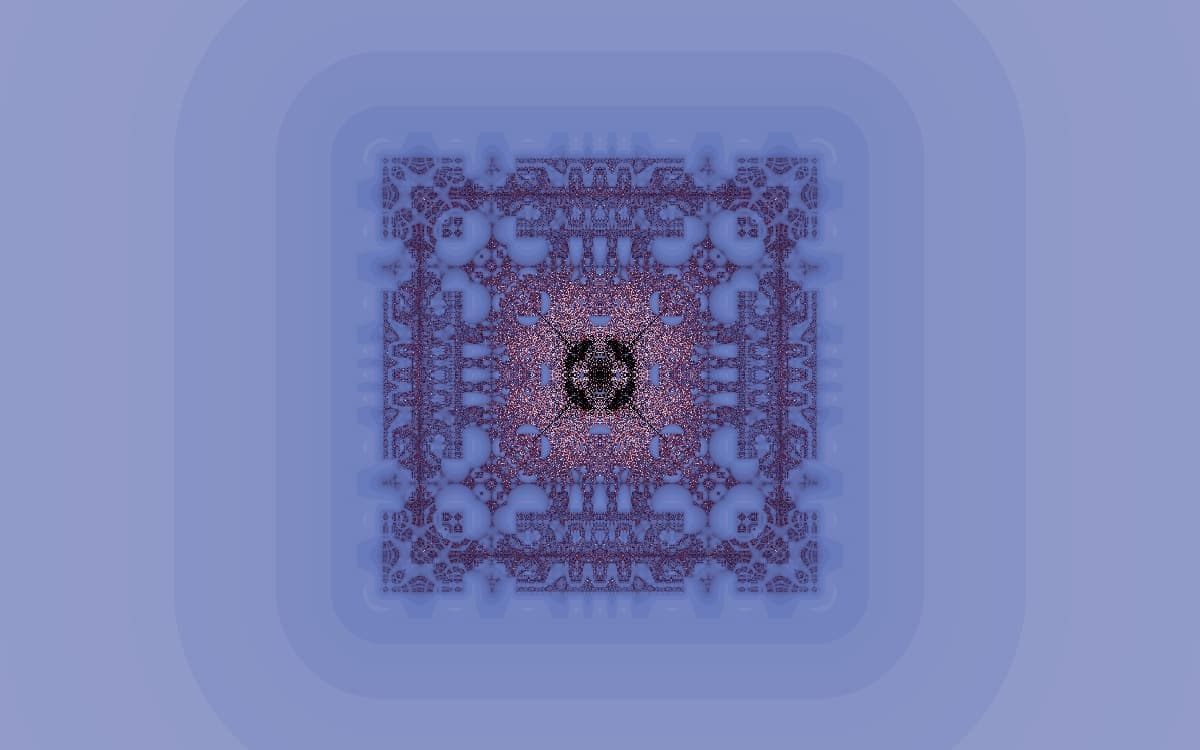
차가운 청색 톤의 Mandelbox 2차원 지도, 날카로운 모서리의 방들과 겹겹이 쌓인 요새 같은 움푹한 공간
FractalPark의 Mandelbox 영감 지도: 곧은 벽, 직각 모서리, 수정 요새 내부 같은 층층의 움푹한 공간.

개요

대부분의 프랙탈 공식은 z² + c처럼 제곱에서 시작해요. Mandelbox는 다른 길을 택해요. 상자 접기(box fold)는 고정된 정육면체 바깥의 좌표를 다시 면 쪽으로 되돌려 보내고, 방사형(공) 접기는 원점과의 거리에 따라 점을 뒤집거나 스케일해요. 마지막으로 균일 스케일이 결과를 늘리거나 압축한 다음 c를 더해요. 이 순서를 반복하면 구조를 만드는 건 제곱이 아니라 접기예요.

반사와 반전은 특정한 차원 수를 요구하지 않아서, 어떤 차원에서든 만들 수 있어요. FractalPark은 복소평면에서 동일한 접기-스케일 핵심을 유지한 2차원 변형을 그려요.

이 매개변수 지도는 다항식에서 익숙한 곡선으로 부드러워지지 않아요. 날카로운 모서리의 방들, 겹겹이 쌓인 요새, 설계도에서 옮겨온 듯한 통로들을 잘라 내요. 그 경계는 닿을 수 있는 범위 안에 머무는 유계 궤도와 탈출하는 궤도를 가르고, 확대하면 톱니처럼 들쭉날쭉한 자기유사 가장자리가 더 작은 규모로 상자 모티프를 다시 보여줘요.

수학

Fold-and-scale iteration

z(n+1) = scale times ballFold(boxFold(z(n))) + c

Each round puts the orbit through four moves: box fold, radial fold, scale, then a shift by c.

The box fold handles one coordinate at a time. Take a component a of z. Above 1, it reflects as a → 2 − a; below −1, as a → −2 − a. Components in [−1, 1] stay put. The outer plane folds back into the central square.

Next comes the ball fold, checking the squared magnitude r² = |z|². If r² < 0.25 (|z| < 0.5), scale the point by 4 and push it away from the origin. If 0.25 ≤ r² < 1, invert it through the unit sphere: z → z/r², so a radius of m becomes 1/m. Points with r² ≥ 1 stay put. The near points move outward; the middle band turns across the unit sphere. These moves make the unsettled interface behind the Mandelbox's boxy layers.

Try z₀ = (1.5, 0) with scale s = 2. The box fold reflects x = 1.5 to x = 0.5. Since r² = 0.25 falls in the middle band, the ball fold inverts it: z = z/r² = (2, 0). Scaling by 2 gives (4, 0), and adding c completes the step. Start at the origin instead and you are in the innermost band: the ball fold multiplies it by 4—still the origin—so the first iterate lands exactly on c.
역사

The Mandelbox was first presented by Tom Lowe (known online as Tglad) in early 2010 on the FractalForums community. Lowe was experimenting with iterative folding operations in three dimensions — box reflections and spherical inversions — to see whether they could produce bounded, self‑similar structures analogous to the Mandelbrot set. The results were immediately recognised as a new class of fractal, and the name "Mandelbox" was adopted both as an homage to the Mandelbrot set and because of the boxlike shape of the set when visualised.

The discovery followed closely on the 2009 Mandelbulb by Daniel White and Paul Nylander, which had sparked renewed hobbyist interest in finding non‑trivial 3D fractals. Within months, contributors on FractalForums — including Knighty, Jesse, and others — extended the Mandelbox idea to different symmetry planes and polyhedral folds.

Despite its popularity in fractal art software (Mandelbulber, Mandelbulb3D, Fragmentarium, Ultra Fractal), the Mandelbox has received relatively little formal mathematical analysis. One of the few peer‑reviewed treatments is Gregg Helt's 2018 Bridges Conference paper, which generalises the spherical inversion step to arbitrary shape inversions.

시각적 특징

Repeated folds produce hard-edged chambers, nested fortifications, and corridors with depth. The default parameter s = 2 gives the structure straight walls, right-angle corners, and layered recesses like the inside of a crystalline fortress.

At finer scales, the box theme returns: small copies of the overall shape appear in recesses and along boundaries, all with the same rectilinear geometry. The canonical image uses cool blues and cyans, which suit the mechanical geometry of the folds.

파라미터

배율
Scale sets how strongly the folded orbit expands or reverses before c is added. A scale of 2 (the default) roughly doubles the folded value; negative values reverse direction and produce mirror-image variations.

리믹스와 예제

표준 문서에서 시작하기

이 가이드가 사용하는 동일한 승인된 수식 상태를 연 다음, 인터랙티브 탐색기에서 뷰, 컬러링, 변환, 애니메이션을 바꿔보세요.

자주 묻는 질문

What are box and ball folds?

A box fold reflects coordinates outside a fixed interval toward the origin—like folding a sheet’s edges inward. A ball fold (or sphere fold) makes a conditional inversion: points too close to the origin are pushed outward, points at an intermediate distance invert through a sphere, and distant points remain unchanged. Together they redirect the orbit at every step and make the Mandelbox’s layered geometry.

Is this the three‑dimensional Mandelbox?

No. FractalPark renders a two-dimensional map inspired by the same fold-and-scale construction. The original Mandelbox is most often explored in 3D, where the box fold reflects across a cube’s faces; here the same logic works in the complex plane with a square boundary.

참고 자료