FractalPark
클래식쉬움

Quartic Julia

4차 줄리아 사상이에요. z를 네제곱하고 고정된 c를 더하면 네 갈래 가지가 시작돼요.

탐색기에서 열기
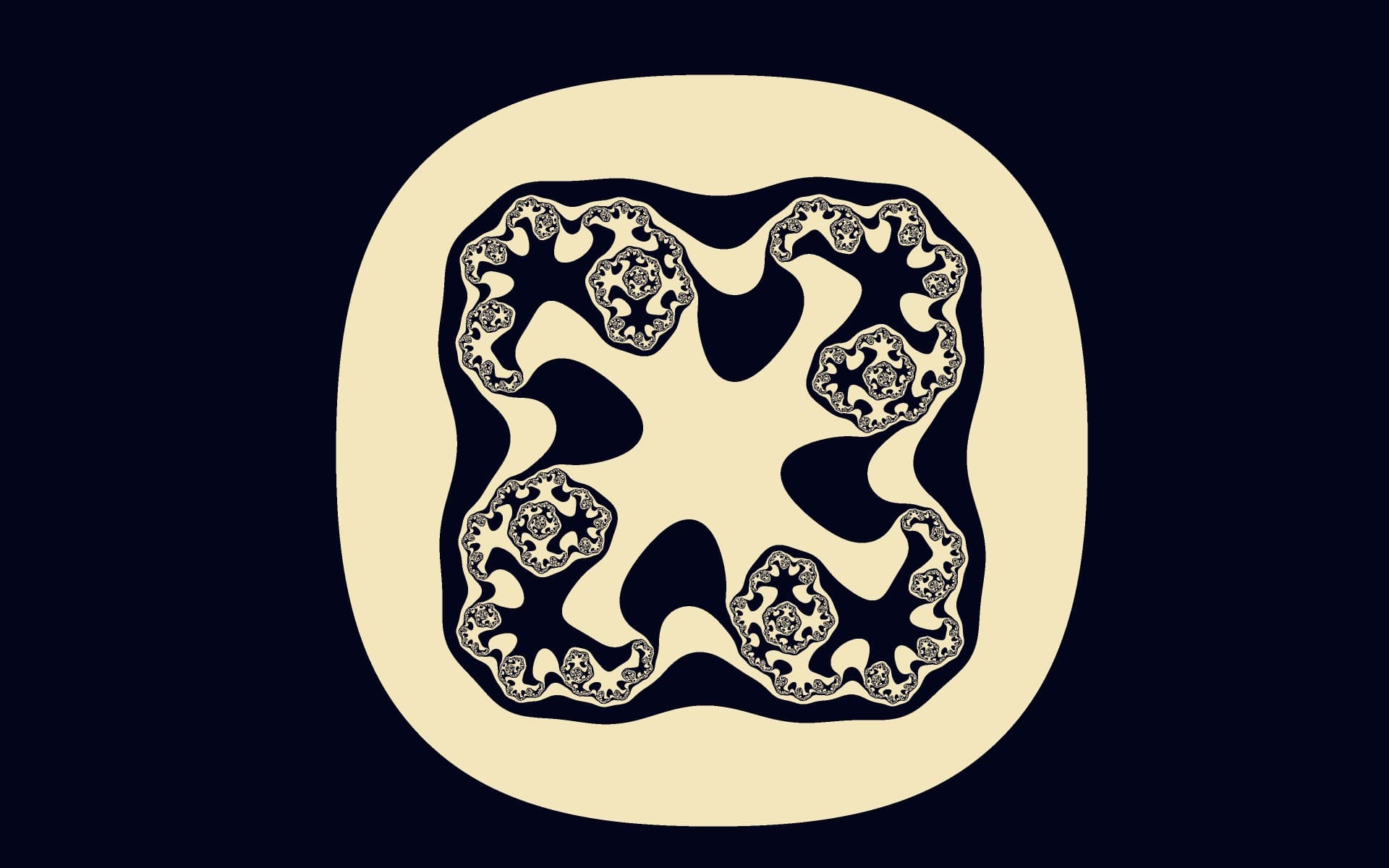
상아색으로 가장자리 장식된 Quartic Julia 집합, 4중 장미 문양과 가지치는 정교한 무늬
FractalPark의 Quartic Julia: 상아색 정교한 무늬가 가지치는 장미 문양과 4중 실들을 따라가요.

개요

익숙한 줄리아 레시피에서 다이얼을 한 칸 돌려 봐요. 복소 상수 c 하나를 고정하고 z → z⁴ + c를 반복해요. 네제곱은 복소 편각을 매번 네 배로 만들어요. 이차 사상에서 두 갈래로 갈라질 방향이 여기서는 네 갈래로 열릴 수 있는데, 그게 네 갈래 가지의 원천이에요.

같은 c에서 이 고차 사상은 보통 이차 사촌보다 집합 안에 더 많은 굽이를 채워 넣어요. 채워진 줄리아 집합이 한 덩어리로 남을지 갈라질지도 여전히 c에 달려 있는데, 이는 고차 다항식에 대한 파투–줄리아 분류에 따른 거예요. 임계 궤도, 즉 임계점 z = 0과 도함수의 임계점이 지배하는 궤도를 살펴보면 연결성의 실마리가 보여요.

화면에서는 구름보다 도장 찍은 장식처럼 읽혀요. 섬세한 정교한 무늬(filigree), 장미 문양, 도장 같은 매듭이 4중 대칭으로 반복돼요. 차수가 높아진 만큼 디테일이 빽빽하지만, 각진 배치는 놀라울 정도로 정돈돼 있어요.

수학

Quartic iteration

z(n+1) = z(n)^4 + c

One step has the effect of four squarings: the argument is multiplied by four, so a point near the boundary can split four ways. Try c = 0. The recurrence becomes zₙ₊₁ = zₙ⁴, simply a fourth-power map. From z₀ = 0.5 + 0i, the values shrink toward zero and remain bounded; from z₀ = 1.5 + 0i, they grow rapidly and escape. As in the quadratic case, |zₙ| signals escape: once it passes a fixed threshold (about 2 for this quartic), the orbit must diverge. The fourth power hastens the outward flight; it also speeds the angular splitting that creates the four-fold shape.

FractalPark holds c fixed across the image and varies the starting point z₀ from pixel to pixel—the usual Julia-family setup.
역사

The theory came first. Pierre Fatou and Gaston Julia developed the classical framework for iterated rational functions in 1917–1918, and it applies to polynomials of any degree. Quartic Julia sets inherit its principles for connectivity and dynamical classification. When fractal-rendering software moved beyond quadratics in the 1980s and 1990s, computer exploration of higher-degree Julia sets became common. The named quartic variant belongs to that line; no single discoverer is attributed to it.

FractalPark uses the standard fourth-degree recurrence as a fixed-parameter Julia-family formula.

시각적 특징

Angles multiplied by four leave a recognizable trace: fine seals, branching rosettes, and filaments arranged on a quartic grid. A quadratic Julia may grow a spiral or one pair of arms; here, feature centers often send out four matching arms or lobes.

More detail fits into the same space than in a quadratic Julia, but it arrives in a tidier order. Turn ninety degrees around a prominent point and a motif often returns. The canonical FractalPark image picks out those edges with ivory filigree.

리믹스와 예제

표준 문서에서 시작하기

이 가이드가 사용하는 동일한 승인된 수식 상태를 연 다음, 인터랙티브 탐색기에서 뷰, 컬러링, 변환, 애니메이션을 바꿔보세요.

자주 묻는 질문

Why is this called Quartic Julia?

Its rule uses the fourth power of z, so it is a quartic, or degree-four, polynomial. The name distinguishes it from the standard quadratic Julia set and other higher-degree variants.

What does c change?

The fixed complex constant c decides whether the filled Julia set is connected or disconnected, then shapes its fine geometry. Nudge c and four-way branches rearrange, seals and filaments shift, and a connected set can fall into disconnected dust.

참고 자료