FractalPark
MagnetMédio

Magnet Type 1

Um quociente de Möbius elevado ao quadrado com um polo em z = c, reunindo o plano em bacias agrupadas e cadeias semelhantes a contas.

Abrir no Explorar
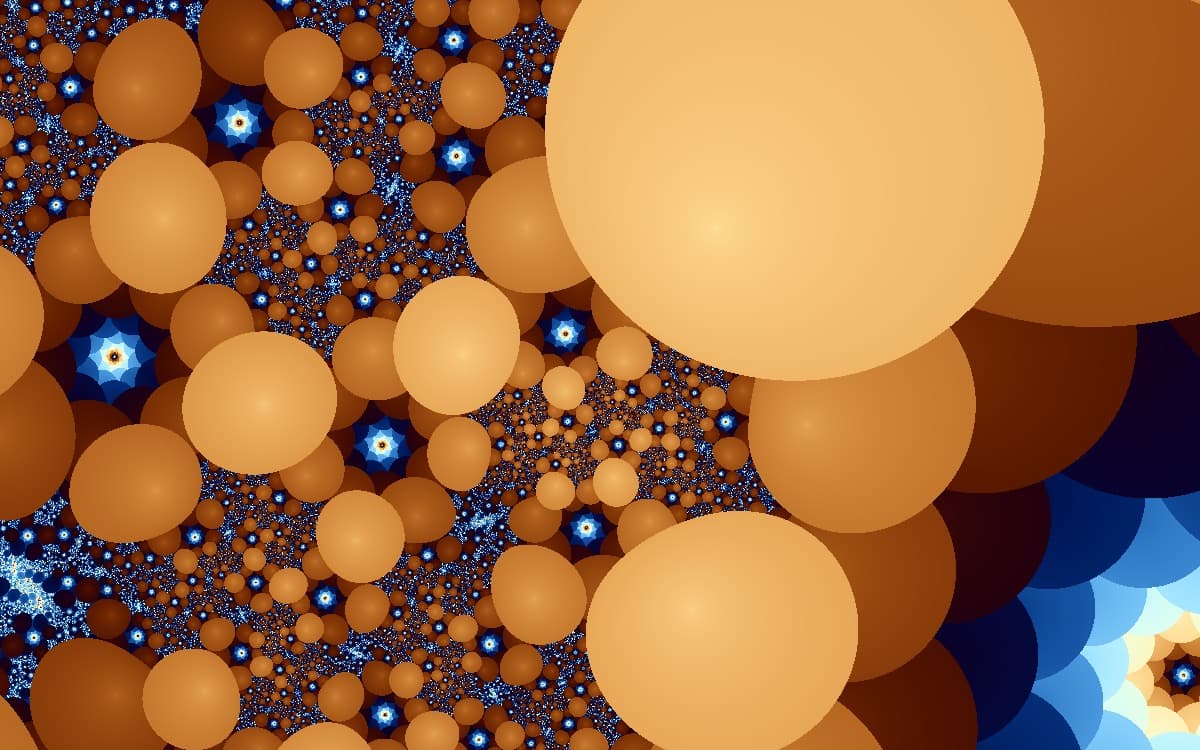
Esferas cobre-laranja de vários tamanhos agrupadas sobre um campo azul profundo salpicado de pequenas rosetas estreladas azuis e brancas
Uma visão de Julia do Magnet Type 1: bacias arredondadas e suaves se reúnem em aglomerados, enquanto rosetas estreladas se amontoam em suas bordas fractais.

Visão geral

O Magnet Type 1 parte de ((z + c) / (z − c))². A razão entre parênteses é uma transformação de Möbius, a função racional não trivial mais simples; elevá-la ao quadrado produz um mapa racional de grau dois. Ao contrário de z² + c, este mapa não envia pontos distantes cada vez mais para longe. Eles voltam em direção a 1.

A dinâmica se concentra em duas localizações opostas. O quociente é zero em z = −c e tem um polo em z = c. Uma órbita que roça o polo voa para longe e depois retorna perto de 1 no passo seguinte. Bacias estáveis se espalham pelo plano; entre elas há uma borda fractal feita de camada após camada de pré-imagens do polo.

O FractalPark oferece um plano de parâmetros, onde c se move, e visões de Julia, onde c permanece fixo. A imagem-guia é um close-up de Julia. Suas bacias arredondadas se agrupam em montes como limalha de ferro ao redor de um ímã — daí o nome da família.

A Matemática

A Möbius quotient, squared

z(n+1) = ((z(n) + c) / (z(n) - c))^2

Each step forms (z + c) / (z − c), then squares it. The ratio is zero at z = −c and blows up at z = c. Squaring makes −c a double zero and c a double pole, while leaving the map with rational degree two.

Infinity behaves differently here. As |z| grows, (z + c) / (z − c) approaches 1, so the next value lands near 1 however large z becomes. Huge values arise only near z = c. FractalPark treats |z| above 16 as escaped, so a “fast escape” marks a close pass by the pole, not a one-way trip to infinity.

On the Riemann sphere, the pole maps to infinity and infinity maps to 1, so the orbit remains well-defined at the singularity. A numerical renderer cannot divide by zero: when the denominator is exactly zero, the shader substitutes 0, and the next step continues from f(0) = 1. That is a computational safeguard, not another mathematical definition.
História

In 1986, Heinz-Otto Peitgen and Peter H. Richter brought magnet fractals into the literature in *The Beauty of Fractals: Images of Complex Dynamical Systems*. Their chapter “Magnetism and Complex Boundaries” (pp. 129–138) presented rational maps derived from renormalization transformations in a model of magnetic materials. There, the boundary between magnetic and non-magnetic phases is fractal. Iterating the transformation draws that boundary, giving the images their clustered, field-like structure.

Fractint later included the maps as “magnet1” and “magnet2,” in both Mandelbrot-style and Julia-style views; the name was then adopted by other fractal software. POV-Ray’s documentation still calls its magnet1 and magnet2 patterns “derived from some magnetic renormalization transformations,” crediting the Fractint help files.

The classic Type 1 formula from that lineage is ((z² + c − 1) / (2z + c − 2))². FractalPark implements a simplified squared quotient, ((z + c) / (z − c))², under the same name; every render and every mathematical statement on this page refers to the formula as FractalPark actually computes it.

Características Visuais

In this Julia-set close-up, large smooth copper-orange spheres gather on the right in clusters of very different sizes. The deep blue at left and below holds smaller spheres and blue-white rosettes, each star-shaped around a faint orange core.

The rounded blobs are basins, where orbits settle. Rosettes and dense grain trace the fractal border between them. This arrangement belongs to this parameter and framing—other c values rearrange it. The warm/cool palette is a colouring choice, not a property of the formula.

Remix e Exemplos

Comece pelo Documento canônico

Abra o mesmo estado de fórmula aprovado usado por este guia e depois altere a visualização, a coloração, as transformações ou a animação no Explorar interativo.

Perguntas Frequentes

Why is it called Magnet?

The name comes from a family made widely known by Fractint. Its maps trace back to renormalization calculations for a model of magnetic phase transitions, presented in Heinz-Otto Peitgen and Peter H. Richter’s 1986 book *The Beauty of Fractals*. The squared-quotient formulas form clustered, domain-like basins; their boundaries mark the transition between magnetic and non-magnetic phases.

FractalPark’s Type 1 keeps the name and the squared-quotient shape but uses the simpler ratio ((z + c) / (z − c))². The formula shown on this page is exactly the one the engine computes.

What happens near z = c?

At that point the denominator z − c vanishes. Thus z = c is a pole of the quotient, and a double pole after squaring. Orbits that skim past it leap to very large values, then fold back near 1 a step later.

This behaviour builds the boundary: a growing web of points whose orbits eventually hit the pole. For the rare pixel that lands exactly there, the shader uses a safe value rather than divide by zero, matching the orbit’s continuation on the Riemann sphere.

Referências