
FractalPark
TranscendentalMedium

Cosh Mandelbrot

A transcendental escape-time map: hyperbolic cosine replaces squaring, and vertically repeating plumes and layered fans take its place.

Open in Explorer
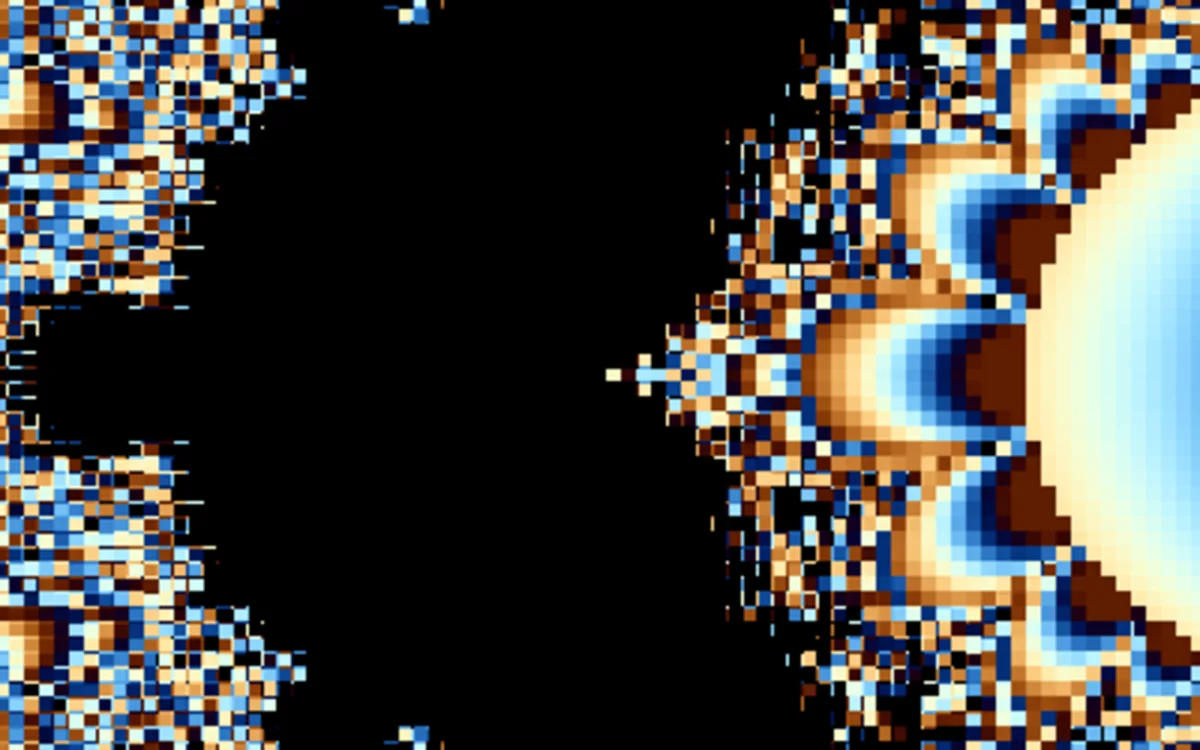
Layered gold plumes and fans repeating at regular vertical intervals in the Cosh Mandelbrot fractal
FractalPark’s Cosh Mandelbrot: gilt plumes and layered fans return vertically with cosh’s 2π imaginary-direction period.

Overview

Cosh Mandelbrot leaves the familiar polynomial step behind. Instead of repeating z² + c, it repeats z → cosh(z) + c. Squaring is replaced by hyperbolic cosine's exponential growth along the real axis and 2π repetition along the imaginary axis.

Complex cosine and hyperbolic cosine are close relatives: each repeats along one direction and grows without limit along another. For cosh(z), the imaginary-axis period is 2π, so a detail band returns above and below itself. When |Re(z)| is large, its exponential terms race outward. Most starting points escape quickly; only slim bands hold an orbit — keeping its successive values bounded for many steps.

The parameter plane no longer resembles the Mandelbrot set’s cardioid and bulbs. It stacks fans, gilt plumes, and vertical echoes instead. Its line between escape and non-escape is drawn by the transcendental iteration itself; no simple algebraic escape radius is available.

The Mathematics

Hyperbolic cosine iteration

z(n+1) = cosh(z(n)) + c

Each turn evaluates complex hyperbolic cosine at the current z, then adds c. The definition cosh(z) = (eᶻ + e⁻ᶻ)/2 puts exponential growth on the real axis beside imaginary-axis repetition with period 2π.

Try z = iπ/2 on the imaginary axis. Since cosh(iπ/2) = cos(π/2) = 0, starting there with c = 0 gives z₁ = 0 after one step. Zero is not a fixed point here: the following step gives z₂ = cosh(0) = 1. Nudge the point off that axis and the eᶻ term can drive exponential growth and rapid escape. That sharp divide—bounded behavior in a narrow strip, rapid escape elsewhere—is typical of transcendental iteration. Unlike a polynomial, this map has no universal escape radius; FractalPark uses a bailout threshold chosen to detect divergence in practice.

History

In 1988, Clifford A. Pickover, a computer scientist and author at IBM's Thomas J. Watson Research Center, published the short paper "Chaotic behavior of the transcendental mapping (Z → cosh(Z) + μ)" in The Visual Computer. He presented images of chaotic behavior produced by this transcendental function, alongside maps such as z → sin(z) + c and z → eᶻ + c.

Pickover’s work brought the cosh-based map into the fractal-rendering community, where it became a standard transcendental escape-time example. Earlier, mathematicians including Robert Devaney and Michał Krych had developed the broader study of transcendental complex dynamics—exponential, trigonometric, and hyperbolic families—and analyzed the dynamics of exp(z) in the 1980s.

Visual Characteristics

First notice the vertical repetition. Because cosh(z) repeats in the imaginary direction every 2π, fine plumes, layered fans, and gilt filaments return at regular intervals. The result is striped and tiered, far from the radial branching of polynomial Mandelbrot sets.

In the canonical rendering, plumes and fans often carry warm tones. The finest detail concentrates in narrow horizontal bands, where an orbit lingers near the boundary between escape and non-escape. Above and below, escape accelerates and the image becomes smoother.

Remix and Examples

Start from the canonical Document

Open the same approved formula state used by this guide, then change the view, coloring, transforms, or animation in the interactive Explorer.

Frequently Asked Questions

Why do patterns repeat vertically?

Complex hyperbolic cosine repeats along the imaginary axis with period 2π. Because every step uses cosh(z), the orbit structure repeats too: bounded and escaping behavior returns at regular vertical intervals in the parameter plane.

Why do many points escape rapidly?

Hyperbolic cosine is built from exponentials: cosh(z) = (eᶻ + e⁻ᶻ)/2. At a point with a substantial real part, the eᶻ term takes over and the orbit can grow extremely fast. There is no simple polynomial-style escape radius, so the bailout threshold is a practical computational choice.

References

Formula Record

coshMandelb

This canonical FractalPark implementation is published and runnable.

Deterministic preview of coshMandelb

Canonical source

Language
frm-like/1
Standard library
1
Profile mode
parameter-plane
Profile center
-0.5, 0
Profile zoom
0.4
Profile iterations
96
Profile evidence
mechanical

Parameters

No declared parameters

Canonical source

This verified canonical revision is read-only. Remix creates a separate editable fork.

Loading canonical source…

Source and implementation

Formula ID
201c54f3-a77a-5be0-a0a5-6f4f1998ee6d
Canonical name
coshMandelb
Original name
coshMandelb
Historical source
FractalPark
Current implementation
Project-owned

This is a FractalPark project-owned implementation. The linked file is the pinned canonical Definition.

Rights or attribution concern?

Send the Formula ID and supporting evidence. The maintainer can hold or withdraw the implementation while the claim is reviewed. contact@fractalpark.com