FractalPark
ExoticHard

Zaslavsky Map

A complex sine map: a 0.28-weighted sine perturbation bends the orbit, a fixed 0.55-radian turn rotates it, and c shifts it—an adaptation inspired by George Zaslavsky's 1978 dissipative kicked-rotor map.

Open in Explorer
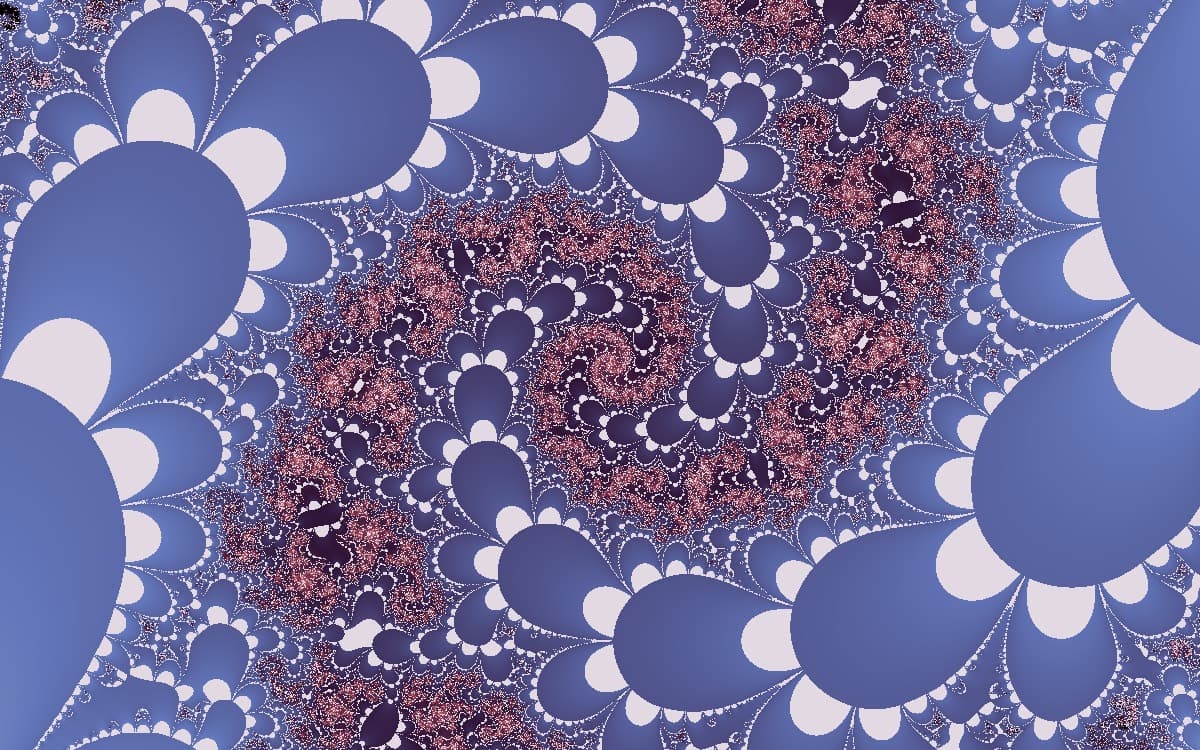
The Zaslavsky map: swirling arms and mandala-like rings in warm orange and gold
The Zaslavsky map rendered by FractalPark: concentric arcs and radiating spokes form a glowing mandala in warm oranges and golds.

Overview

FractalPark implements z(n+1) = exp(0.55 i) * (z(n) + 0.28 sin(z(n))) + c. Sine is a 0.28-weighted perturbation of the existing orbit, then the fixed complex phase rotates the full perturbed result by 0.55 radians (about 31.5°), and c shifts it.

In 1978, George M. Zaslavsky introduced the original map to model a dissipative kicked rotor: a rotating body repeatedly kicked while friction drains energy. That classical map is two-dimensional, using real action-angle variables. FractalPark recasts the idea in one complex variable for escape-time images; it is not the exact recurrence from the 1978 paper.

Complex sine can grow without bound along the imaginary axis, so this is not simple polynomial escape. An orbit can circle for a while, then fly apart. That hesitation leaves swirling arms and concentric rings, especially after a kaleidoscopic spatial transform.

The Mathematics

Sinusoidal rotation map

z(n+1) = exp(0.55 i) times (z(n) + 0.28 sin(z(n))) + c

FractalPark uses z(n+1) = exp(0.55 i) * (z(n) + 0.28 sin(z(n))) + c. The sine term is a 0.28-weighted perturbation of z, not a replacement for it. The fixed multiplier rotates the whole perturbed orbit counter-clockwise by 0.55 radians (about 31.5°), then c shifts the result.

For z₀ = 0, sin(0)=0, so the parenthesized perturbed term is zero; rotating zero still gives zero, and only c remains: z₁ = c. After that, complex sine can grow: the magnitude of sin(a + ib) contains terms up to cosh(b). A point with a large imaginary coordinate can receive a large sine perturbation and is more likely to escape.

The 0.55-radian rotation is fixed in the formula, not adjustable by the user. As an implementation detail rather than part of the idealized recurrence, FractalPark clamps the input imaginary component to ±80 and rounds each output component to a 1/16 grid.

History

George M. Zaslavsky (1929–2008) was a Soviet‑born mathematical physicist who made foundational contributions to the theory of dynamical chaos. He introduced the map that now bears his name in a 1978 paper titled "The Simplest Case of a Strange Attractor," published in Physics Letters A. The map was derived as a stroboscopic description of a dissipative kicked rotor — a rotating system that receives periodic impulses and loses energy through friction.

Zaslavsky later moved to the United States, joining New York University's physics department and the Courant Institute of Mathematical Sciences. He authored several books on Hamiltonian chaos and fractional dynamics. The Scholarpedia article on the Zaslavsky map, written by Zaslavsky himself in 2007, provides an authoritative technical reference.

Classical Zaslavsky maps operate on two real variables (action and angle). FractalPark's complex escape-time variant uses z(n+1) = exp(0.55 i) * (z(n) + 0.28 sin(z(n))) + c; it is a creative adaptation rather than a direct transcription of the original dissipative system.

Visual Characteristics

Kaleidoscopic transforms make the swirling arms and mandala-like rings especially clear. The canonical image sets concentric arcs and radiating spokes around a central region where the perturbed orbit can remain bounded.

Warm oranges and golds sit against deep black in the canonical rendering. Constant rotation curves the arms; the sine perturbation puts fine ripples along the ring edges.

Remix and Examples

Start from the canonical Document

Open the same approved formula state used by this guide, then change the view, coloring, transforms, or animation in the interactive Explorer.

Frequently Asked Questions

Where does the rotation come from?

The map multiplies the full perturbed orbit z + 0.28 sin(z) by exp(0.55 i), rotating it about 31.5° counter-clockwise, then adds c. It happens on every iteration and is fixed in the formula, not adjustable by the user.

Is kaleidoscope part of the formula?

No. Kaleidoscope is an optional spatial transform outside the iteration. It reflects or copies sectors of the parameter plane. The Zaslavsky Map has no built-in reflection symmetry; the kaleidoscope is a separate rendering step that can be switched independently.

References

Formula Record

zaslavskyMap

This canonical FractalPark implementation is published and runnable.

Deterministic preview of zaslavskyMap

Canonical source

Language
frm-like/1
Standard library
1
Profile mode
parameter-plane
Profile center
-0.5, 0
Profile zoom
0.4
Profile iterations
96
Profile evidence
mechanical

Parameters

No declared parameters

Canonical source

This verified canonical revision is read-only. Remix creates a separate editable fork.

Loading canonical source…

Source and implementation

Formula ID
22d9a008-eb14-53de-9960-11eb5d37bb8e
Canonical name
zaslavskyMap
Original name
zaslavskyMap
Historical source
FractalPark
Current implementation
Project-owned

This is a FractalPark project-owned implementation. The linked file is the pinned canonical Definition.

Rights or attribution concern?

Send the Formula ID and supporting evidence. The maintainer can hold or withdraw the implementation while the claim is reviewed. contact@fractalpark.com