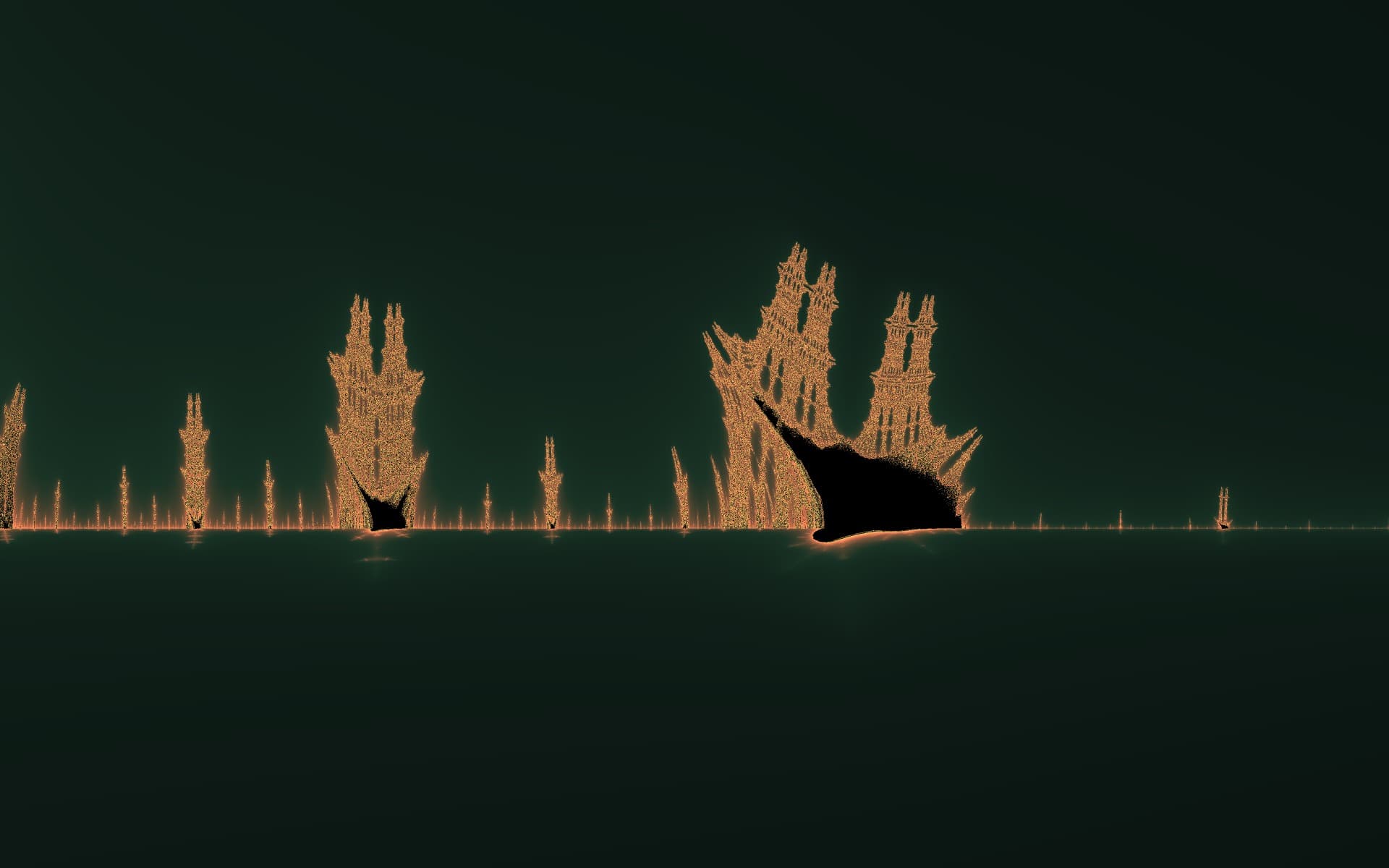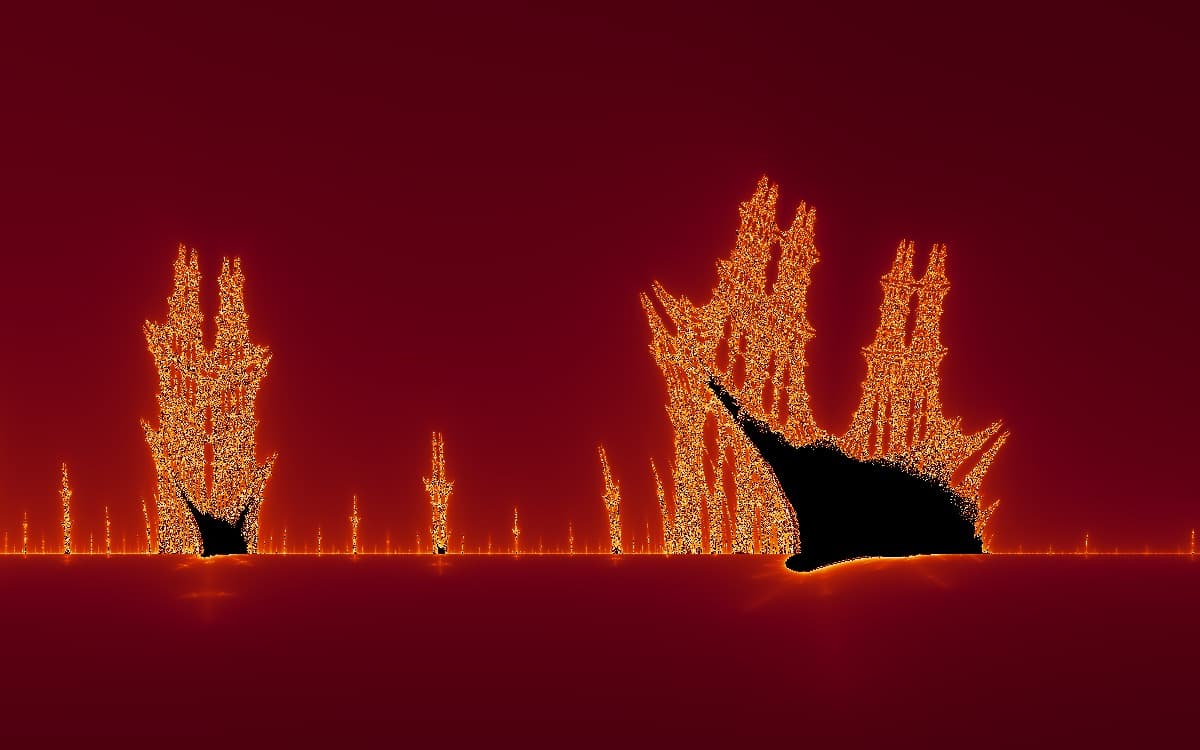
Fold, then square
Both real and imaginary components are reflected to nonnegative values, combined into a complex number, then squared. In expanded form, the real part is xₙ₊₁ = xₙ² − yₙ² + Re(c) and the imaginary part is yₙ₊₁ = 2|xₙ||yₙ| + Im(c). At every iteration, the absolute values fold the orbit back toward the axes: if xₙ or yₙ is negative, it is mirrored to positive before the squaring step. That fold produces the sharp, rectangular boundaries that set the Burning Ship apart from the Mandelbrot set’s smooth contours.
Try c = −1. For the Mandelbrot set, the orbit z₀=0, z₁=−1, z₂=0, z₃=−1, … stays bounded (period 2). For the Burning Ship, z₁ = (|0| + i|0|)² − 1 = −1, then z₂ = (|−1| + i|0|)² − 1 = 0, and the orbit settles into the same 2-cycle. Now take a point such as c = i: the fold redirects its orbit where the Mandelbrot iteration would not, producing a different escape decision.