FractalPark
NewtonHard

Newton Cosh

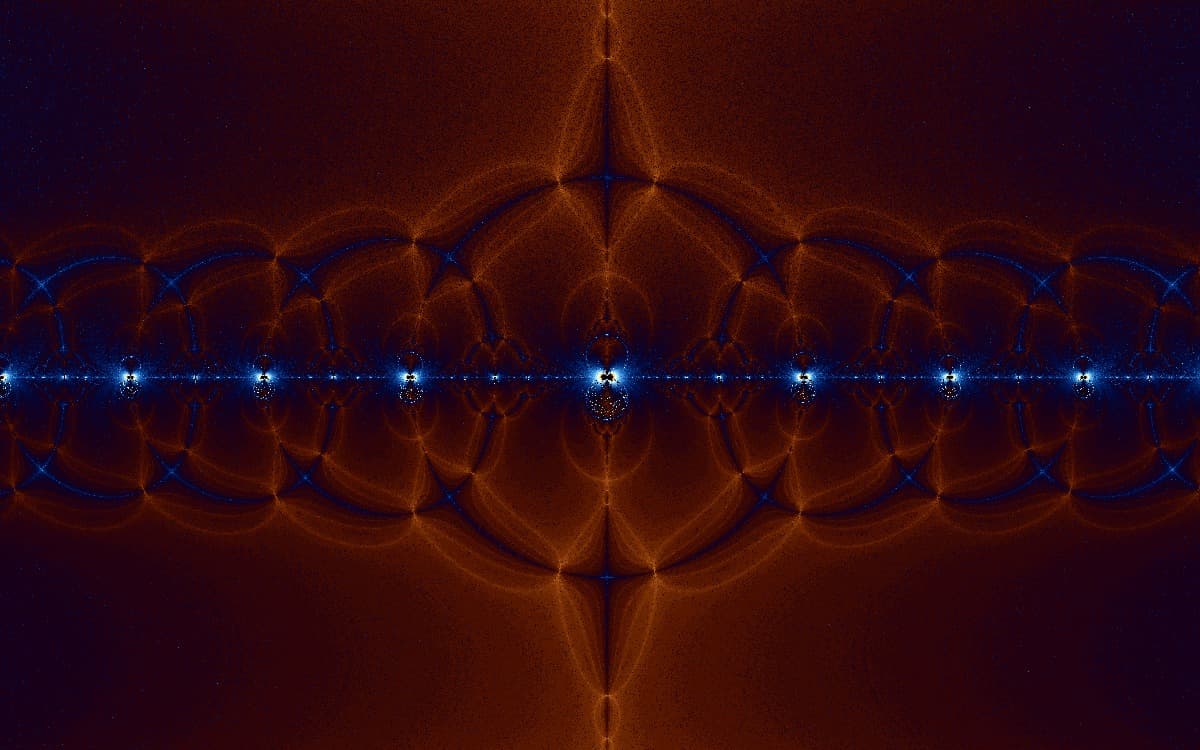
Newton's method applied to cosh z = 1: infinitely many evenly spaced roots turn the plane into repeating convergence bands.

Open in Explorer
Newton fractal for cosh z = 1, with repeating horizontal bands and warped boundaries stacked along the imaginary axis
FractalPark’s Newton view of cosh z = 1: repeating convergence bands along the imaginary axis, separated by folded, threadlike borders.

Overview

Newton's usual root-finding step changes character when f(z) = cosh z − 1. Its roots are 2πik for every integer k. A polynomial gives an orbit only finitely many possible destinations; these roots keep marching along the imaginary axis at equal intervals. The fractal therefore arranges itself into bands running upward and downward, rather than settling into a few basins.

The map N(z) = z − (cosh z − 1) / sinh z is meromorphic: it works throughout the complex plane except at its singularities. Keep an eye on two repeating sets of points: the roots of cosh z − 1, and the zeros of its denominator sinh z at z = πik for integer k. Near a denominator zero, nudging the starting point can switch the root the orbit reaches.

You can see the periodicity along the imaginary axis at a glance — no math background needed. The horizontal bands repeat above and below one another, one for each period of the roots. At their joins, fine vertical threads record where one basin hands an orbit to the next.

The Mathematics

Newton’s cosh iteration

z(n+1) = z(n) - (cosh(z(n)) - 1) / sinh(z(n))

Newton's rule is N(z) = z − f(z) / f′(z). Here f(z) = cosh z − 1 and f′(z) = sinh z. Each step finds the correction (cosh z − 1) / sinh z, then takes it away from z.

The equation cosh z = 1 has infinitely many solutions: z = 2πik for every integer k. Each is a simple root: cosh z grows linearly close by, so Newton's method converges quadratically there. Far from the real axis, cosh and sinh grow exponentially. Their quotient may be tiny or enormous, and that is where the image's sensitive seams take shape.

Try z₀ = 0.2i. Since i·sinh(0.2) ≈ 0.201i and cosh(0.2) ≈ 1.020, the first correction is small; the orbit quickly reaches the root at z = 0. Now move to z₀ = (0.5 + 3.0i), farther from every root. The correction now contains large exponential terms. The orbit can cross several basin boundaries before settling, or wander chaotically between roots for many iterations before one captures it.

The function repeats with period 2πi in the imaginary direction, and the Newton map does too: N(z + 2πi) = N(z) + 2πi. That repeated rule is the source of the horizontal banding.
Visual Characteristics

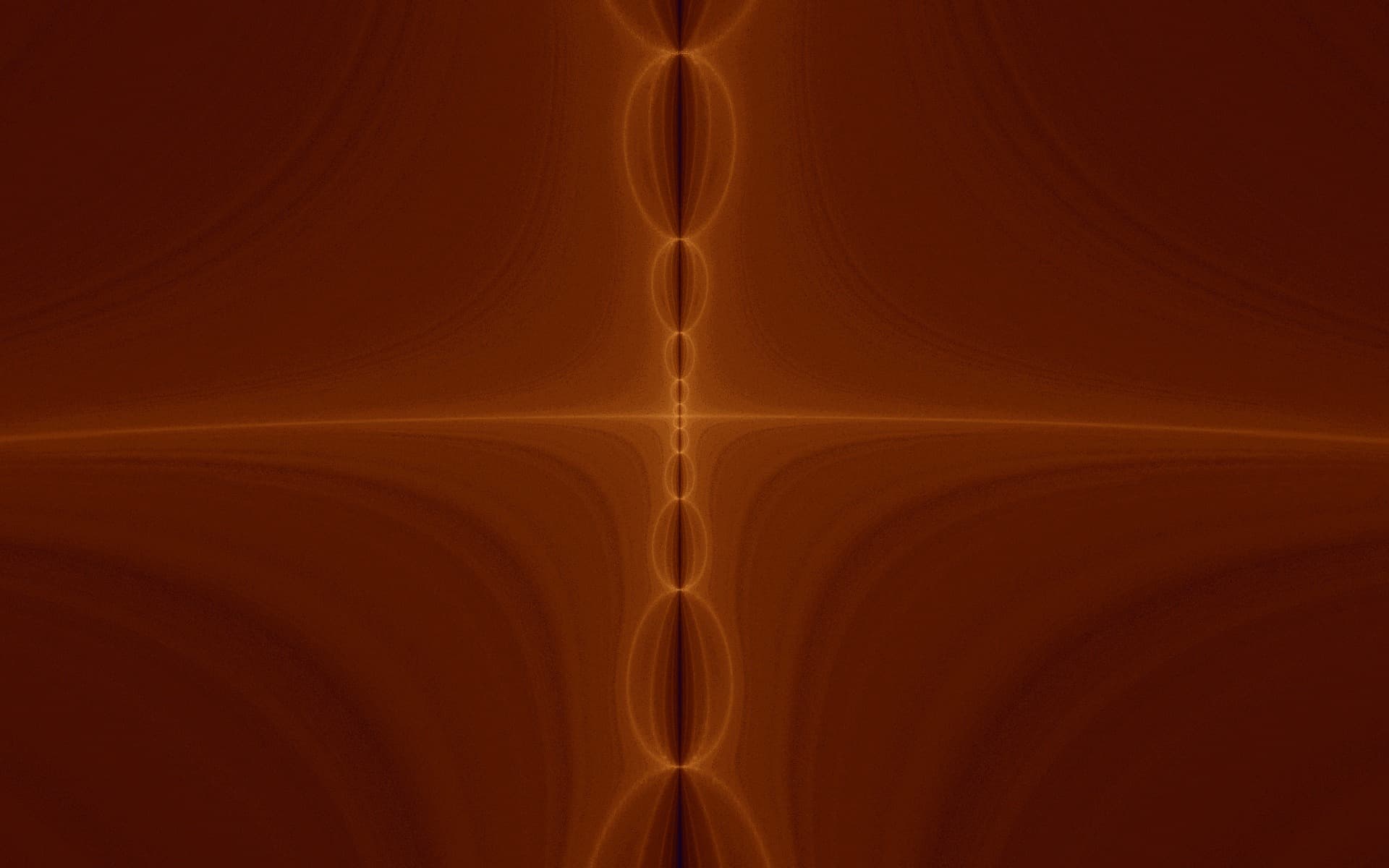
Start with the horizontal bands along the imaginary axis. A period of roots makes one band, and the convergence pattern returns in the next. The borders do not run straight: they bend and fold, then pull out fine vertical filaments like taut threads.

Within each band, the basin geometry resembles its neighbours, with small distortions. Think of a ribbon folded repeatedly. The warm and cool zones come from the colouring; the sharp breaks arise where singularities of sinh z destabilise the Newton correction.

Remix and Examples

Start from the canonical Document

Open the same approved formula state used by this guide, then change the view, coloring, transforms, or animation in the interactive Explorer.

Frequently Asked Questions

What equation is being solved?

It seeks the complex solutions of cosh(z) = 1: z = 2πik for every integer k. The equally spaced roots line the imaginary axis. Each draws in nearby Newton orbits, and their repeating arrangement creates the horizontal bands.

Why are some regions extremely sensitive?

The correction divides by sinh(z), which vanishes at z = πik for integer k. Close to one of these points, the correction can become huge, sending an orbit across several basin boundaries before it converges. These singularities are not roots; they pull the fine vertical filaments and unsettled border zones into view.