FractalPark
ClassicEasy

Quartic Julia

A fourth-degree Julia map: raise z to the fourth power, add a fixed c, and four-way branching begins.

Open in Explorer
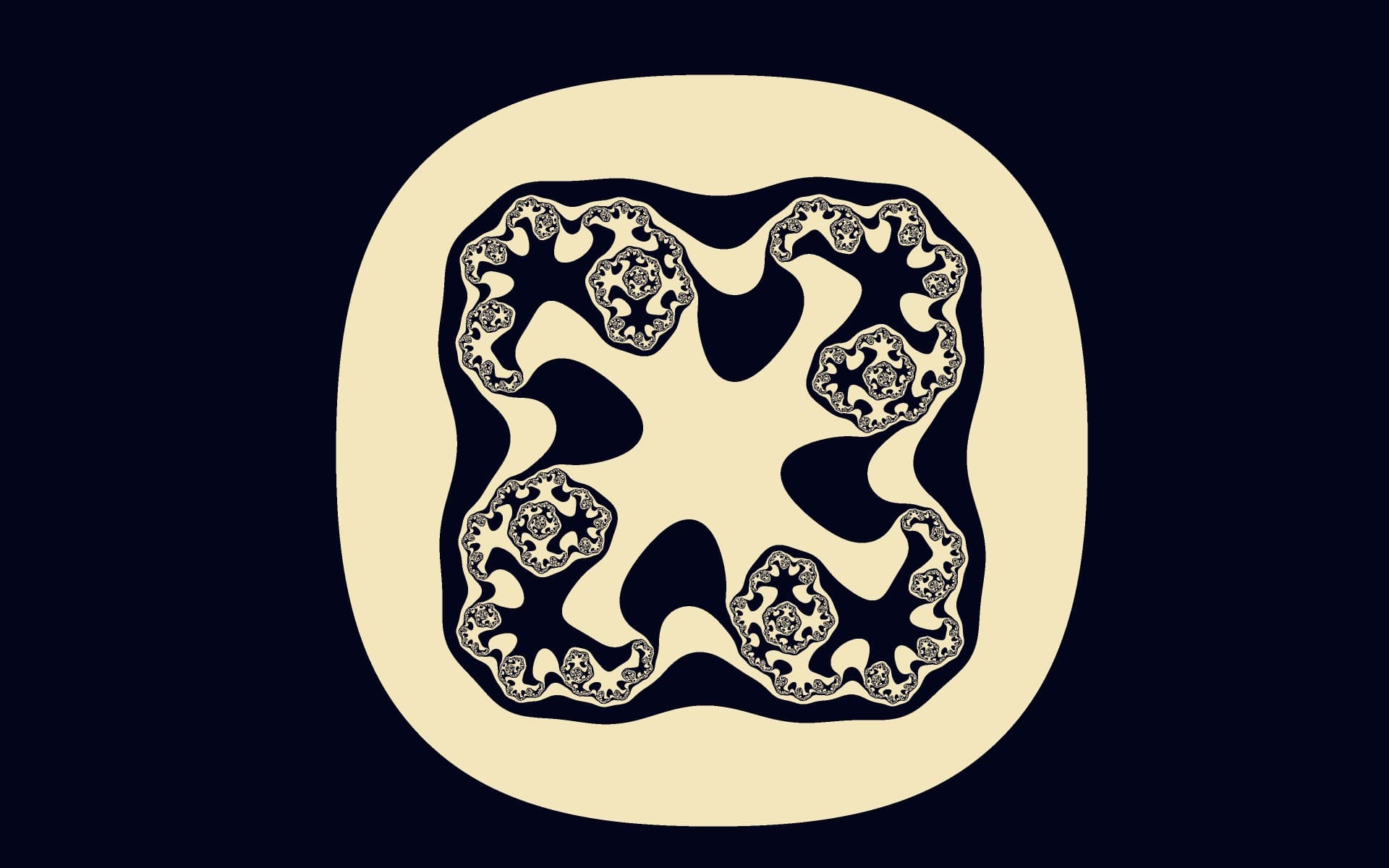
Quartic Julia set edged in ivory, with four-fold rosettes and branching filigree
FractalPark’s Quartic Julia: ivory filigree follows branching rosettes and four-fold filaments.

Overview

Take the usual Julia recipe and turn the dial one notch: fix one complex constant c, then repeat z → z⁴ + c. Each fourth power multiplies the complex argument by four. A direction that might fork in two for a quadratic map can open into four here — the source of the four-way branching.

With the same c, this higher-degree map usually crams more turns into the set than its quadratic cousin. Whether the filled Julia set stays in one piece or breaks apart still depends on c, under the Fatou–Julia classification for higher-degree polynomials. Watch the critical orbit—here governed by the critical point z = 0 and the critical points of the derivative—and it gives the clue to that connectivity.

On screen, it reads less like a cloud than a stamped ornament: fine filigree, rosettes, and seal-like knots recur with four-fold symmetry. The extra degree packs in detail, yet the angular layout stays strikingly orderly.

The Mathematics

Quartic iteration

z(n+1) = z(n)^4 + c

One step has the effect of four squarings: the argument is multiplied by four, so a point near the boundary can split four ways. Try c = 0. The recurrence becomes zₙ₊₁ = zₙ⁴, simply a fourth-power map. From z₀ = 0.5 + 0i, the values shrink toward zero and remain bounded; from z₀ = 1.5 + 0i, they grow rapidly and escape. As in the quadratic case, |zₙ| signals escape: once it passes a fixed threshold (about 2 for this quartic), the orbit must diverge. The fourth power hastens the outward flight; it also speeds the angular splitting that creates the four-fold shape.

FractalPark holds c fixed across the image and varies the starting point z₀ from pixel to pixel—the usual Julia-family setup.
History

The theory came first. Pierre Fatou and Gaston Julia developed the classical framework for iterated rational functions in 1917–1918, and it applies to polynomials of any degree. Quartic Julia sets inherit its principles for connectivity and dynamical classification. When fractal-rendering software moved beyond quadratics in the 1980s and 1990s, computer exploration of higher-degree Julia sets became common. The named quartic variant belongs to that line; no single discoverer is attributed to it.

FractalPark uses the standard fourth-degree recurrence as a fixed-parameter Julia-family formula.

Visual Characteristics

Angles multiplied by four leave a recognizable trace: fine seals, branching rosettes, and filaments arranged on a quartic grid. A quadratic Julia may grow a spiral or one pair of arms; here, feature centers often send out four matching arms or lobes.

More detail fits into the same space than in a quadratic Julia, but it arrives in a tidier order. Turn ninety degrees around a prominent point and a motif often returns. The canonical FractalPark image picks out those edges with ivory filigree.

Remix and Examples

Start from the canonical Document

Open the same approved formula state used by this guide, then change the view, coloring, transforms, or animation in the interactive Explorer.

Frequently Asked Questions

Why is this called Quartic Julia?

Its rule uses the fourth power of z, so it is a quartic, or degree-four, polynomial. The name distinguishes it from the standard quadratic Julia set and other higher-degree variants.

What does c change?

The fixed complex constant c decides whether the filled Julia set is connected or disconnected, then shapes its fine geometry. Nudge c and four-way branches rearrange, seals and filaments shift, and a connected set can fall into disconnected dust.

References