FractalPark
ExóticaMedia

Circle Inversion

Un mapa cuadrático recíproco que intercambia cerca y lejos en cada paso: los valores pequeños salen volando hacia afuera y los grandes regresan hacia el origen.

Abrir en Explorar
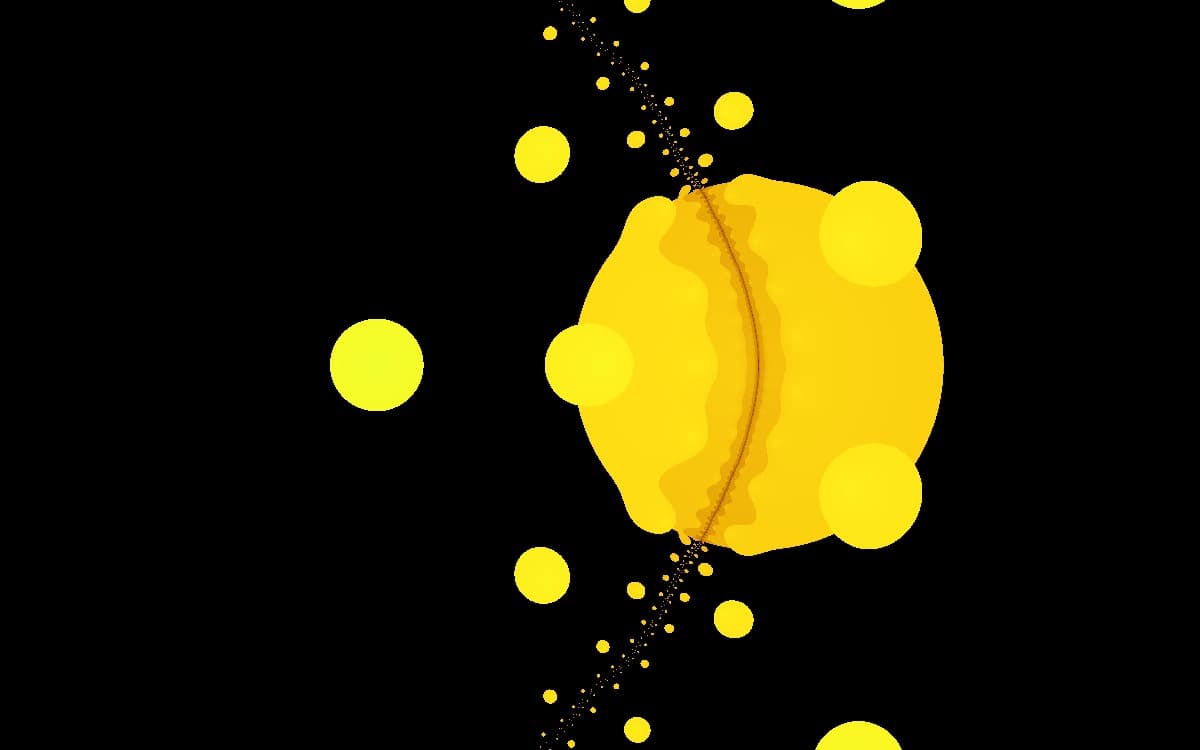
Fractal Circle Inversion con anillos concéntricos y espinas radiales brillantes alrededor de un polo central
El plano de parámetros de Circle Inversion: anillos anidados, espinas axiales y el polo en el origen.

Resumen

Circle Inversion cambia el crecimiento cuadrático familiar por un paso cuadrático recíproco: toma 1/z² y luego lo desplaza por c. Parece un pequeño intercambio. El comportamiento no lo es.

En la iteración polinomial ordinaria, una vez que una órbita crece más allá de cierto tamaño sigue alejándose del origen. Aquí esa lógica se da vuelta: lo cercano a cero se vuelve enorme, y un valor enorme regresa cerca de cero. Luego c decide dónde aterriza ese valor intercambiado.

La imagen es radial, con anillos anidados y trazos axiales marcados. El origen es un polo de orden 2 —un punto donde el mapa no está definido— y su atracción alcanza todo el plano de parámetros.

Las matemáticas

Reciprocal quadratic iteration

z(n+1) = 1 / z(n)^2 + c

At each step, the map takes the reciprocal of z²—geometric inversion through the unit circle with a doubled angle—then shifts the result by the complex parameter c. That inversion gives the formula its name; it is classical circle inversion applied to z² rather than to z.

Try c = 0 and start at z₀ = 2. Then z₁ = 1/4 = 0.25, z₂ = 1/(0.0625) = 16, z₃ = 1/256 ≈ 0.0039. The orbit ricochets between large and small values rather than settling at a fixed point. For c = 0.5, start at z₀ = 1: z₁ = 1/1 + 0.5 = 1.5, z₂ = 1/2.25 + 0.5 ≈ 0.944, z₃ = 1/0.892 + 0.5 ≈ 1.62. This orbit oscillates without diverging, suggesting c = 0.5 belongs to the bounded set. Escape needs a different test from the quadratic case: a huge value may collapse on the next step, so the bailout must allow for this alternation.
Historia

The map z → 1/z² + c sits near the broader rational family known as McMullen maps, z → zⁿ + λ/zⁿ. Curt McMullen introduced that family in the late 1980s, showing rational maps whose parameter spaces contain several kinds of hyperbolic components, including ones with Sierpiński-carpet Julia sets.

With n = 2, λ = 1, and a translation parameter c, this gives the Circle Inversion map. Its name comes from 1/z², which inverts the complex plane with respect to the unit circle and doubles the angle. Robert L. Devaney and others later studied the McMullen family, tracing how escape loci and Julia sets change with parameters. FractalPark renders exactly this map — the n = 2, λ = 1 case with c as the translation parameter.

Características visuales

Concentric bands and radial spines run outward from the pole at the origin. The bands mark regions whose orbits stay bounded or escape at different rates, making nested rings like a target or the ripples from a dropped pebble.

Sharp axial structures form distinct spokes. They come from the inversion’s angular part: 1/z² doubles z’s angle, creating preferred directions where the dynamics line up. The reciprocal quadratic form gives this parameter plane a more rigid radial symmetry than most.

Remix y ejemplos

Empieza desde el Documento canónico

Abre el mismo estado de fórmula aprobado que usa esta guía y luego cambia la vista, la coloración, las transformaciones o la animación en el Explorar interactivo.

Preguntas frecuentes

Why is the origin special?

The origin is a pole of order 2: 1/z² is undefined at z = 0 because division by zero creates a singularity. An orbit landing exactly there cannot continue; one passing nearby gets a very large next value. That is why the rendered image grows rings and spines around the origin.

How does FractalPark handle values near zero?

The renderer clips the denominator at a small epsilon value to prevent division by zero. The pole still leaves its rings and spines visible, while the calculation stays numerically stable. Its effect remains part of the rendered structure.

Referencias