FractalPark
ExóticaDifícil

Rational Map 1

Una iteración racional de grado 2, z²/(z + c), con un cero y un polo que viaja a medida que c cambia.

Abrir en Explorar
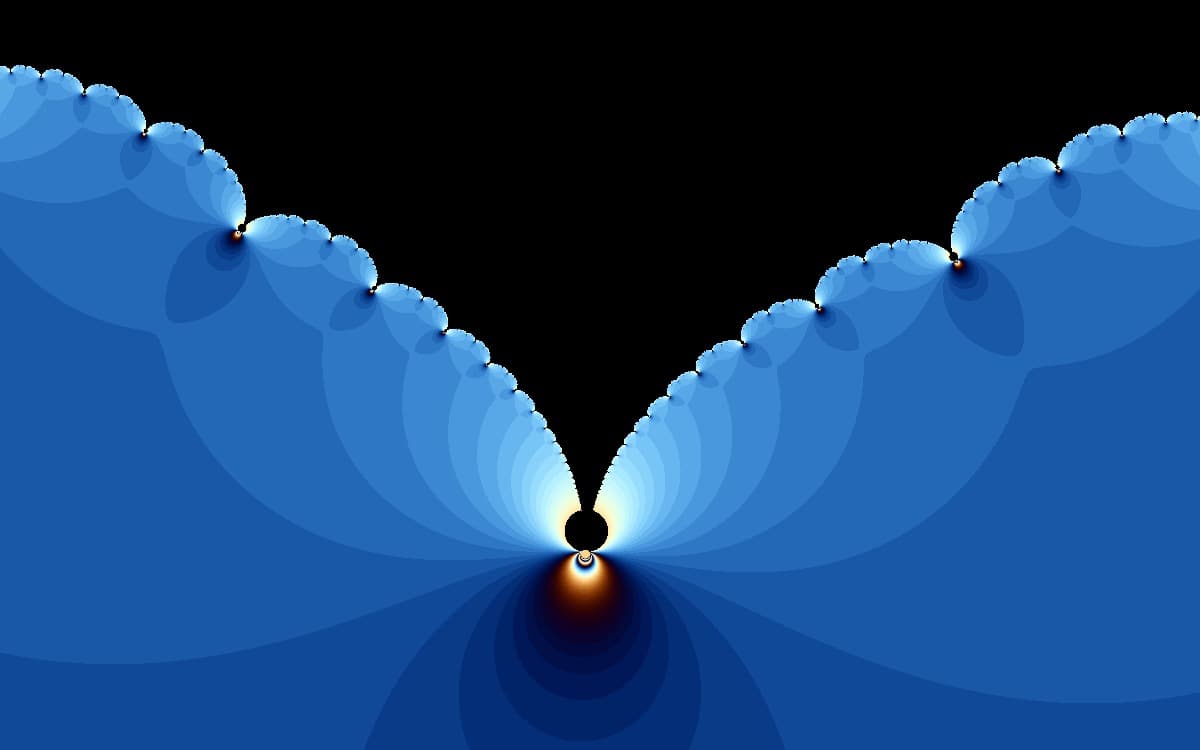
Primer plano Julia de Rational Map 1: un abanico de palas curvas y canales barridos que irradian desde el polo
Rational Map 1 renderizado por FractalPark: un abanico de giro lento de palas curvas irradia desde el polo, con bandas estrechas que registran las órbitas cercanas al polo.

Resumen

Rational Map 1 itera z² / (z + c). Un polinomio como z² + c no tiene ningún punto donde falle su denominador; este mapa sí. En z = −c hay un polo móvil. Una órbita que lo roza puede salir lanzada hacia afuera y luego tomar una ruta muy distinta en los pasos siguientes.

Hay un cero, en z = 0, y un polo, en z = −c. La función sigue teniendo grado dos, pero ese polo redibuja el plano. Lejos, z² / (z + c) crece aproximadamente como z (para |z| grande, z² / (z + c) ≈ z), así que el infinito no es el punto fijo que manda. Las cuencas se reúnen alrededor de un conjunto finito de ciclos atractores, mientras el polo corta canales curvos y sectores en forma de abanico entre ellas.

FractalPark muestra planos de parámetros, donde c se mueve, y vistas Julia, donde c se mantiene quieta. Esta imagen guía es un primer plano Julia: palas curvas se abren alrededor del polo, mientras finas bandas de color siguen las órbitas que rozan la singularidad.

Las matemáticas

Rational iteration

z(n+1) = z(n)^2 / (z(n) + c)

Each step squares z, then divides by z + c. The numerator is zero at z = 0; the denominator is zero at z = −c, which makes that point a pole. The map has degree two: (z²)/(z + c) is degree‑2 over degree‑1, and after cancelling a common factor it has one zero and one pole, each counted with multiplicity.

Try the pole at close range. Take c = 0.5, so the pole is at z = −0.5, and start at z₀ = −0.49, just to its right. Then z₁ = (−0.49)² / (−0.49 + 0.5) = 0.2401 / 0.01 = 24.01. One step has thrown the orbit far out. Since |z₁| is large, the next step gives z₂ ≈ z₁² / z₁ = z₁ = 24.01: the large value persists instead of snapping back as in the magnet family. Pixel colour records the steps before the orbit crosses the escape threshold.

Unlike polynomial maps, where infinity always attracts escaping orbits, this map is nearly linear far out (z → z). Thrown-out orbits may drift. The escape-time colours therefore spread into broad, gradual bands rather than the abrupt jumps familiar from z² + c.
Características visuales

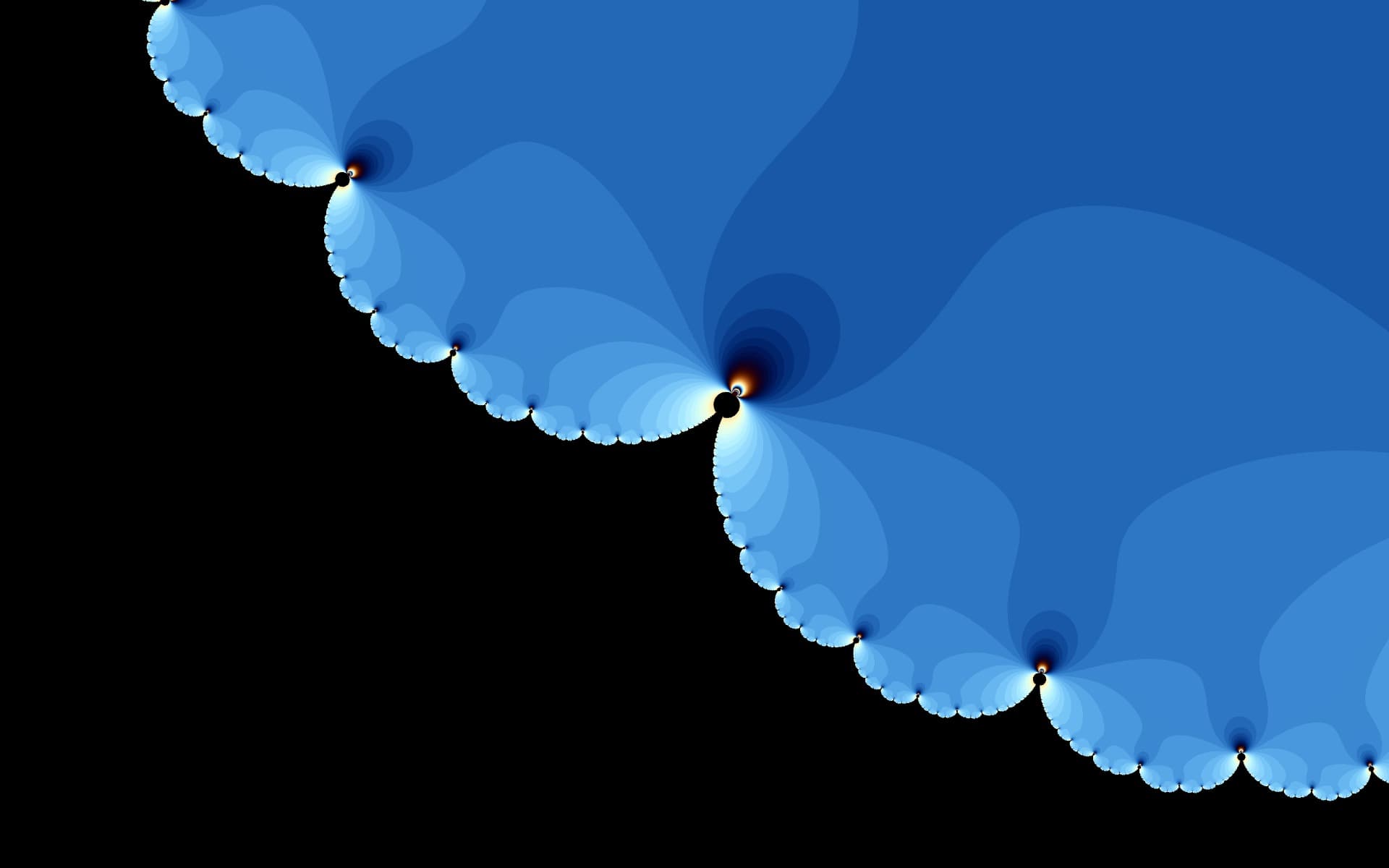
This is a Julia close-up. Around the pole, curved blades open into sweeping channels that follow the map's local direction. Tight colour bands between them mark orbits that graze the pole and need many steps to cross the escape threshold.

Because large-z motion is nearly linear rather than explosive, the bands change colour slowly and broadly. It reads as a turning fan with the pole for its hub. Move c and the pole moves too; the whole fan reorganizes.

Remix y ejemplos

Empieza desde el Documento canónico

Abre el mismo estado de fórmula aprobado que usa esta guía y luego cambia la vista, la coloración, las transformaciones o la animación en el Explorar interactivo.

Preguntas frecuentes

What makes this a rational map?

Its rule is a quotient of two complex polynomials, z² divided by z + c, not one polynomial alone. That permits poles: places where the denominator vanishes and the value becomes infinite. Polynomial maps have no such places, so their dynamics lack this particular detour.

Where is the pole?

Set z + c to zero: the pole is at z = −c. It moves with c and helps draw the curved fan and blades. An orbit passing close by is thrown to a large value, then may drift because the map grows only linearly far from the origin.