FractalPark
TrascendentalMedia

Cosh Mandelbrot

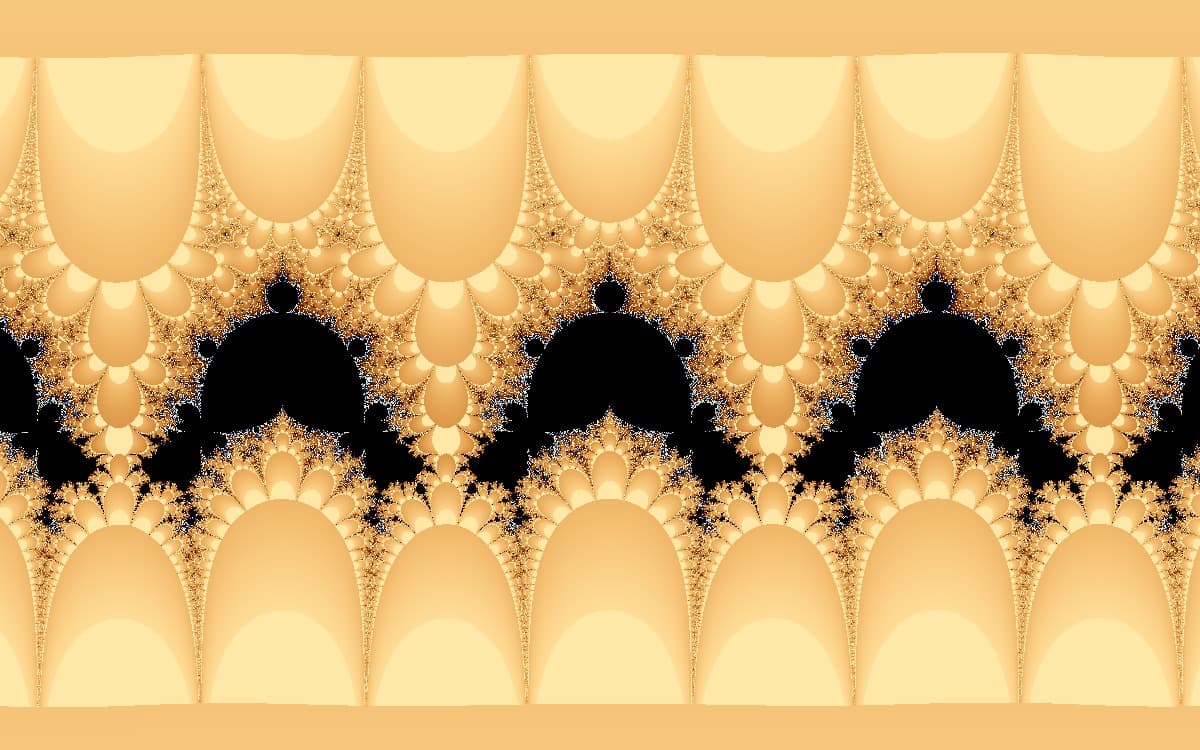
Un mapa trascendente de tiempo de escape: el coseno hiperbólico reemplaza a la elevación al cuadrado, y en su lugar aparecen penachos que se repiten en vertical y abanicos en capas.

Abrir en Explorar
Penachos dorados en capas y abanicos que se repiten a intervalos verticales regulares en el fractal Cosh Mandelbrot
El Cosh Mandelbrot de FractalPark: penachos dorados y abanicos en capas regresan en vertical con el periodo de 2π de cosh en la dirección imaginaria.

Resumen

Cosh Mandelbrot deja atrás el paso polinomial familiar. En lugar de repetir z² + c, repite z → cosh(z) + c. La elevación al cuadrado se reemplaza por el crecimiento exponencial del coseno hiperbólico a lo largo del eje real y su repetición de 2π a lo largo del eje imaginario.

El coseno complejo y el coseno hiperbólico son parientes cercanos: cada uno se repite en una dirección y crece sin límite en otra. Para cosh(z), el periodo a lo largo del eje imaginario es 2π, así que una banda de detalle regresa por encima y por debajo de sí misma. Cuando |Re(z)| es grande, sus términos exponenciales salen disparados. La mayoría de los puntos de partida escapan rápido; solo bandas delgadas retienen una órbita —manteniendo sus valores sucesivos acotados durante muchos pasos.

El plano de parámetros ya no se parece al cardioide y los bulbos del conjunto de Mandelbrot. En su lugar apila abanicos, penachos dorados y ecos verticales. Su línea entre la fuga y la no fuga la traza la propia iteración trascendente; no hay un radio de escape algebraico simple disponible.

Las matemáticas

Hyperbolic cosine iteration

z(n+1) = cosh(z(n)) + c

Each turn evaluates complex hyperbolic cosine at the current z, then adds c. The definition cosh(z) = (eᶻ + e⁻ᶻ)/2 puts exponential growth on the real axis beside imaginary-axis repetition with period 2π.

Try z = iπ/2 on the imaginary axis. Since cosh(iπ/2) = cos(π/2) = 0, starting there with c = 0 leaves the recurrence at zero. Nudge the point off that axis and the eᶻ term can drive exponential growth and rapid escape. That sharp divide—bounded behavior in a narrow strip, rapid escape elsewhere—is typical of transcendental iteration. Unlike a polynomial, this map has no universal escape radius; FractalPark uses a bailout threshold chosen to detect divergence in practice.

Historia

In 1988, Clifford A. Pickover, a computer scientist and author at IBM's Thomas J. Watson Research Center, published the short paper "Chaotic behavior of the transcendental mapping (Z → cosh(Z) + μ)" in The Visual Computer. He presented images of chaotic behavior produced by this transcendental function, alongside maps such as z → sin(z) + c and z → eᶻ + c.

Pickover’s work brought the cosh-based map into the fractal-rendering community, where it became a standard transcendental escape-time example. Earlier, mathematicians including Robert Devaney and Michał Krych had developed the broader study of transcendental complex dynamics—exponential, trigonometric, and hyperbolic families—and analyzed the dynamics of exp(z) in the 1980s.

Características visuales

First notice the vertical repetition. Because cosh(z) repeats in the imaginary direction every 2π, fine plumes, layered fans, and gilt filaments return at regular intervals. The result is striped and tiered, far from the radial branching of polynomial Mandelbrot sets.

In the canonical rendering, plumes and fans often carry warm tones. The finest detail concentrates in narrow horizontal bands, where an orbit lingers near the boundary between escape and non-escape. Above and below, escape accelerates and the image becomes smoother.

Remix y ejemplos

Empieza desde el Documento canónico

Abre el mismo estado de fórmula aprobado que usa esta guía y luego cambia la vista, la coloración, las transformaciones o la animación en el Explorar interactivo.

Preguntas frecuentes

Why do patterns repeat vertically?

Complex hyperbolic cosine repeats along the imaginary axis with period 2π. Because every step uses cosh(z), the orbit structure repeats too: bounded and escaping behavior returns at regular vertical intervals in the parameter plane.

Why do many points escape rapidly?

Hyperbolic cosine is built from exponentials: cosh(z) = (eᶻ + e⁻ᶻ)/2. At a point with a substantial real part, the eᶻ term takes over and the orbit can grow extremely fast. There is no simple polynomial-style escape radius, so the bailout threshold is a practical computational choice.

Referencias