FractalPark
NewtonDifícil

Newton Cosh

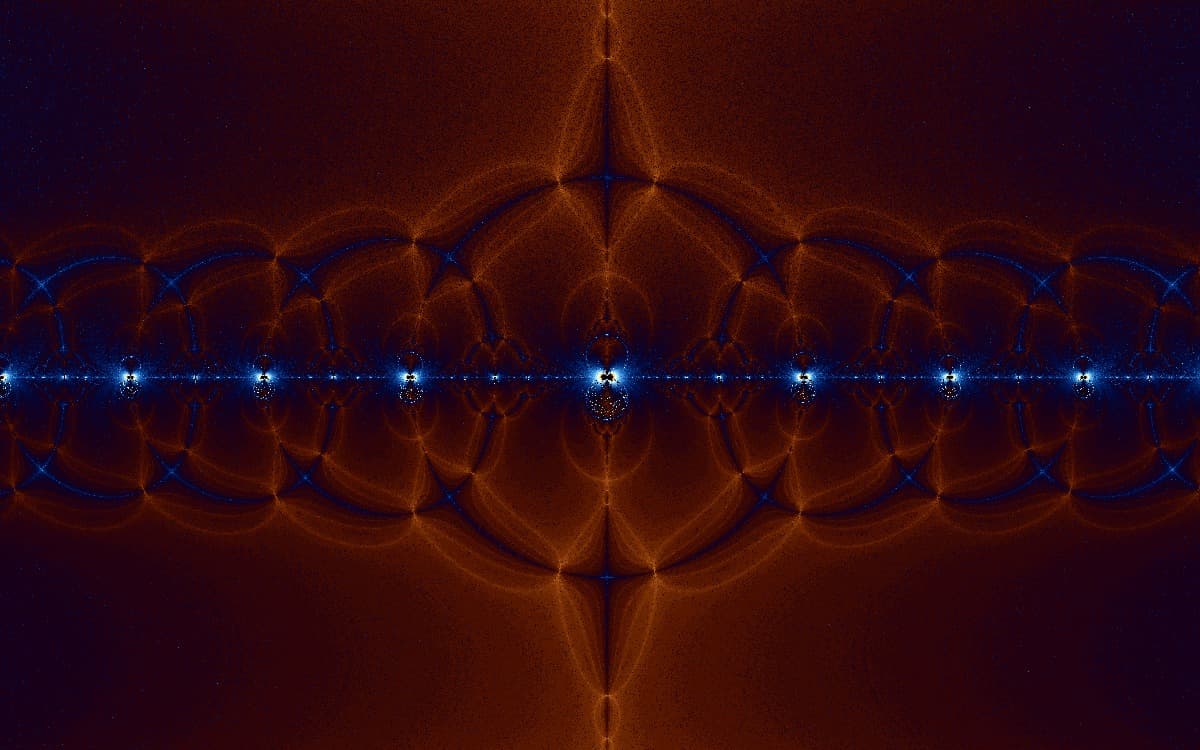
El método de Newton aplicado a cosh z = 1: infinitas raíces igualmente espaciadas convierten el plano en bandas de convergencia repetidas.

Abrir en Explorar
Fractal de Newton para cosh z = 1, con bandas horizontales repetidas y fronteras deformadas apiladas a lo largo del eje imaginario
La vista de Newton de FractalPark de cosh z = 1: bandas de convergencia repetidas a lo largo del eje imaginario, separadas por bordes plegados y filiformes.

Resumen

El paso habitual de Newton para buscar raíces cambia de carácter cuando f(z) = cosh z − 1. Sus raíces son 2πik para todo entero k. Un polinomio solo le da a una órbita un número finito de destinos posibles; estas raíces siguen marchando por el eje imaginario a intervalos iguales. Por eso el fractal se organiza en bandas que corren hacia arriba y hacia abajo, en lugar de asentarse en unas pocas cuencas.

El mapa N(z) = z − (cosh z − 1) / sinh z es meromorfo: funciona en todo el plano complejo salvo en sus singularidades. Presta atención a dos conjuntos de puntos que se repiten: las raíces de cosh z − 1 y los ceros de su denominador sinh z en z = πik para k entero. Cerca de un cero del denominador, mover un poco el punto de partida puede cambiar la raíz a la que llega la órbita.

Puedes ver la periodicidad a lo largo del eje imaginario de un vistazo —no hace falta saber matemáticas. Las bandas horizontales se repiten una encima de otra, una por cada periodo de las raíces. En sus uniones, finos hilos verticales marcan dónde una cuenca le pasa la órbita a la siguiente.

Las matemáticas

Newton’s cosh iteration

z(n+1) = z(n) - (cosh(z(n)) - 1) / sinh(z(n))

Newton's rule is N(z) = z − f(z) / f′(z). Here f(z) = cosh z − 1 and f′(z) = sinh z. Each step finds the correction (cosh z − 1) / sinh z, then takes it away from z.

The equation cosh z = 1 has infinitely many solutions: z = 2πik for every integer k. Each is a simple root: cosh z grows linearly close by, so Newton's method converges quadratically there. Far from the real axis, cosh and sinh grow exponentially. Their quotient may be tiny or enormous, and that is where the image's sensitive seams take shape.

Try z₀ = 0.2i. Since i·sinh(0.2) ≈ 0.201i and cosh(0.2) ≈ 1.020, the first correction is small; the orbit quickly reaches the root at z = 0. Now move to z₀ = (0.5 + 3.0i), farther from every root. The correction now contains large exponential terms. The orbit can cross several basin boundaries before settling, or wander chaotically between roots for many iterations before one captures it.

The function repeats with period 2πi in the imaginary direction, and the Newton map does too: N(z + 2πi) = N(z) + 2πi. That repeated rule is the source of the horizontal banding.
Características visuales

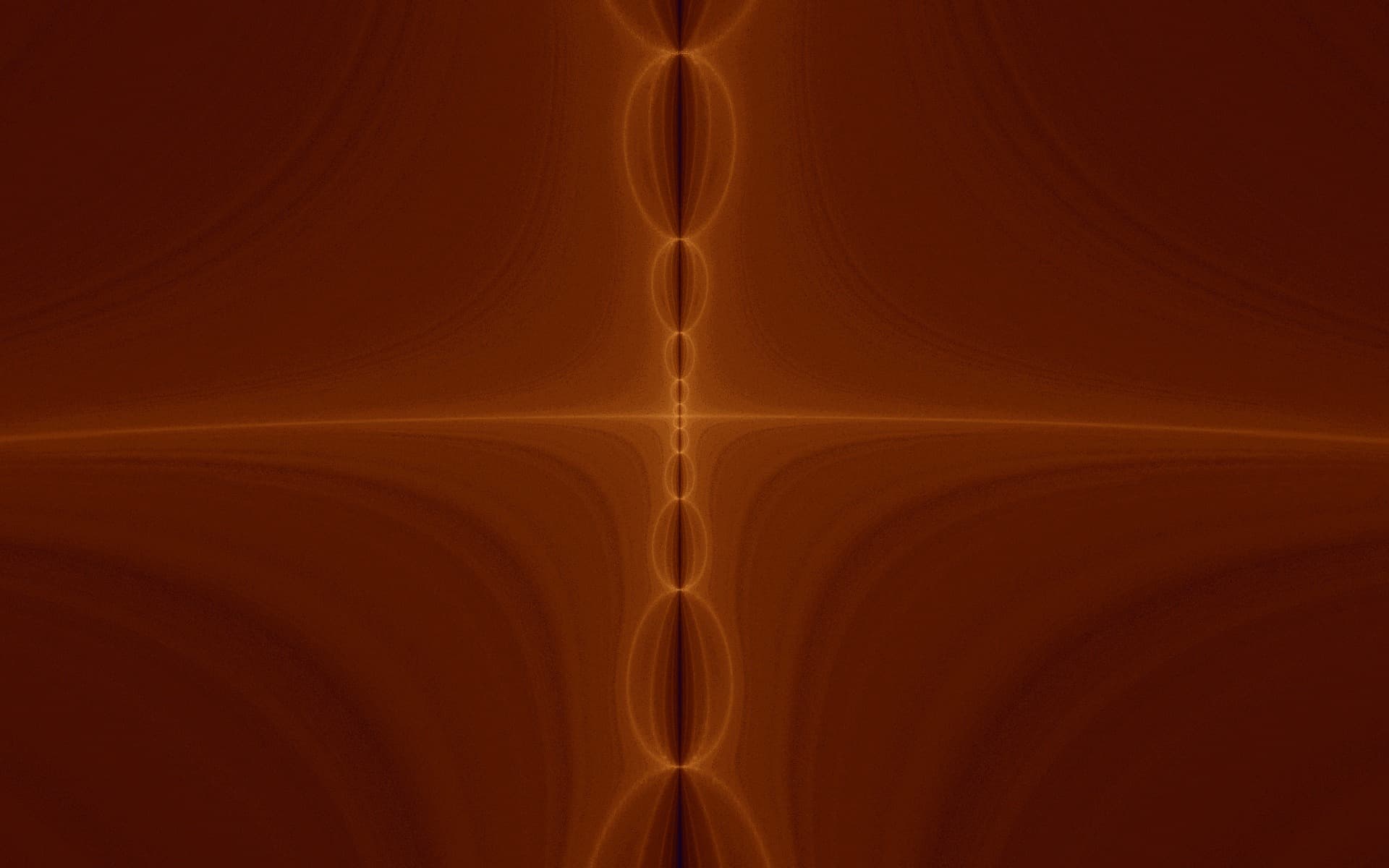
Start with the horizontal bands along the imaginary axis. A period of roots makes one band, and the convergence pattern returns in the next. The borders do not run straight: they bend and fold, then pull out fine vertical filaments like taut threads.

Within each band, the basin geometry resembles its neighbours, with small distortions. Think of a ribbon folded repeatedly. The warm and cool zones come from the colouring; the sharp breaks arise where singularities of sinh z destabilise the Newton correction.

Remix y ejemplos

Empieza desde el Documento canónico

Abre el mismo estado de fórmula aprobado que usa esta guía y luego cambia la vista, la coloración, las transformaciones o la animación en el Explorar interactivo.

Preguntas frecuentes

What equation is being solved?

It seeks the complex solutions of cosh(z) = 1: z = 2πik for every integer k. The equally spaced roots line the imaginary axis. Each draws in nearby Newton orbits, and their repeating arrangement creates the horizontal bands.

Why are some regions extremely sensitive?

The correction divides by sinh(z), which vanishes at z = πik for integer k. Close to one of these points, the correction can become huge, sending an orbit across several basin boundaries before it converges. These singularities are not roots; they pull the fine vertical filaments and unsettled border zones into view.