Newton iteration
For a function f(z), Newton iteration is N(z) = z − f(z) / f′(z). Here f(z) = z³ − 1 and f′(z) = 3z². Each step subtracts the polynomial value divided by its derivative, nudging z toward a root. For the cubic z³ − 1, the iteration simplifies to:
N(z) = z − (z³ − 1) / (3z²) = (2z³ + 1) / (3z²).
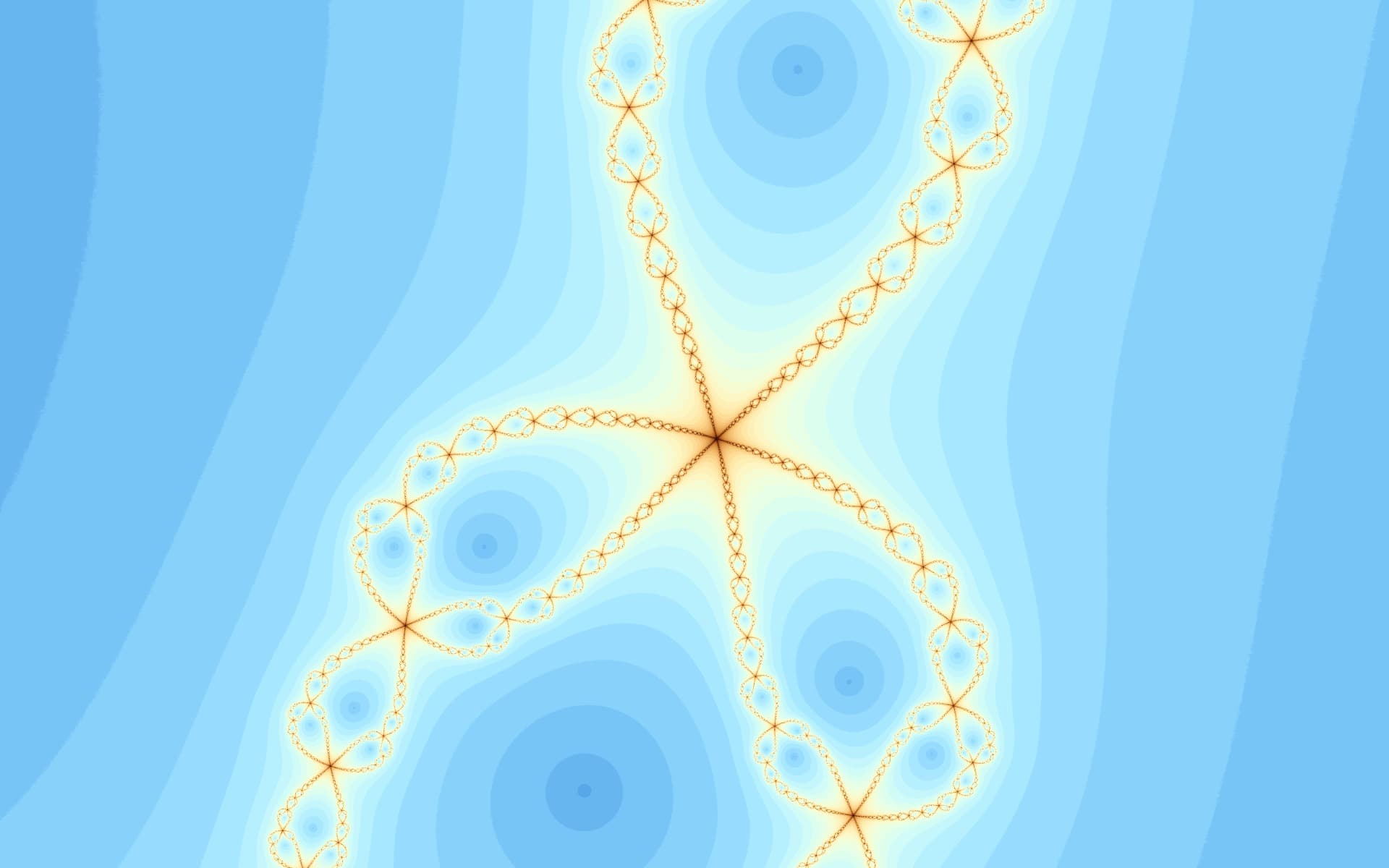
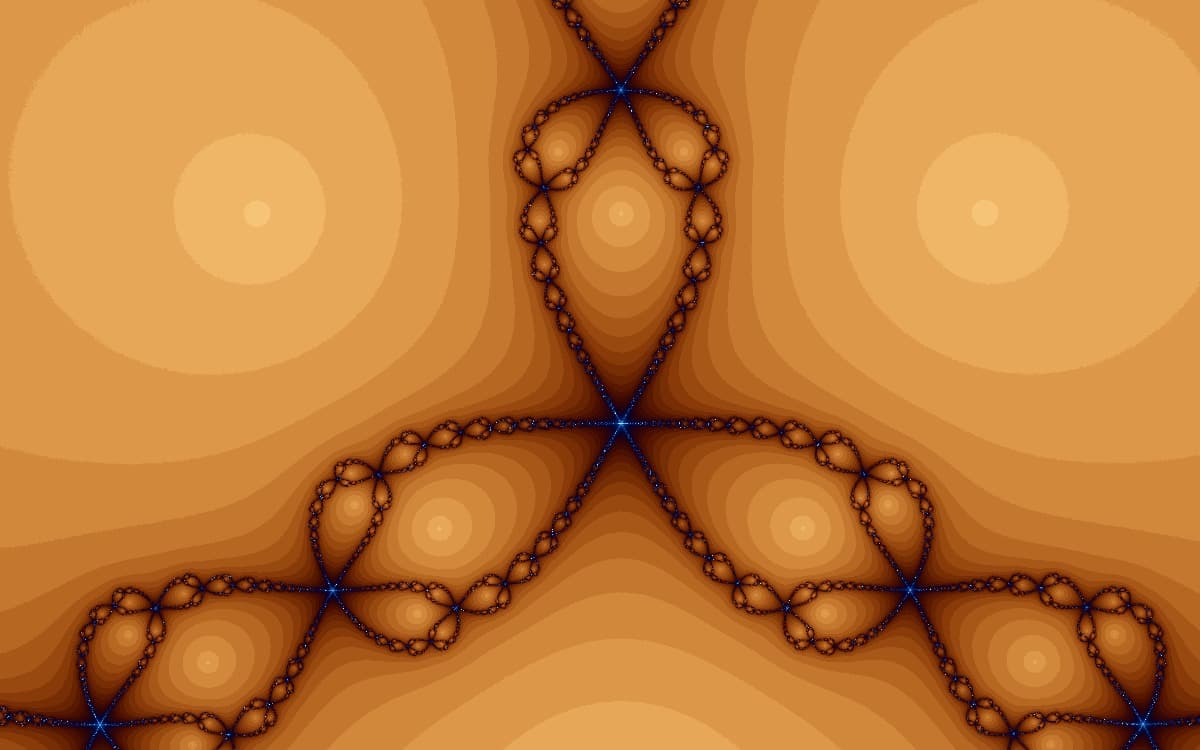
This is a degree‑2 rational map of the Riemann sphere. Its fixed points are exactly the three cube roots of unity, and they are all superattracting—once an orbit is close enough to a root, convergence is extremely fast. The Julia set is the boundary where basins meet, and the map is chaotic there.
Try a concrete starting point: z₀ = 0.5. Then z₁ = (2·0.125 + 1) / (3·0.25) = (0.25 + 1) / 0.75 ≈ 1.667, z₂ ≈ 1.107, z₃ ≈ 1.001, and the orbit rapidly converges to the root at 1. Now try z₀ = 0.5i: z₁ ≈ −0.417 + 0.583i, z₂ ≈ −0.495 + 0.865i, and the orbit converges to e^{2πi/3} = −0.5 + 0.866i. A third starting point, say z₀ = −0.5 − 0.5i, converges to the remaining root e^{4πi/3} = −0.5 − 0.866i. The basins are large and well separated, but close to a boundary a tiny nudge in the starting value can switch the destination entirely.
FractalPark uses a stability threshold: an orbit counts as converged when consecutive iterates differ by less than a chosen tolerance. The pixel is then coloured by the root reached and the number of steps needed.