FractalPark
NewtonMedia

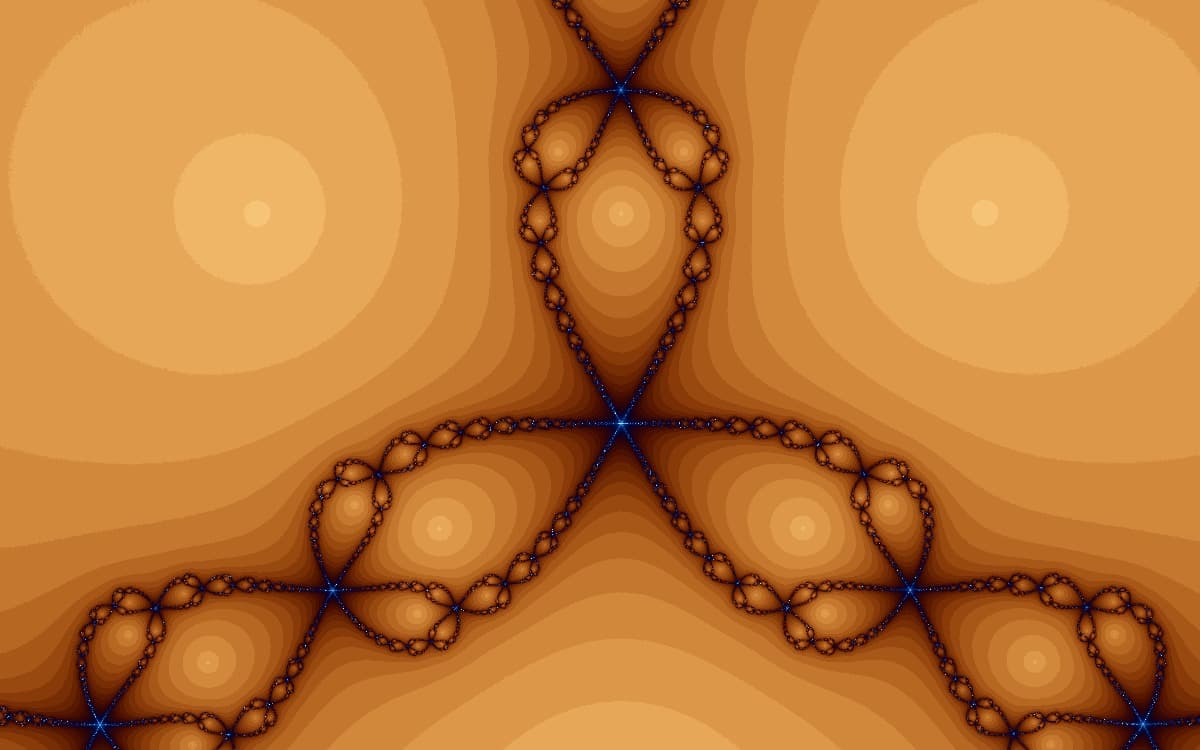
Newton Fractal for z³ − 1

El método de Newton para z³ − 1: tres cuencas de convergencia divididas por una frontera que nunca se asienta.

Abrir en Explorar
Fractal de Newton para z³ − 1: tres cuencas se encuentran a lo largo de líneas tipo rayos de rueda con detalle espiral en la frontera
El fractal de Newton de FractalPark para z³ − 1: tres cuencas de convergencia en simetría tripartita, unidas por bordes espirales anidados.

Resumen

Esta fórmula convierte un algoritmo conocido de búsqueda de raíces en un mapa del plano complejo. A diferencia del conjunto de Mandelbrot, no pregunta si una órbita escapa. Pregunta a cuál raíz de z³ − 1 llega el método de Newton desde un punto de partida dado. Las tres raíces cúbicas de la unidad (1, e^{2πi/3}, e^{4πi/3}) reclaman cada una su cuenca de atracción: todos los valores iniciales cuya órbita converge a esa raíz.

Las tres cuencas son fáciles de distinguir. Su frontera compartida no. Un punto exactamente sobre ella no llega a ninguna raíz; sigue un camino caótico que no se repite. Esta frontera es el conjunto de Julia del mapa de Newton —la función racional N(z) = z − (z³ − 1)/(3z²). Acércate y sigue apareciendo más estructura.

Es un fractal de convergencia clásico: un algoritmo numérico cotidiano con una frontera inquieta en su interior. Arthur Cayley planteó el problema de clasificación de las cuencas de Newton en 1879. Resolvió el caso cuadrático, pero el cúbico «parece presentar una dificultad considerable». La dinámica compleja posterior de Fatou y Julia hizo legible el problema; las primeras visualizaciones por computadora llegaron a principios de los años ochenta.

Las matemáticas

Newton iteration

z(n+1) = z(n) - (z(n)^3 - 1) / (3 z(n)^2)

For a function f(z), Newton iteration is N(z) = z − f(z) / f′(z). Here f(z) = z³ − 1 and f′(z) = 3z². Each step subtracts the polynomial value divided by its derivative, nudging z toward a root. For the cubic z³ − 1, the iteration simplifies to:

N(z) = z − (z³ − 1) / (3z²) = (2z³ + 1) / (3z²).

This is a degree‑2 rational map of the Riemann sphere. Its fixed points are exactly the three cube roots of unity, and they are all superattracting—once an orbit is close enough to a root, convergence is extremely fast. The Julia set is the boundary where basins meet, and the map is chaotic there.

Try a concrete starting point: z₀ = 0.5. Then z₁ = (2·0.125 + 1) / (3·0.25) = (0.25 + 1) / 0.75 ≈ 1.667, z₂ ≈ 1.107, z₃ ≈ 1.001, and the orbit rapidly converges to the root at 1. Now try z₀ = 0.5i: z₁ ≈ −0.417 + 0.583i, z₂ ≈ −0.495 + 0.865i, and the orbit converges to e^{2πi/3} = −0.5 + 0.866i. A third starting point, say z₀ = −0.5 − 0.5i, converges to the remaining root e^{4πi/3} = −0.5 − 0.866i. The basins are large and well separated, but close to a boundary a tiny nudge in the starting value can switch the destination entirely.

FractalPark uses a stability threshold: an orbit counts as converged when consecutive iterates differ by less than a chosen tolerance. The pixel is then coloured by the root reached and the number of steps needed.
Historia

At the heart of this image is Newton's method, discovered by Isaac Newton in 1669 and independently refined by Joseph Raphson in 1690. For real functions it is a practical root‑finding tool; for complex polynomials it reveals fractal basins no one could have foreseen at the time.

The mathematical study of those basins began in 1879 with Arthur Cayley's paper "The Newton–Fourier imaginary problem" (American Journal of Mathematics, vol. 2, p. 97). For a complex quadratic polynomial, Cayley showed that the basins of attraction are simply the two half-planes separated by the perpendicular bisector of the line segment joining the two roots. At cubic polynomials, though, he found the problem "considerable difficult." His inability to extend the simple quadratic result to the cubic case became known as Cayley's problem.

The resolution came through complex dynamics, developed by Pierre Fatou and Gaston Julia in the years around 1918. Their theory of iterated rational functions supplied the language for the basins and their infinitely convoluted boundaries. But the first pictures of the Newton fractal for z³ − 1 had to wait for computer graphics in the early 1980s.

In 1986, Heinz-Otto Peitgen and Peter H. Richter included a chapter titled "Newton's Method for Complex Polynomials: Cayley's Problem" (Chapter 6, pp. 93–106) in *The Beauty of Fractals: Images of Complex Dynamical Systems*. It presents some of the earliest published computer renderings of these basins and helped introduce a wide audience to the fractal structure hidden inside Newton's method.

Características visuales

Three large basins, one for each cube root of unity, occupy the image. They meet in wheel-spoke lines from the centre, making the three-part symmetry plain. Inside each basin, convergence is quick and the colour stays smooth.

Between any two basins—and especially at the central three-way meeting—spirals, miniature three-basin copies, and dendritic threads crowd in. Follow a spiral arm inward: the three-basin arrangement returns at smaller scales, bent by local dynamics. Broad calm regions; then a restless frontier.

Remix y ejemplos

Empieza desde el Documento canónico

Abre el mismo estado de fórmula aprobado que usa esta guía y luego cambia la vista, la coloración, las transformaciones o la animación en el Explorar interactivo.

Preguntas frecuentes

What do the main regions represent?

Each coloured region is a basin of attraction: it contains the starting points whose Newton iteration converges to the same root of z³ − 1. The three cube roots of unity are 1, e^{2πi/3} = −0.5 + 0.866i, and e^{4πi/3} = −0.5 − 0.866i. A point’s colour records the root it reaches and how quickly convergence happens.

Is this an escape-time fractal?

It is primarily a convergence fractal. The classification is not about whether the orbit escapes to infinity (as in the Mandelbrot set), but which root it approaches and how many steps it takes. There is no escape-radius test. Instead, the renderer checks whether consecutive iterates have become very close—indicating convergence to a root—and, if so, which root they are near.

Referencias

Recorrido por el código fuente

  1. frm-v1:5e3522c53ca358df8d61d5a3b82aa0b90ff8009602b1952fb5022027f00fdd45:init/0

    En newton3, este nodo ejecuta z = pixel.

  2. frm-v1:5e3522c53ca358df8d61d5a3b82aa0b90ff8009602b1952fb5022027f00fdd45:loop/0

    En newton3, este nodo ejecuta z2 = z * z.

  3. frm-v1:5e3522c53ca358df8d61d5a3b82aa0b90ff8009602b1952fb5022027f00fdd45:loop/4

    En newton3, este nodo ejecuta z = numerator / denominator.

  4. frm-v1:5e3522c53ca358df8d61d5a3b82aa0b90ff8009602b1952fb5022027f00fdd45:bailout

    En newton3, este nodo ejecuta |z - zPrev| >= 0.000001.

Características de sintaxis

state-flow

El flujo de estado concreto es: z comienza como pixel; después, z2 y z3 alimentan numerator / denominator.

stopping-test

La prueba de parada solo evalúa |z - zPrev| >= 0.000001; no asigna el estado.

Experimento de parámetros

Pasos

  1. Con los demás controles del perfil fijos, ejecuta newton3 con 48 iteraciones.
  2. Después usa las 96 iteraciones del perfil fijado y anota si hay diferencia.

Qué observar

Anota si z2 = z * z; z3 = z2 * z; numerator = 2 * z3 + 1; denominator = 3 * z2; z = numerator / denominator cambia el resultado visible o la prueba de parada |z - zPrev| >= 0.000001 frente a la línea base; la definición no garantiza una diferencia.

Ejercicio

Sigue las anotaciones de newton3 y explica cómo se ejecuta z2 = z * z; z3 = z2 * z; numerator = 2 * z3 + 1; denominator = 3 * z2; z = numerator / denominator en las operaciones señaladas.

Comprobación de finalización

Tu respuesta explica las 4 anotaciones, señala z2 = z * z; z3 = z2 * z; numerator = 2 * z3 + 1; denominator = 3 * z2; z = numerator / denominator y distingue |z - zPrev| >= 0.000001 como prueba de parada, no como asignación.

Pista

El flujo de estado ejecuta z = pixel → z2 = z * z → z3 = z2 * z → numerator = 2 * z3 + 1 → denominator = 3 * z2 → z = numerator / denominator en secuencia y entrega el resultado al paso siguiente.

Fuentes y derechos

Fuente: definición de ejecución fijada y decisión de publicación.

La información de derechos sigue la decisión fijada en la unidad en inglés.

Registro de la fórmula

newton3

Esta implementación canónica de FractalPark está publicada y se puede ejecutar.

Vista previa determinista de newton3

Código fuente canónico

Lenguaje
frm-like/1
Biblioteca estándar
1
Modo del perfil
parameter-plane
Centro del perfil
0, 0
Zoom del perfil
0.35
Iteraciones del perfil
96
Evidencia del perfil
family

Parámetros

No hay parámetros declarados

Código fuente canónico

Esta revisión canónica verificada es de solo lectura. Remix crea una bifurcación editable independiente.

Cargando código canónico…

Fuente e implementación

ID de fórmula
dd052c9f-868f-5516-9af0-3f4e78ac7a13
Nombre canónico
newton3
Nombre original
newton3
Fuente histórica
FractalPark
Implementación actual
Propiedad del proyecto

Esta es una implementación propia del proyecto FractalPark. El archivo enlazado es la Definition canónica fijada.

¿Problemas de derechos o atribución?

Envía el ID de la fórmula y las pruebas. El mantenedor puede retener o retirar la implementación mientras revisa la reclamación. contact@fractalpark.com