FractalPark
ClásicaMedia

Mandelbox

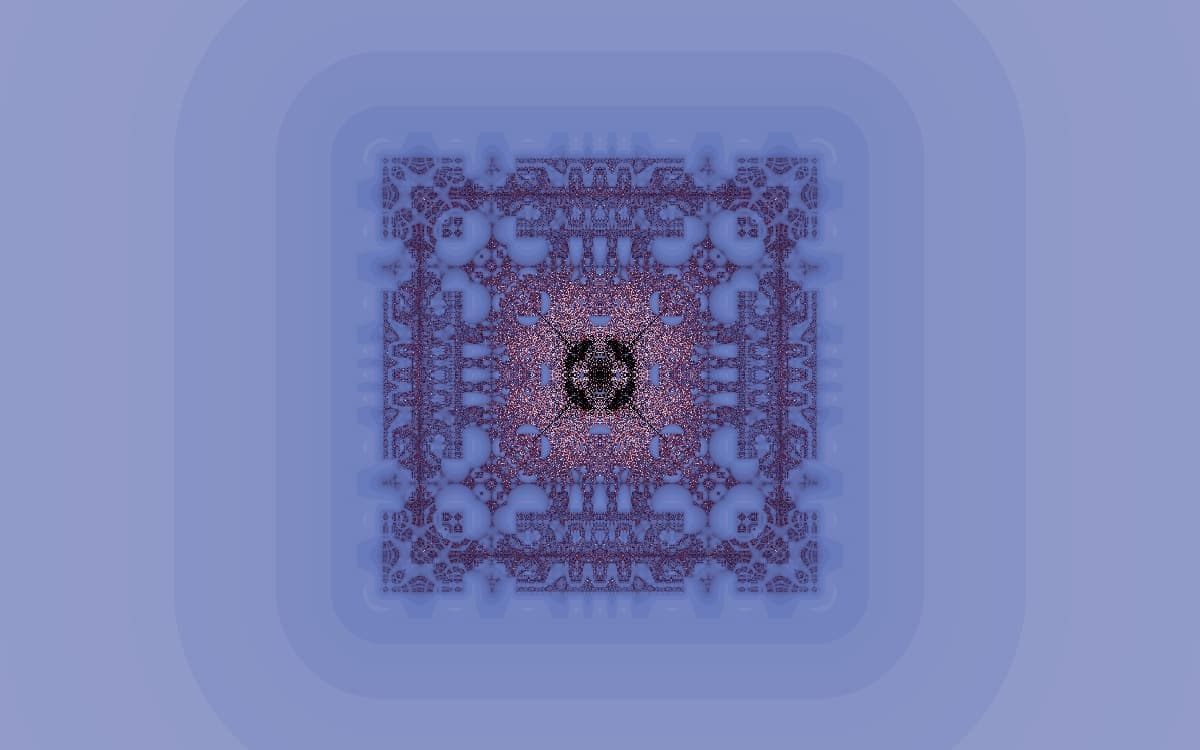
Un mapa de pliegue y escala inspirado en el Mandelbox de Tom Lowe de 2010: reflexiones de caja, pliegue radial y escala convierten una iteración en habitaciones y muros.

Abrir en Explorar
Mapa Mandelbox bidimensional con cámaras de bordes duros y recovecos anidados tipo fortaleza en azules fríos
El mapa inspirado en Mandelbox de FractalPark: muros rectos, esquinas en ángulo recto y recovecos en capas como el interior de una fortaleza cristalina.

Resumen

La mayoría de las fórmulas fractales empiezan elevando al cuadrado, como en z² + c. El Mandelbox toma otra ruta: un pliegue de caja manda las coordenadas que están fuera de un cubo fijo de regreso hacia sus caras; luego un pliegue radial, o de bola, invierte o escala un punto según su distancia al origen; y una escala uniforme estira o comprime el resultado antes de sumar c. Repite la secuencia y los pliegues —no la elevación al cuadrado— construyen la estructura.

Las reflexiones y las inversiones no exigen un número particular de dimensiones, así que la construcción se puede hacer en cualquiera de ellas. FractalPark dibuja una variante bidimensional que conserva el mismo núcleo de pliegue y escala en el plano complejo.

Este mapa de parámetros no se suaviza en las curvas típicas de los polinomios. Corta cámaras de bordes duros, fortificaciones anidadas y pasajes que parecen sacados de un plano. Su frontera divide las órbitas acotadas —las que se quedan al alcance— de las que escapan. Acércate y el borde dentado y autosimilar trae de vuelta el motivo de la caja a menor escala.

Las matemáticas

Fold-and-scale iteration

z(n+1) = scale times ballFold(boxFold(z(n))) + c

Each round puts the orbit through four moves: box fold, radial fold, scale, then a shift by c.

The box fold handles one coordinate at a time. Take a component a of z. Above 1, it reflects as a → 2 − a; below −1, as a → −2 − a. Components in [−1, 1] stay put. The outer plane folds back into the central square.

Next comes the ball fold, checking the squared magnitude r² = |z|². If r² < 0.25 (|z| < 0.5), scale the point by 4 and push it away from the origin. If 0.25 ≤ r² < 1, invert it through the unit sphere: z → z/r², so a radius of m becomes 1/m. Points with r² ≥ 1 stay put. The near points move outward; the middle band turns across the unit sphere. These moves make the unsettled interface behind the Mandelbox's boxy layers.

Try z₀ = (1.5, 0) with scale s = 2. The box fold reflects x = 1.5 to x = 0.5. Since r² = 0.25 falls in the middle band, the ball fold inverts it: z = z/r² = (2, 0). Scaling by 2 gives (4, 0), and adding c completes the step. Start at the origin instead and you are in the innermost band: the ball fold multiplies it by 4—still the origin—so the first iterate lands exactly on c.
Historia

The Mandelbox was first presented by Tom Lowe (known online as Tglad) in early 2010 on the FractalForums community. Lowe was experimenting with iterative folding operations in three dimensions — box reflections and spherical inversions — to see whether they could produce bounded, self‑similar structures analogous to the Mandelbrot set. The results were immediately recognised as a new class of fractal, and the name "Mandelbox" was adopted both as an homage to the Mandelbrot set and because of the boxlike shape of the set when visualised.

The discovery followed closely on the 2009 Mandelbulb by Daniel White and Paul Nylander, which had sparked renewed hobbyist interest in finding non‑trivial 3D fractals. Within months, contributors on FractalForums — including Knighty, Jesse, and others — extended the Mandelbox idea to different symmetry planes and polyhedral folds.

Despite its popularity in fractal art software (Mandelbulber, Mandelbulb3D, Fragmentarium, Ultra Fractal), the Mandelbox has received relatively little formal mathematical analysis. One of the few peer‑reviewed treatments is Gregg Helt's 2018 Bridges Conference paper, which generalises the spherical inversion step to arbitrary shape inversions.

Características visuales

Repeated folds produce hard-edged chambers, nested fortifications, and corridors with depth. The default parameter s = 2 gives the structure straight walls, right-angle corners, and layered recesses like the inside of a crystalline fortress.

At finer scales, the box theme returns: small copies of the overall shape appear in recesses and along boundaries, all with the same rectilinear geometry. The canonical image uses cool blues and cyans, which suit the mechanical geometry of the folds.

Parámetros

Escala
Scale sets how strongly the folded orbit expands or reverses before c is added. A scale of 2 (the default) roughly doubles the folded value; negative values reverse direction and produce mirror-image variations.

Remix y ejemplos

Empieza desde el Documento canónico

Abre el mismo estado de fórmula aprobado que usa esta guía y luego cambia la vista, la coloración, las transformaciones o la animación en el Explorar interactivo.

Preguntas frecuentes

What are box and ball folds?

A box fold reflects coordinates outside a fixed interval toward the origin—like folding a sheet’s edges inward. A ball fold (or sphere fold) makes a conditional inversion: points too close to the origin are pushed outward, points at an intermediate distance invert through a sphere, and distant points remain unchanged. Together they redirect the orbit at every step and make the Mandelbox’s layered geometry.

Is this the three‑dimensional Mandelbox?

No. FractalPark renders a two-dimensional map inspired by the same fold-and-scale construction. The original Mandelbox is most often explored in 3D, where the box fold reflects across a cube’s faces; here the same logic works in the complex plane with a square boundary.

Referencias