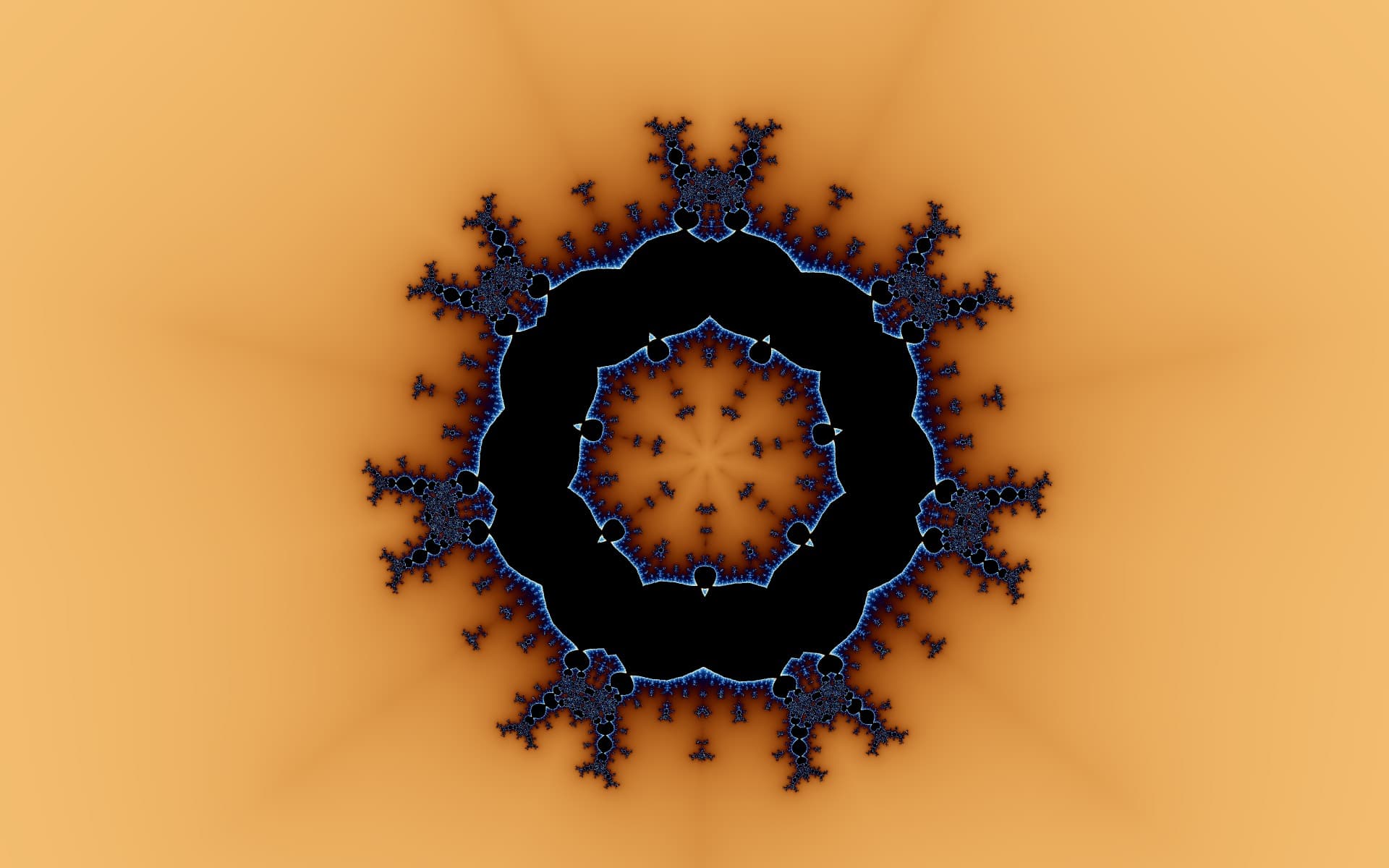
Component-folded iteration
z(n+1) is the component-wise absolute value of z(n)^2 + c
Here the bars mean component-wise absolute value, not complex magnitude. For u = x + iy, |u| means |x| + i|y|: take the absolute value of each part. Picture folding the point into the first quadrant.
Try c = −0.5 + 0i. In the standard Mandelbrot iteration, z₀ = 0 produces z₁ = −0.5, z₂ = −0.25, z₃ ≈ −0.4375, and so on, converging to a fixed point. Zubieta folds those same values: after one step, |−0.5| = 0.5, so z₁ is 0.5 rather than −0.5. One small fold redirects the orbit—and changes how c is classified.
The escape threshold comes from the quadratic Mandelbrot test: once |zₙ| exceeds 2, divergence is guaranteed. The component-wise fold can keep some orbits bounded longer than the unfolded rule would.