FractalPark
NewtonDifficile

Newton Cosh

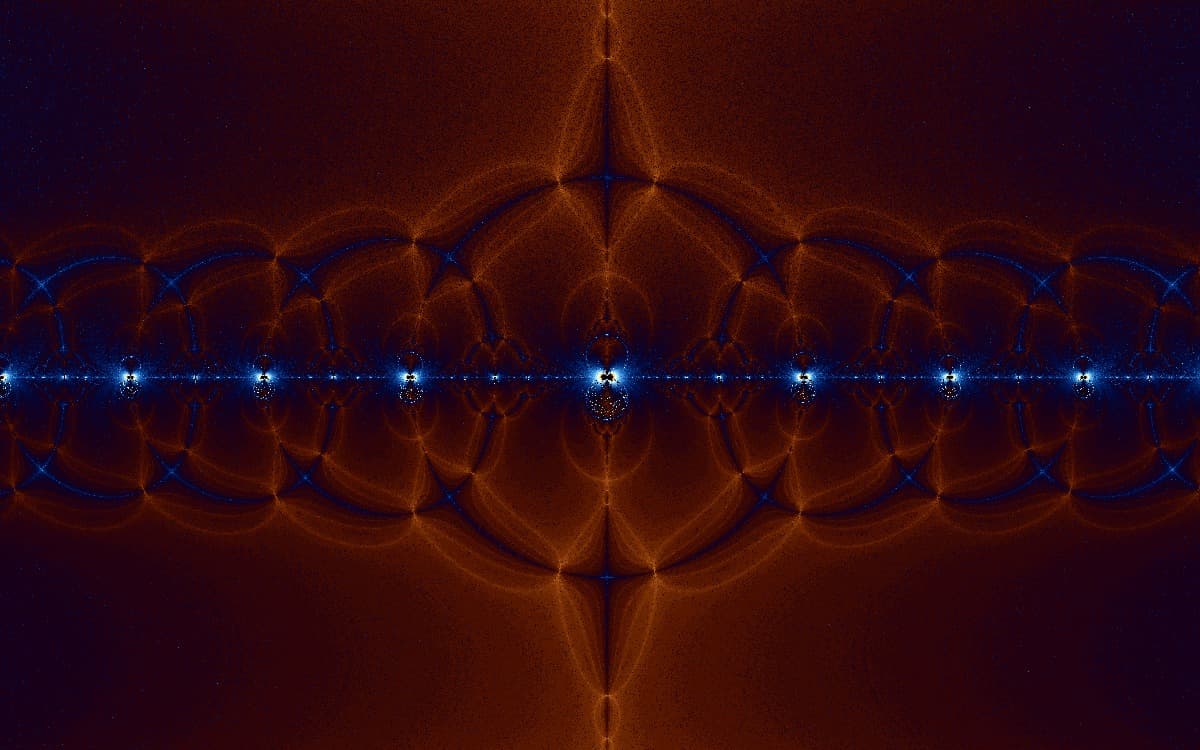
La méthode de Newton appliquée à cosh z = 1 : une infinité de racines régulièrement espacées transforme le plan en bandes de convergence répétées.

Ouvrir dans l'Explorateur
Fractale de Newton pour cosh z = 1, avec des bandes horizontales répétées et des frontières déformées empilées le long de l'axe imaginaire
La vue Newton de cosh z = 1 par FractalPark : bandes de convergence répétées le long de l'axe imaginaire, séparées par des bordures pliées et filiformes.

Vue d'ensemble

L'étape habituelle de recherche de racines de Newton change de caractère quand f(z) = cosh z − 1. Ses racines sont 2πik pour tout entier k. Un polynôme ne donne à une orbite qu'un nombre fini de destinations possibles ; ces racines, elles, continuent de défiler le long de l'axe imaginaire à intervalles égaux. La fractale s'organise donc en bandes qui montent et descendent, plutôt que de se fixer en quelques bassins.

L'application N(z) = z − (cosh z − 1) / sinh z est méromorphe : elle fonctionne dans tout le plan complexe, sauf à ses singularités. Garde un œil sur deux séries de points qui se répètent : les racines de cosh z − 1 et les zéros de son dénominateur sinh z en z = πik pour k entier. Près d'un zéro du dénominateur, déplacer légèrement le point de départ peut changer la racine atteinte par l'orbite.

Tu vois la périodicité le long de l'axe imaginaire d'un coup d'œil — aucun bagage mathématique requis. Les bandes horizontales se répètent les unes au-dessus des autres, une par période des racines. À leurs jonctions, de fins fils verticaux enregistrent l'endroit où un bassin passe l'orbite au suivant.

Les mathématiques

Newton’s cosh iteration

z(n+1) = z(n) - (cosh(z(n)) - 1) / sinh(z(n))

Newton's rule is N(z) = z − f(z) / f′(z). Here f(z) = cosh z − 1 and f′(z) = sinh z. Each step finds the correction (cosh z − 1) / sinh z, then takes it away from z.

The equation cosh z = 1 has infinitely many solutions: z = 2πik for every integer k. Each is a simple root: cosh z grows linearly close by, so Newton's method converges quadratically there. Far from the real axis, cosh and sinh grow exponentially. Their quotient may be tiny or enormous, and that is where the image's sensitive seams take shape.

Try z₀ = 0.2i. Since i·sinh(0.2) ≈ 0.201i and cosh(0.2) ≈ 1.020, the first correction is small; the orbit quickly reaches the root at z = 0. Now move to z₀ = (0.5 + 3.0i), farther from every root. The correction now contains large exponential terms. The orbit can cross several basin boundaries before settling, or wander chaotically between roots for many iterations before one captures it.

The function repeats with period 2πi in the imaginary direction, and the Newton map does too: N(z + 2πi) = N(z) + 2πi. That repeated rule is the source of the horizontal banding.
Caractéristiques visuelles

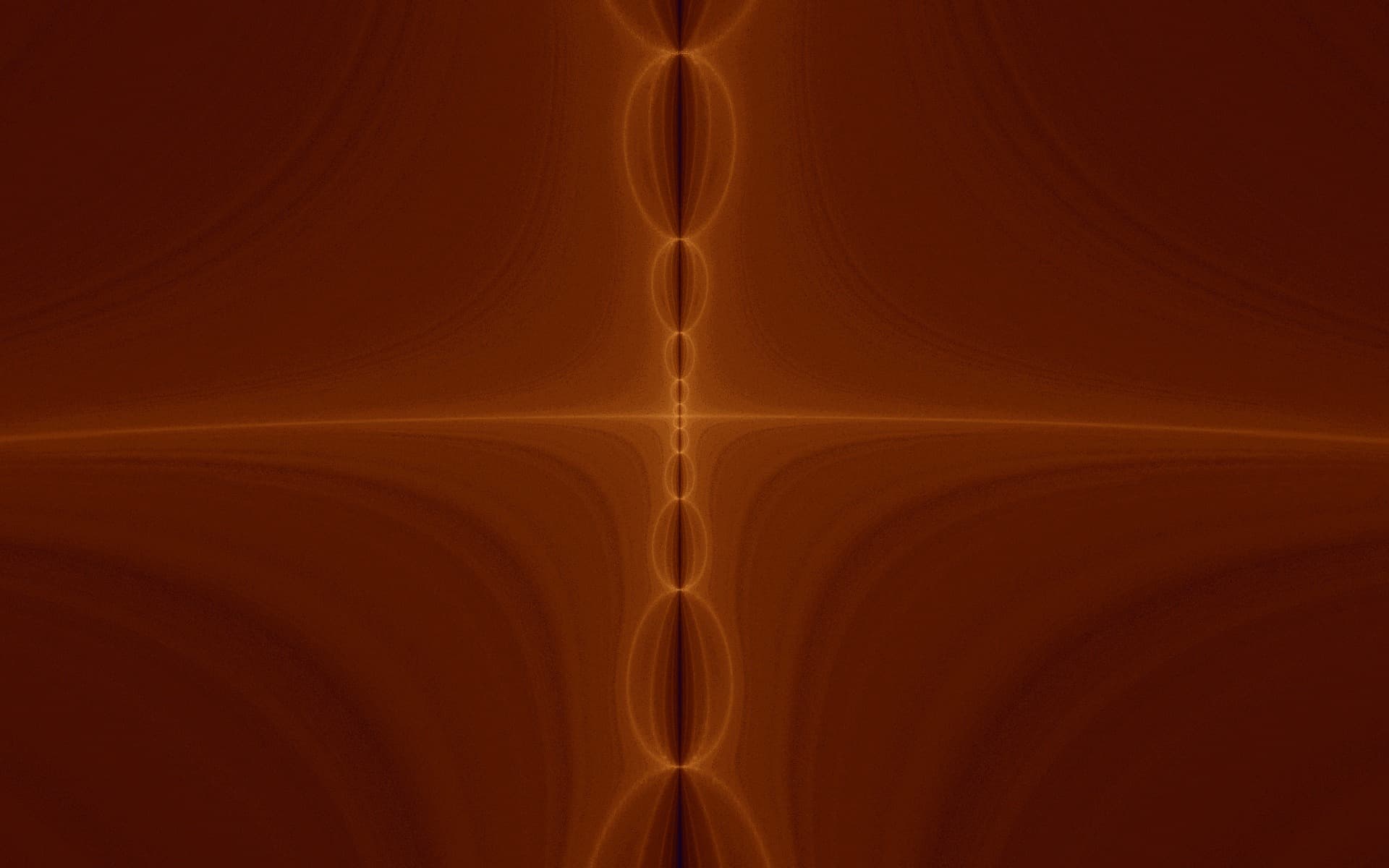
Start with the horizontal bands along the imaginary axis. A period of roots makes one band, and the convergence pattern returns in the next. The borders do not run straight: they bend and fold, then pull out fine vertical filaments like taut threads.

Within each band, the basin geometry resembles its neighbours, with small distortions. Think of a ribbon folded repeatedly. The warm and cool zones come from the colouring; the sharp breaks arise where singularities of sinh z destabilise the Newton correction.

Remix et exemples

Pars du Document canonique

Ouvre le même état de formule approuvé utilisé par ce guide, puis modifie la vue, la colorisation, les transformations ou l'animation dans l'Explorateur interactif.

Questions fréquentes

What equation is being solved?

It seeks the complex solutions of cosh(z) = 1: z = 2πik for every integer k. The equally spaced roots line the imaginary axis. Each draws in nearby Newton orbits, and their repeating arrangement creates the horizontal bands.

Why are some regions extremely sensitive?

The correction divides by sinh(z), which vanishes at z = πik for integer k. Close to one of these points, the correction can become huge, sending an orbit across several basin boundaries before it converges. These singularities are not roots; they pull the fine vertical filaments and unsettled border zones into view.