FractalPark
TranscendantaleMoyen

Cosh Mandelbrot

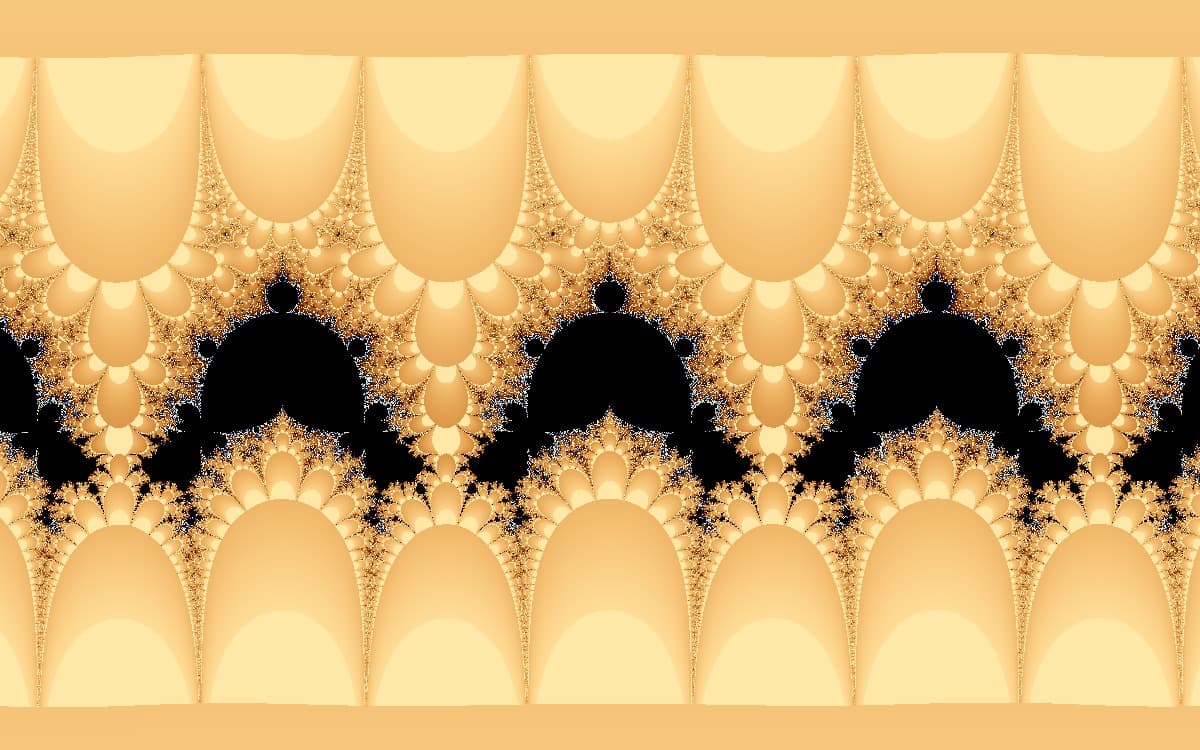
Une application transcendante à temps de fuite : le cosinus hyperbolique remplace la mise au carré, et des panaches répétés verticalement et des éventails en couches prennent sa place.

Ouvrir dans l'Explorateur
Panaches dorés et éventails en couches se répétant à intervalles verticaux réguliers dans la fractale Cosh Mandelbrot
Le Cosh Mandelbrot de FractalPark : panaches dorés et éventails en couches reviennent verticalement avec la période 2π de cosh dans la direction imaginaire.

Vue d'ensemble

Cosh Mandelbrot laisse derrière lui l'étape polynomiale familière. Au lieu de répéter z² + c, il répète z → cosh(z) + c. La mise au carré est remplacée par la croissance exponentielle du cosinus hyperbolique le long de l'axe réel et sa répétition de période 2π le long de l'axe imaginaire.

Le cosinus complexe et le cosinus hyperbolique sont proches parents : chacun se répète dans une direction et croît sans limite dans une autre. Pour cosh(z), la période sur l'axe imaginaire est 2π, si bien qu'une bande de détail revient au-dessus et en dessous d'elle-même. Quand |Re(z)| est grand, ses termes exponentiels filent vers l'extérieur. La plupart des points de départ s'échappent vite ; seules de minces bandes retiennent une orbite — gardant ses valeurs successives bornées pendant de nombreuses étapes.

Le plan des paramètres ne ressemble plus au cardioïde et aux bulbes de l'ensemble de Mandelbrot. Il empile des éventails, des panaches dorés et des échos verticaux. Sa ligne entre fuite et non-fuite est tracée par l'itération transcendante elle-même ; aucun rayon de fuite algébrique simple n'est disponible.

Les mathématiques

Hyperbolic cosine iteration

z(n+1) = cosh(z(n)) + c

Each turn evaluates complex hyperbolic cosine at the current z, then adds c. The definition cosh(z) = (eᶻ + e⁻ᶻ)/2 puts exponential growth on the real axis beside imaginary-axis repetition with period 2π.

Try z = iπ/2 on the imaginary axis. Since cosh(iπ/2) = cos(π/2) = 0, starting there with c = 0 leaves the recurrence at zero. Nudge the point off that axis and the eᶻ term can drive exponential growth and rapid escape. That sharp divide—bounded behavior in a narrow strip, rapid escape elsewhere—is typical of transcendental iteration. Unlike a polynomial, this map has no universal escape radius; FractalPark uses a bailout threshold chosen to detect divergence in practice.

Histoire

In 1988, Clifford A. Pickover, a computer scientist and author at IBM's Thomas J. Watson Research Center, published the short paper "Chaotic behavior of the transcendental mapping (Z → cosh(Z) + μ)" in The Visual Computer. He presented images of chaotic behavior produced by this transcendental function, alongside maps such as z → sin(z) + c and z → eᶻ + c.

Pickover’s work brought the cosh-based map into the fractal-rendering community, where it became a standard transcendental escape-time example. Earlier, mathematicians including Robert Devaney and Michał Krych had developed the broader study of transcendental complex dynamics—exponential, trigonometric, and hyperbolic families—and analyzed the dynamics of exp(z) in the 1980s.

Caractéristiques visuelles

First notice the vertical repetition. Because cosh(z) repeats in the imaginary direction every 2π, fine plumes, layered fans, and gilt filaments return at regular intervals. The result is striped and tiered, far from the radial branching of polynomial Mandelbrot sets.

In the canonical rendering, plumes and fans often carry warm tones. The finest detail concentrates in narrow horizontal bands, where an orbit lingers near the boundary between escape and non-escape. Above and below, escape accelerates and the image becomes smoother.

Remix et exemples

Pars du Document canonique

Ouvre le même état de formule approuvé utilisé par ce guide, puis modifie la vue, la colorisation, les transformations ou l'animation dans l'Explorateur interactif.

Questions fréquentes

Why do patterns repeat vertically?

Complex hyperbolic cosine repeats along the imaginary axis with period 2π. Because every step uses cosh(z), the orbit structure repeats too: bounded and escaping behavior returns at regular vertical intervals in the parameter plane.

Why do many points escape rapidly?

Hyperbolic cosine is built from exponentials: cosh(z) = (eᶻ + e⁻ᶻ)/2. At a point with a substantial real part, the eᶻ term takes over and the orbit can grow extremely fast. There is no simple polynomial-style escape radius, so the bailout threshold is a practical computational choice.

Références