FractalPark
ClassiqueFacile

Lambda Fractal

Une application logistique complexe centrée : un seul paramètre étire une orbite et la replie sur elle-même.

Ouvrir dans l'Explorateur
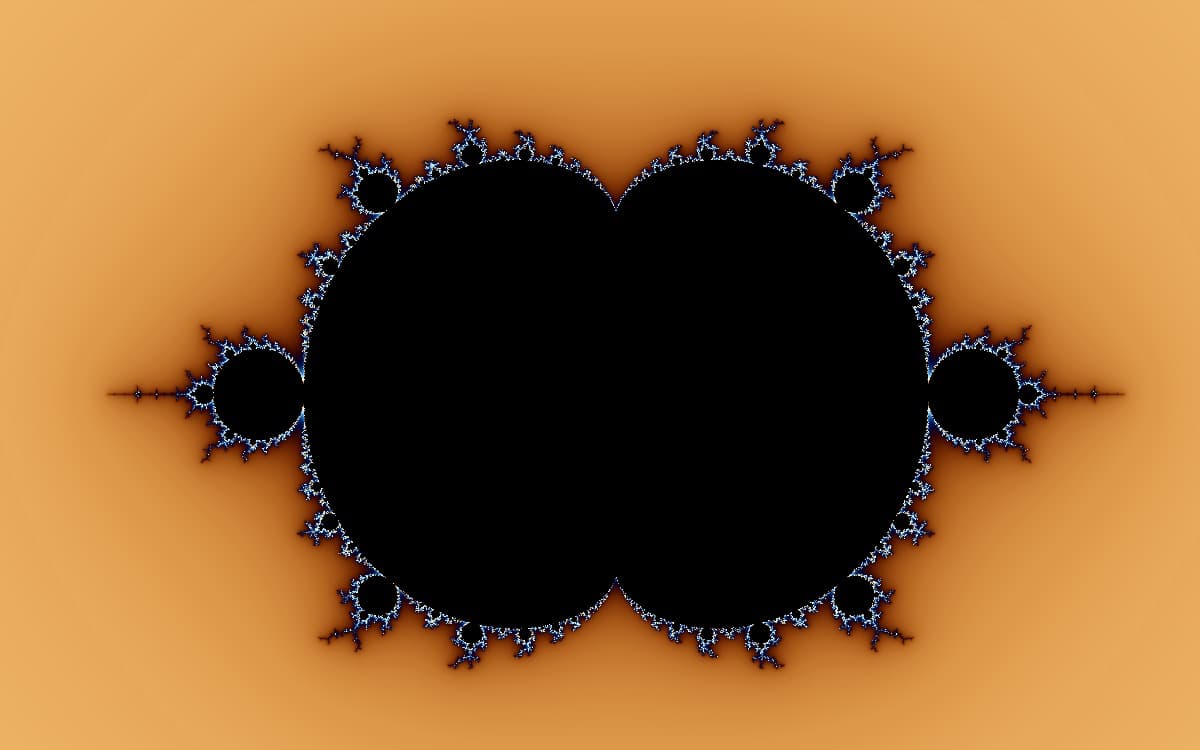
Ensemble Lambda noir sur fond bleu-vert, son bord laissant traîner des filaments ramifiés
Le plan des paramètres de l'application logistique complexe centrée : un cœur en forme de disque, des bulbes attachés et un bord filiforme.

Vue d'ensemble

Sur la droite réelle, l'application logistique est devenue un petit laboratoire du chaos. Laisse ses valeurs errer dans le plan complexe et elle s'ouvre sur la fractale Lambda, ou fractale λ. FractalPark utilise une forme centrée : c met à l'échelle deux facteurs complémentaires qui tirent dans des directions opposées.

Un changement de coordonnées affine rend cette formule conjuguée à l'application quadratique standard z² + c. Elle partage les traits de famille de l'ensemble de Mandelbrot, mais pas son contour : ici, un disque occupe la place du cardioïde, et les bulbes attachés s'organisent selon leurs propres périodes.

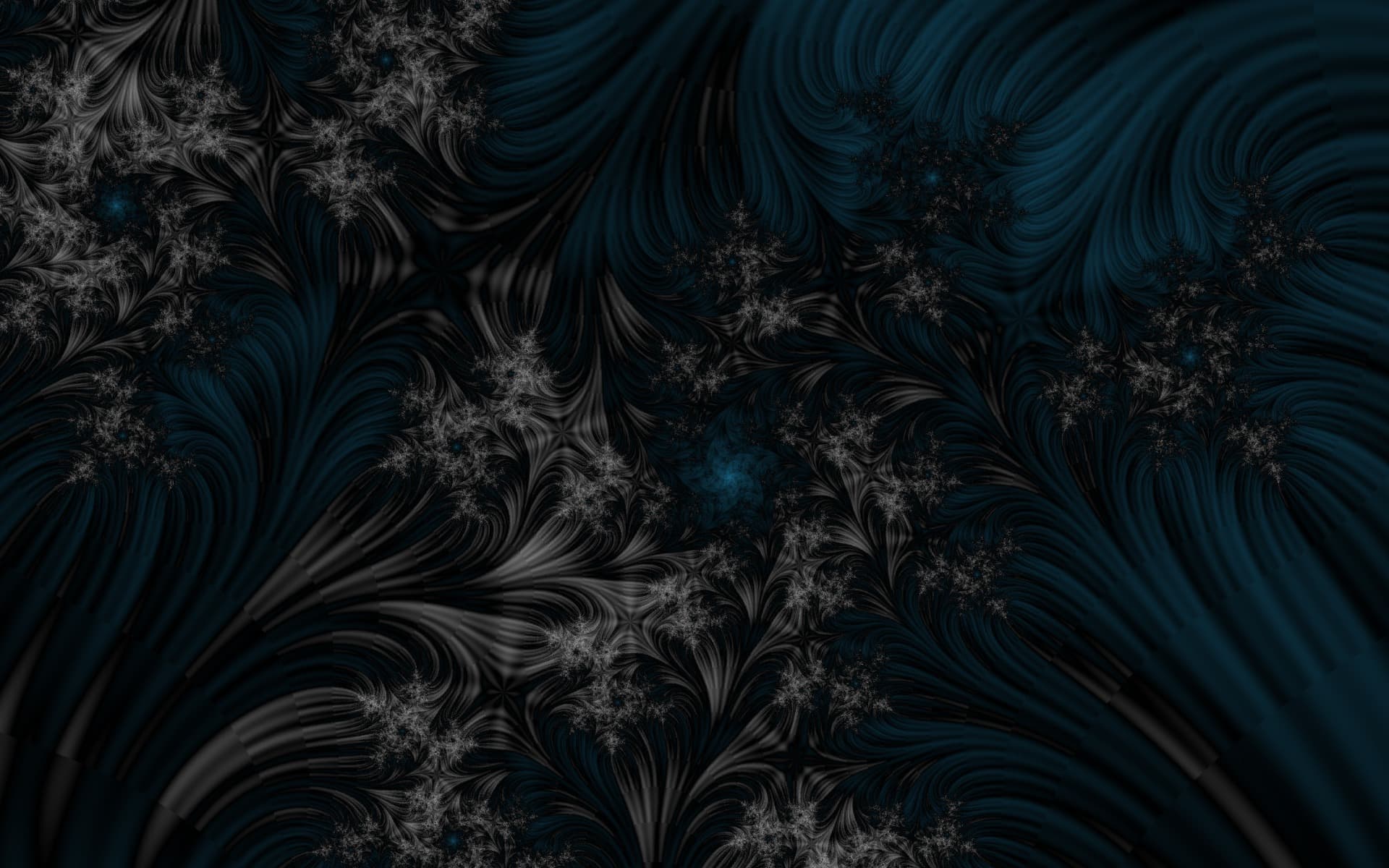
Ici, c tourne deux boutons à la fois — croissance et rotation. Fixe-le pour une vue de Julia, puis pousse-le doucement : un bassin presque rond peut devenir une frontière de branches et de spirales.

Les mathématiques

Complex logistic iteration

z(n+1) = c times (z(n) + 1/2) times (1/2 - z(n))

At each step, shift the current value halfway either side of center, multiply (z + ½) by (½ − z), then scale the product with c. The two factors make ¼ − z², so the same step reads z → c(¼ − z²).

Try c = 2 with z₀ = 0. The first step is z₁ = 2 × (½) × (½) = 0.5; the next is z₂ = 2 × 1.0 × 0 = 0. The orbit now shuttles between 0 and 0.5: a stable 2-cycle. Turn c up to 4 and the pull changes: z₁ = 4 × ½ × ½ = 1, then z₂ = 4 × 1.5 × (−0.5) = −3. The orbit diverges, so c = 4 lies outside the bounded set. In Julia mode, hold c still and vary z₀ across the image; the dividing line between trapped and escaping appears.

Histoire

The map z → λz(1 − z) began as the complex extension of the real logistic map, studied extensively in the 1970s as a simple model of population dynamics and chaotic behavior. In 1980, Benoit B. Mandelbrot took the iteration to unrestricted complex λ and z. His paper, "Fractal Aspects of the Iteration of z → λz(1−z) for Complex λ and z," introduced the λ-plane parameter set—now the Lambda fractal—and placed it in the broader theory of iterated rational maps.

The groundwork was already there. Around 1917–1918, Pierre Fatou and Gaston Julia developed the general theory of iterated rational functions that later made families such as the logistic map available to explore. In 1986, Heinz-Otto Peitgen and Peter H. Richter brought the Lambda fractal to a wider audience in "The Beauty of Fractals," with some of the first widely seen computer-generated images of the set.

Caractéristiques visuelles

At full scale, the Lambda set begins with an almost circular body—the countershape to the Mandelbrot set’s heart-like cardioid. Smaller bulbs cling to the disk; each marks a stable periodic cycle, and the largest marks a period-2 cycle. Beyond them lie branching channels, tiny disk islands, and spirals.

The islands give away the difference: they are round here, not cardioid-shaped, because the algebra has changed. In Julia mode, c can select a filled disk or a many-armed vortex.

Remix et exemples

Pars du Document canonique

Ouvre le même état de formule approuvé utilisé par ce guide, puis modifie la vue, la colorisation, les transformations ou l'animation dans l'Explorateur interactif.

Questions fréquentes

What does lambda control?

The complex parameter c—often written λ in the literature—sets both the orbit’s growth rate and its rotation. Its magnitude controls the strength of expansion or contraction; its argument supplies the turn at each step.

Why does Julia mode look especially varied?

Fix c and the question shifts to the starting point: does it stay bounded or escape? With linear and quadratic terms in the same formula, the border may be a smooth closed curve or a heavily branched connected set. The chosen c decides what the renderer reveals.

Références