FractalPark
ClassiqueFacile

Mandelbrot Set

Une carte de la famille quadratique z² + c : choisis un point, démarre à zéro et regarde son orbite décider du résultat.

Ouvrir dans l'Explorateur
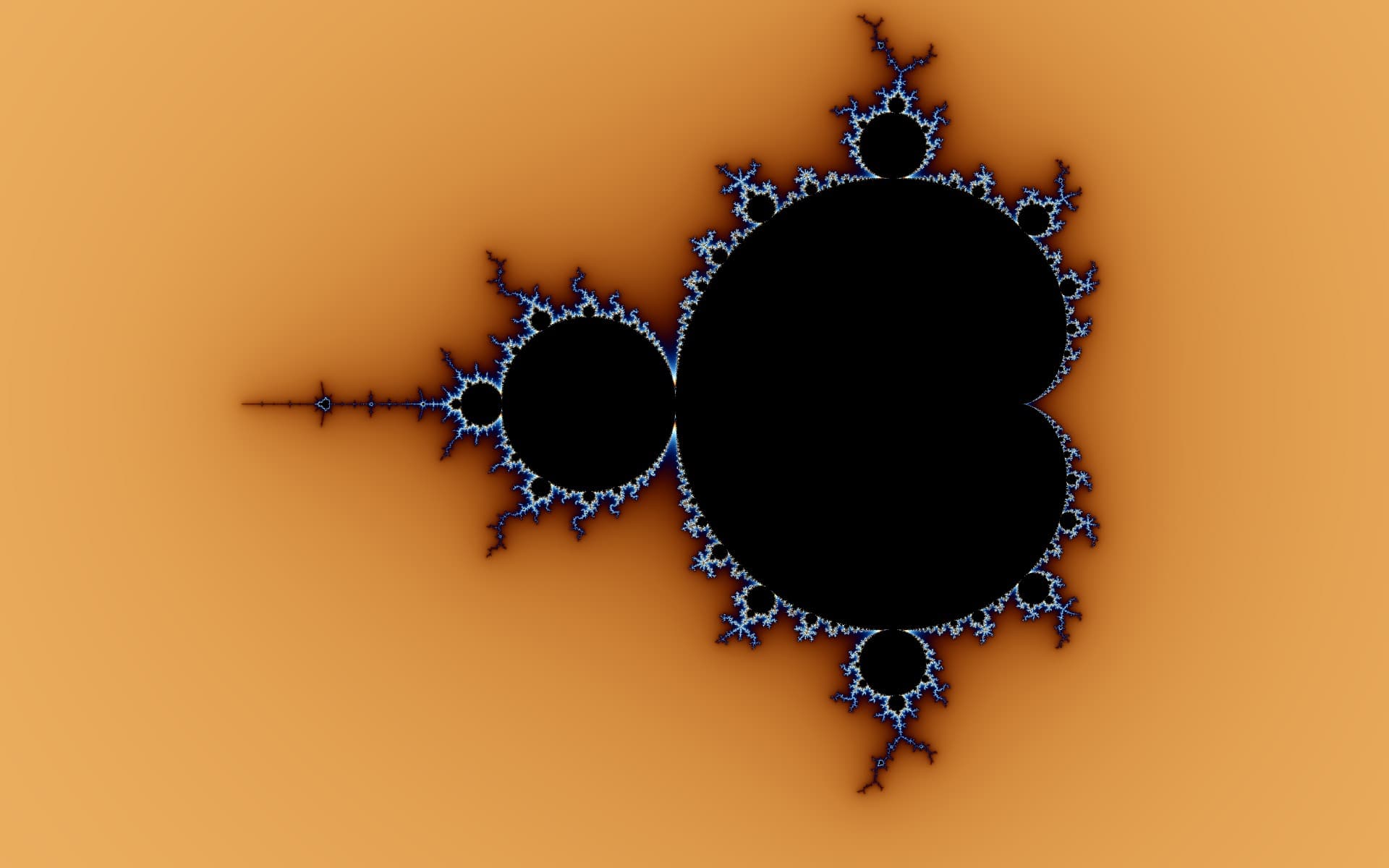
Ensemble de Mandelbrot noir sur fond or chaleureux, avec un fin liseré bleu-blanc à sa frontière
L'ensemble complet : un cardioïde principal, des bulbes attachés et un bord ramifié coloré selon le temps de fuite.

Vue d'ensemble

L'ensemble de Mandelbrot est une carte pour toute une famille, pas une simple courbe issue d'une équation. Choisis un point c dans le plan complexe. Commence à z = 0, élève au carré ce que tu as, ajoute c, et répète. L'orbite, c'est cette liste de valeurs qui défile. Certaines restent dans une zone finie ; d'autres filent vers l'infini. Les valeurs de c du premier groupe forment l'ensemble.

Il sert aussi d'index pour les ensembles de Julia quadratiques. Fixe un c et tu obtiens un ensemble de Julia ; il est connexe exactement quand c se trouve dans l'ensemble de Mandelbrot. Déplace-toi de quelques pixels dans le plan des paramètres et le comportement peut passer d'un cycle répétitif bien installé à une fuite.

Dans l'image familière, l'ensemble est généralement noir. La couleur qui l'entoure n'en fait pas partie : elle enregistre à quelle vitesse une orbite en fuite franchit le seuil choisi, comme des lignes de niveau tracées par le calcul.

Les mathématiques

Give one parameter its turn

z(n+1) = z(n)^2 + c, with z(0) = 0

Choose a complex number c, then keep it fixed. The orbit starts at z₀ = 0; each new value is the old one squared, with c added back in.

Try two anchors. If c = 0, the orbit stays at zero forever, so 0 belongs to the Mandelbrot set. If c = 1, it runs 0, 1, 2, 5, 26, … and escapes, so 1 is out. In this quadratic map, once the magnitude of z exceeds 2, there is no return: the orbit diverges. A renderer treats that as its escape signal and stops at a chosen iteration limit.

Histoire

The story starts before anyone could print a detailed parameter plane. Around 1917–1918, Pierre Fatou and Gaston Julia laid foundations for iterating complex functions. Fatou was a French mathematician and astronomer at the Paris Observatory; Julia’s 1918 memoir on iterated rational functions became an early landmark.

There is no uncontested “discovery moment.” At the 1978 Stony Brook conference, Robert W. Brooks and J. Peter Matelski were studying Kleinian groups when they published an early image now recognized as this same parameter locus. Their question was different, and the rough image did not yet carry the interpretation that later made the set famous.

Benoit B. Mandelbrot, at IBM’s Thomas J. Watson Research Center, used computer graphics to examine related quadratic parameter spaces and published his study in 1980. He placed the images in the wider frame of fractal geometry, making the object hard to ignore on its own terms. Mandelbrot was born in Warsaw, educated in France, spent 35 years at IBM, and later taught at Yale.

In the early 1980s, Adrien Douady and John H. Hubbard built the modern mathematical theory of the set, including the proof of its connectedness. Their work helped establish the name “Mandelbrot set.” Douady, a leading French mathematician in complex dynamics, died in 2006; Hubbard’s Cornell faculty page remains available and describes his work on iterative systems and computer-assisted mathematical exploration.
Caractéristiques visuelles

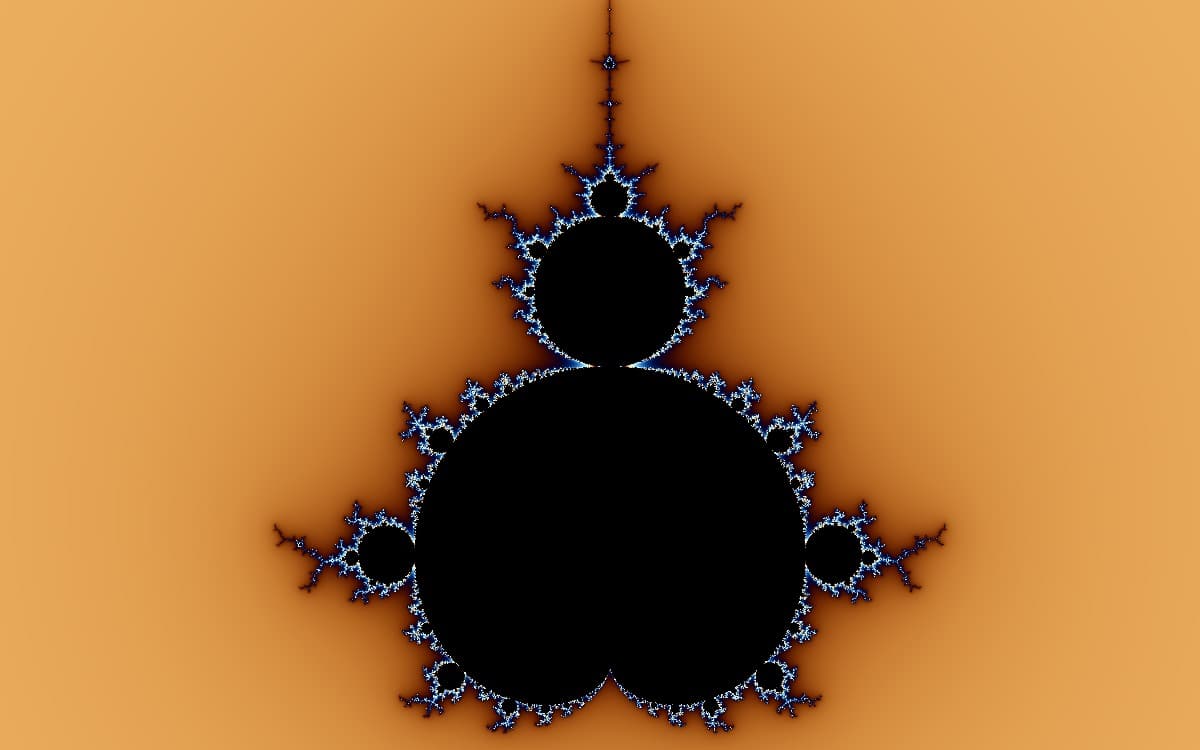
From a distance, first comes the heart-shaped main cardioid, then its round bulbs. The largest bulb marks a stable two-step cycle; smaller ones collect other repeating cycles. Follow the edge and the smooth arc frays into antennae, spirals, threads, and tiny copies of the whole set.

The boundary never finishes. Zooming brings out more structure, though not exact photocopies: local dynamics stretch and bend every return. The broad black interiors are relatively calm. At the fine edge, the slightest nudge to c can send an orbit elsewhere.

Remix et exemples

Pars du Document canonique

Ouvre le même état de formule approuvé utilisé par ce guide, puis modifie la vue, la colorisation, les transformations ou l'animation dans l'Explorateur interactif.

Questions fréquentes

What gets a point into the Mandelbrot set?

c belongs when the orbit from zero remains bounded under iteration. On a computer, |z| exceeding 2 settles it: the orbit escapes. Points that have not escaped by the iteration limit are drawn as members, although a point tight against the boundary may need many more steps for a dependable verdict.

Where do Julia sets enter?

For a Julia set, c stays fixed while the starting point z₀ ranges across the image. For the Mandelbrot set, zero stays fixed and c moves instead. In the quadratic family, the link is exact: the Julia set for z² + c is connected if and only if c belongs to the Mandelbrot set.

Références