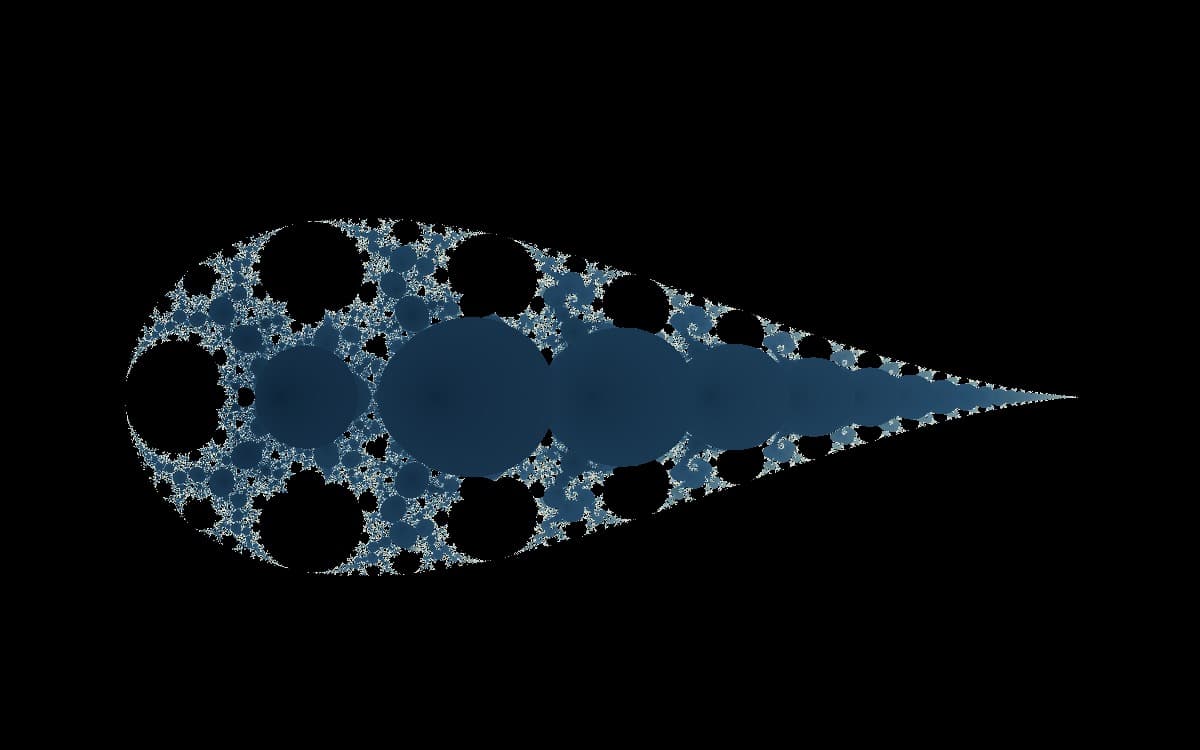
FractalPark
마그넷어려움

Magnet Type 2

몫 안에 z²이 들어 있는 제곱 유리 사상이에요. Type 1의 지형을 더 가파르고 더 많이 접힌 형태로 만들어요.

탐색기에서 열기
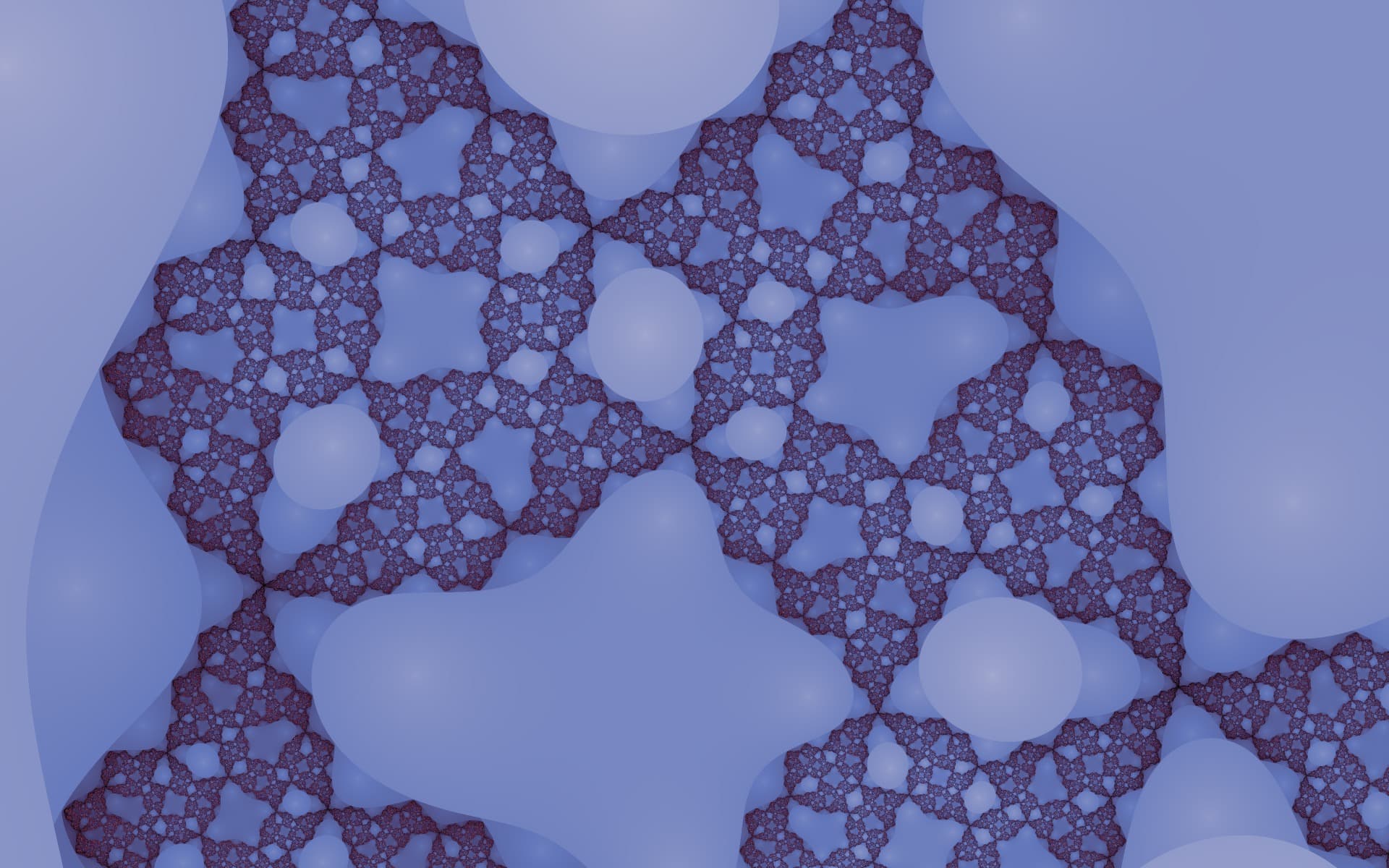
십자 대칭의 Magnet Type 2 줄리아 뷰, 고리와 구슬 사슬, 돌출부가 네 구역으로 반복돼요
c = −0.56 + 0.11i에서의 FractalPark Magnet Type 2: 4중 십자 대칭, 층층의 고리와 구슬 사슬, 쌍극에서 뻗어 나오는 능선.

개요

Magnet Type 2는 ((z² + c) / (z² − c))²을 반복해요. Type 1의 제곱 몫 구조는 유지하지만, 분자와 분모 모두에서 z가 이미 제곱돼 있어요. 그 비를 제곱하면 Type 1의 두 배인 4차 유리 사상이 돼요.

차수가 늘어난 효과는 두 곳에서 드러나요. 분모 z² − c는 c의 제곱근 값 두 곳에서 0이 되는데, 하나가 아니라 둘이라서 극도 두 개예요. 반복된 제곱은 또 각진 접힘을 십자 모양 대칭으로 날카롭게 다듬어요. 극도 많아지고 굽이도 많아지면서 Type 2는 더 빽빽하고 더 각져요.

자석 계열의 메커니즘은 그대로 남아요. 극 근처를 지나는 궤도는 큰 값으로 내던져졌다가 다음 단계에서 1 쪽으로 되접혀요. 무한대로 가는 게 아니라 리만 구면 위에서 1로 사상돼요. 분지가 평면에 모이고, 극의 원상들이 그 사이의 프랙탈 경계를 조립해요.

수학

Type 2 rational iteration

z(n+1) = ((z(n)^2 + c) / (z(n)^2 - c))^2

Each step computes (z² + c) / (z² − c), then squares it. The numerator is zero when z² = −c; the denominator is zero when z² = c. After squaring, every zero and pole is double, leaving the map with two double zeros and two double poles on the Riemann sphere. Its rational degree is four.

As |z| grows, (z² + c) / (z² − c) approaches 1, so the next value lands near 1 no matter how large z becomes. Only a close pass by one of the two poles produces a large value. FractalPark treats |z| above 16 as escaped, so a coloured “fast escape” region records a close encounter with a pole, not a one-way trip to infinity.

Suppose c = 1. The poles are at z² = 1, i.e. z = 1 and z = −1. Choose z₀ = 0.98, very close to the pole at 1. Then (z₀² + c) / (z₀² − c) ≈ (0.9604 + 1) / (0.9604 − 1) = 1.9604 / (−0.0396) ≈ −49.5, and squaring gives z₁ ≈ 2450. The large value then folds back: on the next step, with |z₁| large, the ratio tends to 1 and z₂ lands near 1. The shader colours the pixel according to how quickly the orbit returns near 1 after its pole encounter.

역사

In 1986, Heinz-Otto Peitgen and Peter H. Richter brought magnet fractals into the literature in *The Beauty of Fractals: Images of Complex Dynamical Systems*. Their chapter “Magnetism and Complex Boundaries” (pp. 129–138) presented rational maps derived from renormalization transformations in a model of magnetic materials. The boundary between magnetic and non-magnetic phases is fractal; iterating the transformation draws it, giving the images their clustered, field-like structure.

Fractint later included the maps as “magnet1” and “magnet2,” in both Mandelbrot-style and Julia-style views, and the name spread through fractal software. POV-Ray’s documentation still describes its magnet1 and magnet2 patterns as “derived from some magnetic renormalization transformations,” crediting the Fractint help files.

The classic Type 2 formula from that lineage is ((z² + c − 1) / (2z + c − 2))². FractalPark implements a different simplified squared quotient, ((z² + c) / (z² − c))², under the same name; every render and every mathematical statement on this page refers to the formula as FractalPark actually computes it.

시각적 특징

The guide image is a Julia-mode view at c = −0.56 + 0.11i. Cross-like symmetry holds the frame together: two intersecting folding axes divide the plane into four repeating sectors, each packed with layered rings, bead-like chains, and lobes. Two opposing bright nodes mark the poles, with angular ridges radiating outward.

At the same parameter, Type 2 has finer angular detail and a more articulated basin boundary than Type 1. The warm core and cool exterior emphasise its radial structure, but the geometry comes from the map: the extra degree reorients the basins along the cross axes set by the two poles.

리믹스와 예제

표준 문서에서 시작하기

이 가이드가 사용하는 동일한 승인된 수식 상태를 연 다음, 인터랙티브 탐색기에서 뷰, 컬러링, 변환, 애니메이션을 바꿔보세요.

자주 묻는 질문

How does Type 2 differ from Type 1?

Type 2 squares z before forming the quotient, so its numerator and denominator carry z² rather than z. This raises the rational degree from two to four, takes the number of poles from one to two, and strengthens the cross-like angular symmetry. At the same parameter, its images are denser and more folded than Type 1’s.

Where do its poles occur?

Poles occur where the denominator z² − c vanishes: z = √c and z = −√c. Type 1 has one pole at z = c; Type 2 has two, except when c = 0, when the pole at zero is double. Their positions move with c and strongly influence the fractal boundary’s layout.

참고 자료

소스 해설

  1. frm-v1:6c2c19cfb9bff9d9aa0cca56cea6dc62e324e80009b931665b604726d3784e5d:init/0

    magnet2에서는 초기화 노드는 다음만 실행해요: ismand이면 z = 0, 아니면 z = pixel.

  2. frm-v1:6c2c19cfb9bff9d9aa0cca56cea6dc62e324e80009b931665b604726d3784e5d:loop/0

    magnet2에서는 이 반복 노드는 다음만 실행해요: z2 = z * z.

  3. frm-v1:6c2c19cfb9bff9d9aa0cca56cea6dc62e324e80009b931665b604726d3784e5d:bailout

    magnet2에서는 bailout 노드는 다음만 검사해요: |z| <= 4.

구문 특징

initialization-flow

magnet2에서는 초기화 특징은 하나의 시작 연산 ismand이면 z = 0, 아니면 z = pixel에 초점을 맞춰요.

iteration-flow

magnet2에서는 반복 특징은 하나의 대입 z2 = z * z에 초점을 맞춰요.

bailout-test

magnet2에서는 종료 특징은 비교 |z| <= 4에 초점을 맞춰요.

매개변수 실험

단계

  1. magnet2을 고정된 매개변수 평면 기준으로 렌더링하세요: 중심 (-0.5, 0), 확대 0.4, 회전 0, 및 96회 반복.
  2. 반복 횟수만 바꾸고 기준은 고정한 채 48회로 한 번 렌더링한 뒤 96회 기준과 비교하세요.

관찰할 내용

magnet2에서는 48회와 96회 반복의 비교에서 달라지는 점이 있는지 기록하고 소스 제한 |z| <= 4을 적으세요.

연습

magnet2에서는 세 주석을 찾아 ismand이면 z = 0, 아니면 z = pixel, z2 = z * z, |z| <= 4을 설명하고 그리고 이웃 명령이 반복 주석에 속하지 않는 이유를 설명하세요.

완료 확인

magnet2에서는 모든 3개 주석 키를 열거하고 z2 = z * z와 |z| <= 4의 역할을 정확히 설명하면 완료예요.

출처 및 권리

출처 정보는 영어 사실 단위에 있어요.

권리 정보는 영어 사실 단위에 있어요.

수식 레코드

magnet2

이 FractalPark 표준 구현은 게시되어 실행할 수 있습니다.

magnet2의 결정적 미리보기

표준 소스

언어
frm-like/1
표준 라이브러리
1
프로필 모드
parameter-plane
프로필 중심
-0.5, 0
프로필 확대
0.4
프로필 반복 횟수
96
프로필 근거
mechanical

매개변수

선언된 매개변수 없음

표준 소스

검증된 표준 리비전은 읽기 전용입니다. Remix는 별도의 편집 가능한 포크를 만듭니다.

표준 소스를 불러오는 중…

출처 및 현재 구현

수식 ID
2dd8a5a7-052a-5539-aab9-c533f7dec857
표준 이름
magnet2
원래 이름
magnet2
역사적 출처
FractalPark
현재 구현
프로젝트 소유

FractalPark 프로젝트 소유 구현입니다. 연결된 파일은 고정된 정식 Definition입니다.

권리 또는 저작자 표시에 문제가 있나요?

수식 ID와 근거 자료를 보내 주세요. 검토 중에는 관리자가 구현을 보류하거나 철회할 수 있습니다. contact@fractalpark.com