FractalPark
뉴턴보통

Newton Fractal for z³ − 1

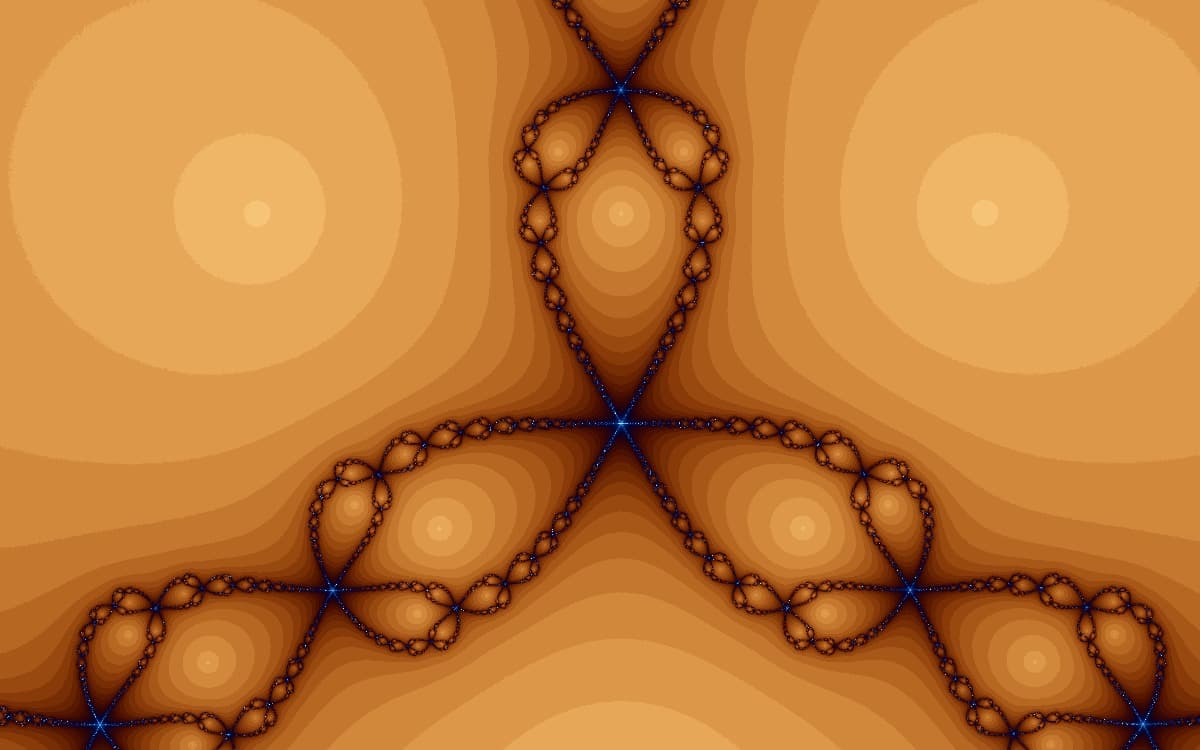
z³ − 1에 대한 뉴턴 방법이에요. 세 개의 수렴 분지가 결코 가라앉지 않는 경계로 나뉘어요.

탐색기에서 열기
z³ − 1에 대한 뉴턴 프랙탈: 바퀴살 모양 선을 따라 세 분지가 만나고, 나선형 경계 디테일이 있어요
FractalPark의 z³ − 1 뉴턴 프랙탈: 3분할 대칭의 세 수렴 분지가 겹겹의 나선 경계로 이어져요.

개요

이 공식은 익숙한 근 찾기 알고리즘을 복소평면의 지도로 바꿔요. 만델브로 집합과 달리 궤도가 탈출하는지를 묻지 않아요. 대신 주어진 시작점에서 뉴턴 방법이 z³ − 1의 어떤 근에 도달하는지를 묻죠. 1의 세 세제곱근 (1, e^{2πi/3}, e^{4πi/3})은 각각 하나의 흡인 분지를 차지해요. 그 근으로 수렴하는 궤도를 가진 모든 시작값이 그 분지에 속해요.

세 분지는 쉽게 구분되지만, 그들이 공유하는 경계는 그렇지 않아요. 경계 위의 점은 어떤 근에도 도달하지 못하고 혼돈적이고 반복되지 않는 경로를 따라가요. 이 경계가 바로 뉴턴 사상, 즉 유리 함수 N(z) = z − (z³ − 1)/(3z²)의 줄리아 집합이에요. 확대하면 더 많은 구조가 계속 나타나요.

고전적인 수렴 프랙탈이에요. 평범한 수치 알고리즘 안에 좀처럼 가라앉지 않는 경계가 숨어 있죠. 아서 케일리(Arthur Cayley)가 1879년 뉴턴 분지의 분류 문제를 처음 제기했어요. 이차의 경우는 풀었지만, 삼차의 경우는 “상당한 어려움이 있는 것으로 보인다”고 했어요. 이후 파투와 줄리아의 복소 동역학이 이 문제를 읽을 수 있게 만들었고, 1980년대 초에 최초의 컴퓨터 시각화가 등장했어요.

수학

Newton iteration

z(n+1) = z(n) - (z(n)^3 - 1) / (3 z(n)^2)

For a function f(z), Newton iteration is N(z) = z − f(z) / f′(z). Here f(z) = z³ − 1 and f′(z) = 3z². Each step subtracts the polynomial value divided by its derivative, nudging z toward a root. For the cubic z³ − 1, the iteration simplifies to:

N(z) = z − (z³ − 1) / (3z²) = (2z³ + 1) / (3z²).

This is a degree‑2 rational map of the Riemann sphere. Its fixed points are exactly the three cube roots of unity, and they are all superattracting—once an orbit is close enough to a root, convergence is extremely fast. The Julia set is the boundary where basins meet, and the map is chaotic there.

Try a concrete starting point: z₀ = 0.5. Then z₁ = (2·0.125 + 1) / (3·0.25) = (0.25 + 1) / 0.75 ≈ 1.667, z₂ ≈ 1.107, z₃ ≈ 1.001, and the orbit rapidly converges to the root at 1. Now try z₀ = 0.5i: z₁ ≈ −0.417 + 0.583i, z₂ ≈ −0.495 + 0.865i, and the orbit converges to e^{2πi/3} = −0.5 + 0.866i. A third starting point, say z₀ = −0.5 − 0.5i, converges to the remaining root e^{4πi/3} = −0.5 − 0.866i. The basins are large and well separated, but close to a boundary a tiny nudge in the starting value can switch the destination entirely.

FractalPark uses a stability threshold: an orbit counts as converged when consecutive iterates differ by less than a chosen tolerance. The pixel is then coloured by the root reached and the number of steps needed.
역사

At the heart of this image is Newton's method, discovered by Isaac Newton in 1669 and independently refined by Joseph Raphson in 1690. For real functions it is a practical root‑finding tool; for complex polynomials it reveals fractal basins no one could have foreseen at the time.

The mathematical study of those basins began in 1879 with Arthur Cayley's paper "The Newton–Fourier imaginary problem" (American Journal of Mathematics, vol. 2, p. 97). For a complex quadratic polynomial, Cayley showed that the basins of attraction are simply the two half-planes separated by the perpendicular bisector of the line segment joining the two roots. At cubic polynomials, though, he found the problem "considerable difficult." His inability to extend the simple quadratic result to the cubic case became known as Cayley's problem.

The resolution came through complex dynamics, developed by Pierre Fatou and Gaston Julia in the years around 1918. Their theory of iterated rational functions supplied the language for the basins and their infinitely convoluted boundaries. But the first pictures of the Newton fractal for z³ − 1 had to wait for computer graphics in the early 1980s.

In 1986, Heinz-Otto Peitgen and Peter H. Richter included a chapter titled "Newton's Method for Complex Polynomials: Cayley's Problem" (Chapter 6, pp. 93–106) in *The Beauty of Fractals: Images of Complex Dynamical Systems*. It presents some of the earliest published computer renderings of these basins and helped introduce a wide audience to the fractal structure hidden inside Newton's method.

시각적 특징

Three large basins, one for each cube root of unity, occupy the image. They meet in wheel-spoke lines from the centre, making the three-part symmetry plain. Inside each basin, convergence is quick and the colour stays smooth.

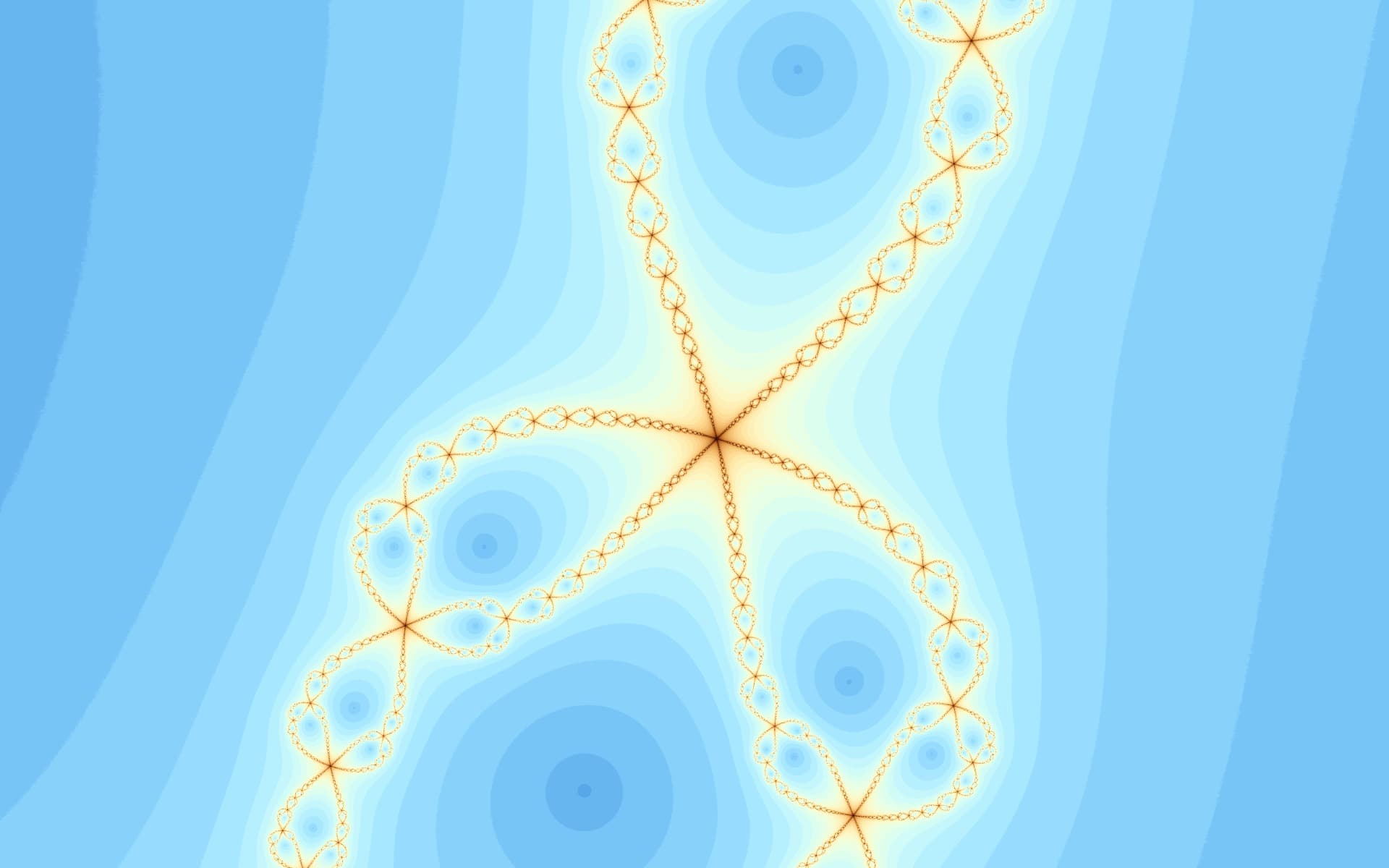
Between any two basins—and especially at the central three-way meeting—spirals, miniature three-basin copies, and dendritic threads crowd in. Follow a spiral arm inward: the three-basin arrangement returns at smaller scales, bent by local dynamics. Broad calm regions; then a restless frontier.

리믹스와 예제

표준 문서에서 시작하기

이 가이드가 사용하는 동일한 승인된 수식 상태를 연 다음, 인터랙티브 탐색기에서 뷰, 컬러링, 변환, 애니메이션을 바꿔보세요.

자주 묻는 질문

What do the main regions represent?

Each coloured region is a basin of attraction: it contains the starting points whose Newton iteration converges to the same root of z³ − 1. The three cube roots of unity are 1, e^{2πi/3} = −0.5 + 0.866i, and e^{4πi/3} = −0.5 − 0.866i. A point’s colour records the root it reaches and how quickly convergence happens.

Is this an escape-time fractal?

It is primarily a convergence fractal. The classification is not about whether the orbit escapes to infinity (as in the Mandelbrot set), but which root it approaches and how many steps it takes. There is no escape-radius test. Instead, the renderer checks whether consecutive iterates have become very close—indicating convergence to a root—and, if so, which root they are near.

참고 자료

소스 해설

  1. frm-v1:5e3522c53ca358df8d61d5a3b82aa0b90ff8009602b1952fb5022027f00fdd45:init/0

    newton3에서 이 노드는 다음 연산을 실행해요: z = pixel.

  2. frm-v1:5e3522c53ca358df8d61d5a3b82aa0b90ff8009602b1952fb5022027f00fdd45:loop/0

    newton3에서 이 노드는 다음 연산을 실행해요: z2 = z * z.

  3. frm-v1:5e3522c53ca358df8d61d5a3b82aa0b90ff8009602b1952fb5022027f00fdd45:loop/4

    newton3에서 이 노드는 다음 연산을 실행해요: z = numerator / denominator.

  4. frm-v1:5e3522c53ca358df8d61d5a3b82aa0b90ff8009602b1952fb5022027f00fdd45:bailout

    newton3에서 이 노드는 다음 연산을 실행해요: |z - zPrev| >= 0.000001.

구문 특징

state-flow

구체적인 상태 흐름은 z는 pixel로 시작하고, 이어서 z2와 z3가 numerator / denominator를 만드는 데 쓰여요.

stopping-test

종료 검사는 |z - zPrev| >= 0.000001만 판단하며 상태에 값을 대입하지 않아요.

매개변수 실험

단계

  1. 다른 프로필 제어를 고정하고 newton3을 48회 반복으로 실행한 결과를 기록하세요.
  2. 고정 프로필의 96회 반복 실행과 비교하여 차이를 기록하세요.

관찰할 내용

기준 실행과 비교해 z2 = z * z; z3 = z2 * z; numerator = 2 * z3 + 1; denominator = 3 * z2; z = numerator / denominator가 보이는 결과나 |z - zPrev| >= 0.000001 종료 검사에 차이를 만드는지 기록하세요. 정의가 차이를 보장하지는 않아요.

연습

newton3의 주석을 추적하고 표시된 연산에서 z2 = z * z; z3 = z2 * z; numerator = 2 * z3 + 1; denominator = 3 * z2; z = numerator / denominator가 어떻게 실행되는지 설명하세요.

완료 확인

답에는 4개 주석의 설명, z2 = z * z; z3 = z2 * z; numerator = 2 * z3 + 1; denominator = 3 * z2; z = numerator / denominator의 식별, 그리고 |z - zPrev| >= 0.000001가 대입이 아닌 종료 검사라는 구분이 있어요.

힌트

상태 흐름에서는 z = pixel → z2 = z * z → z3 = z2 * z → numerator = 2 * z3 + 1 → denominator = 3 * z2 → z = numerator / denominator 순서로 연산하고 결과를 다음 단계에 넘겨요.

출처 및 권리

출처: 고정된 실행 정의와 공개 결정이에요.

권리 정보는 영어 단원의 고정된 결정을 따라요.

수식 레코드

newton3

이 FractalPark 표준 구현은 게시되어 실행할 수 있습니다.

newton3의 결정적 미리보기

표준 소스

언어
frm-like/1
표준 라이브러리
1
프로필 모드
parameter-plane
프로필 중심
0, 0
프로필 확대
0.35
프로필 반복 횟수
96
프로필 근거
family

매개변수

선언된 매개변수 없음

표준 소스

검증된 표준 리비전은 읽기 전용입니다. Remix는 별도의 편집 가능한 포크를 만듭니다.

표준 소스를 불러오는 중…

출처 및 현재 구현

수식 ID
dd052c9f-868f-5516-9af0-3f4e78ac7a13
표준 이름
newton3
원래 이름
newton3
역사적 출처
FractalPark
현재 구현
프로젝트 소유

FractalPark 프로젝트 소유 구현입니다. 연결된 파일은 고정된 정식 Definition입니다.

권리 또는 저작자 표시에 문제가 있나요?

수식 ID와 근거 자료를 보내 주세요. 검토 중에는 관리자가 구현을 보류하거나 철회할 수 있습니다. contact@fractalpark.com