FractalPark
클래식쉬움

Lambda Fractal

중심화된 복소 로지스틱 사상이에요. 하나의 매개변수가 궤도를 늘리는 동시에 스스로를 향해 되접어요.

탐색기에서 열기
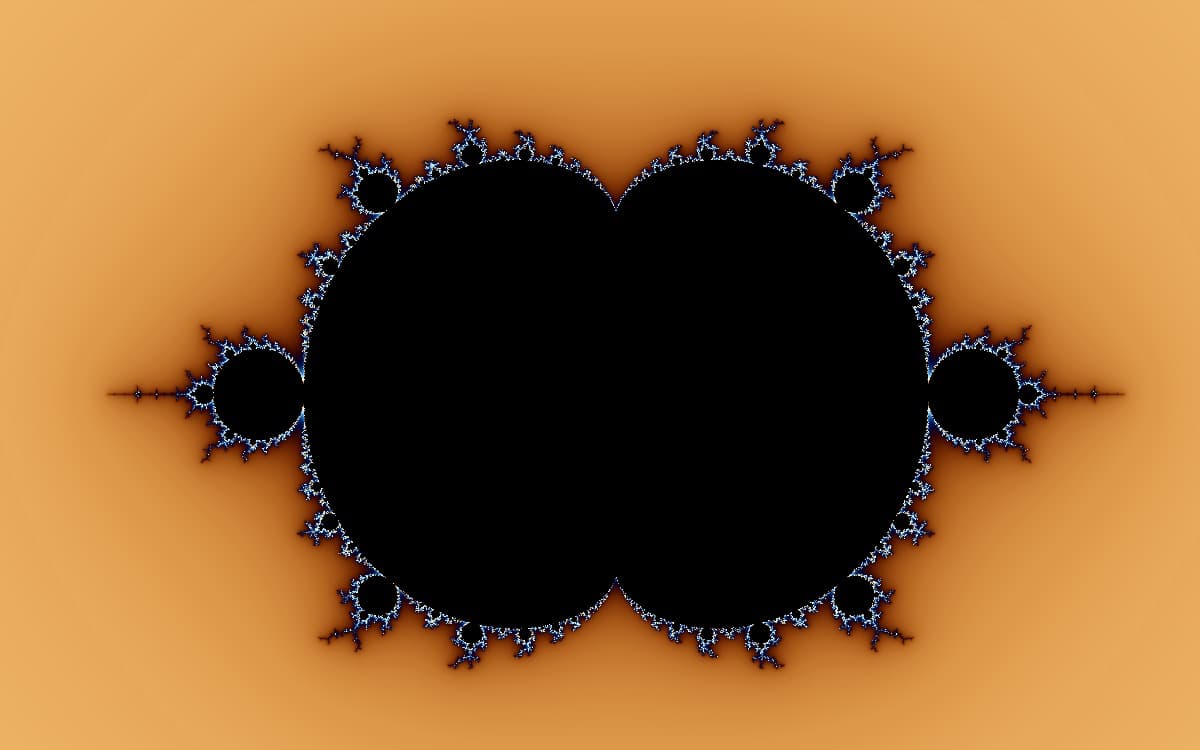
청록색 공간 위의 검은 람다 집합, 가장자리에 가지처럼 뻗은 실들이 늘어져 있어요
중심화된 복소 로지스틱 사상의 매개변수 평면: 원반 같은 중심부, 붙어 있는 돌기들, 실처럼 가는 가장자리.

개요

실수선 위에서 로지스틱 사상은 혼돈을 연구하는 작은 실험실이 되었어요. 그 값을 복소평면으로 확장하면 람다(λ) 프랙탈로 펼쳐져요. FractalPark은 중심화된 형태를 사용해요. c가 서로 반대 방향으로 당기는 두 보완 요소를 동시에 조절하는 구조예요.

좌표의 아핀 변환을 거치면 이 공식은 표준 이차 사상 z² + c와 켤레(conjugate)가 돼요. 만델브로 집합의 가족적 특징은 공유하지만 외곽선은 달라요. 만델브로 집합에서 심장형이 있는 자리에 여기서는 원반이 있고, 붙어 있는 돌기들도 각자의 주기에 따라 배열돼요.

여기서 c는 성장과 회전이라는 두 손잡이를 동시에 돌려요. 줄리아 뷰를 위해 고정해 두었다가 살짝 움직여 보세요. 거의 둥근 분지가 가지와 나선의 경계로 바뀔 수 있어요.

수학

Complex logistic iteration

z(n+1) = c times (z(n) + 1/2) times (1/2 - z(n))

At each step, shift the current value halfway either side of center, multiply (z + ½) by (½ − z), then scale the product with c. The two factors make ¼ − z², so the same step reads z → c(¼ − z²).

Try c = 2 with z₀ = 0. The first step is z₁ = 2 × (½) × (½) = 0.5; the next is z₂ = 2 × 1.0 × 0 = 0. The orbit now shuttles between 0 and 0.5: a stable 2-cycle. Turn c up to 4 and the pull changes: z₁ = 4 × ½ × ½ = 1, then z₂ = 4 × 1.5 × (−0.5) = −3. The orbit diverges, so c = 4 lies outside the bounded set. In Julia mode, hold c still and vary z₀ across the image; the dividing line between trapped and escaping appears.


역사

The map z → λz(1 − z) began as the complex extension of the real logistic map, studied extensively in the 1970s as a simple model of population dynamics and chaotic behavior. In 1980, Benoit B. Mandelbrot took the iteration to unrestricted complex λ and z. His paper, "Fractal Aspects of the Iteration of z → λz(1−z) for Complex λ and z," introduced the λ-plane parameter set—now the Lambda fractal—and placed it in the broader theory of iterated rational maps.

The groundwork was already there. Around 1917–1918, Pierre Fatou and Gaston Julia developed the general theory of iterated rational functions that later made families such as the logistic map available to explore. In 1986, Heinz-Otto Peitgen and Peter H. Richter brought the Lambda fractal to a wider audience in "The Beauty of Fractals," with some of the first widely seen computer-generated images of the set.

시각적 특징

At full scale, the Lambda set begins with an almost circular body—the countershape to the Mandelbrot set’s heart-like cardioid. Smaller bulbs cling to the disk; each marks a stable periodic cycle, and the largest marks a period-2 cycle. Beyond them lie branching channels, tiny disk islands, and spirals.

The islands give away the difference: they are round here, not cardioid-shaped, because the algebra has changed. In Julia mode, c can select a filled disk or a many-armed vortex.

리믹스와 예제

표준 문서에서 시작하기

이 가이드가 사용하는 동일한 승인된 수식 상태를 연 다음, 인터랙티브 탐색기에서 뷰, 컬러링, 변환, 애니메이션을 바꿔보세요.

자주 묻는 질문

What does lambda control?

The complex parameter c—often written λ in the literature—sets both the orbit’s growth rate and its rotation. Its magnitude controls the strength of expansion or contraction; its argument supplies the turn at each step.

Why does Julia mode look especially varied?

Fix c and the question shifts to the starting point: does it stay bounded or escape? With linear and quadratic terms in the same formula, the border may be a smooth closed curve or a heavily branched connected set. The chosen c decides what the renderer reveals.

참고 자료