FractalPark
피닉스보통

Multi-Phoenix

기억을 가진 이차 점화식이에요. 복소 계수가 이전 궤도 값을 다음 단계로 이어서, 깃털 같고 불꽃 같은 형태를 만들어요.

탐색기에서 열기
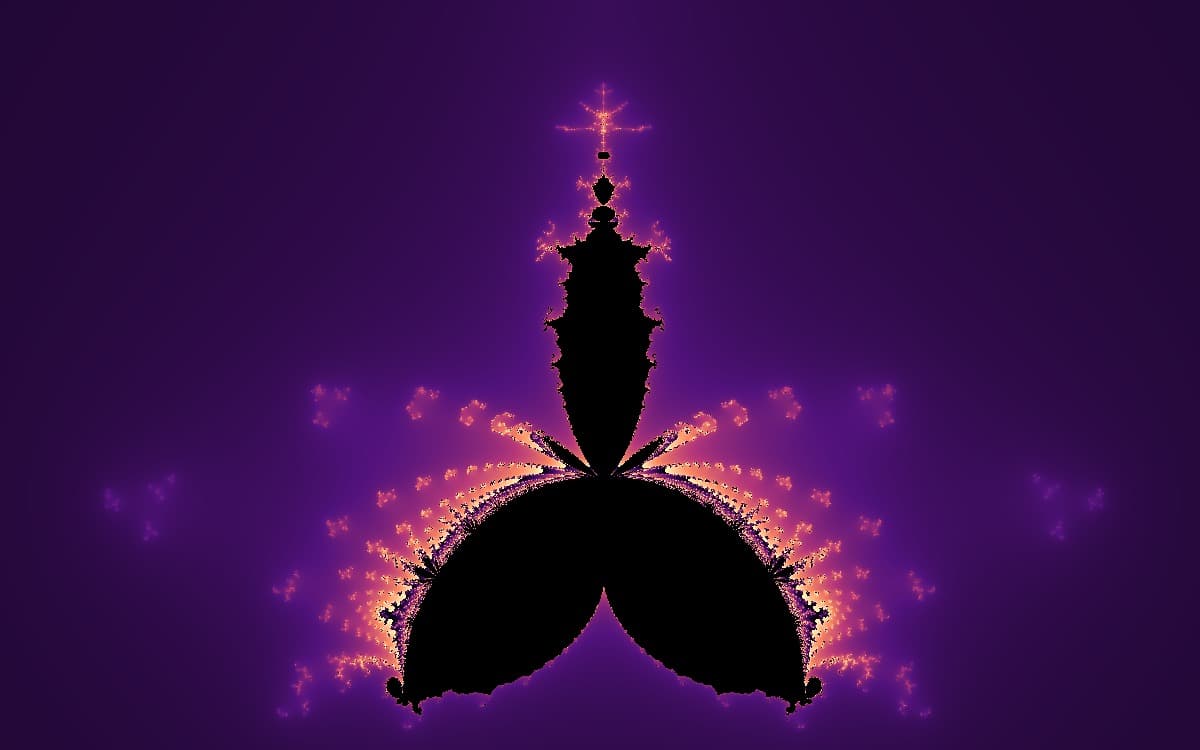
깃털 모양 살과 숯불 같은 실 무리를 가진 Multi-Phoenix 프랙탈 (“Ember Compass”)
FractalPark의 Multi-Phoenix (“Ember Compass”): 나침반 같은 살이 빛나는 실 무리 사이로 방사형으로 뻗어요.

개요

Multi-Phoenix는 마지막 단계를 기억해요. 이 2차 점화식은 현재의 z와 바로 직전 궤도 값을 함께 사용하고, 직전 값에는 복소 기억 계수 p로 가중치를 줘요. 그 기억이 특징의 방향과 지속 시간을 바꿔요.

표준 줄리아 단계 z → z² + c에는 기억이 없어요. Phoenix는 이전 z를 p·zₙ₋₁로 끌어와요. p를 바꾸면 과거가 다른 가중치를 갖게 되고, p가 복소수라서 그 가중치는 커지거나 작아질 뿐 아니라 회전할 수도 있어요. 깃털 모양의 살, 불꽃 같은 부채, 나침반 장미, 숯불 같은 무리들이 따라 나와요.

실 모양의 구조가 신화 속 새의 날개와 꼬리를 떠올리게 해서 “Phoenix”라는 이름이 붙었어요. 교토대학의 우시키 시게히로(Shigehiro Ushiki)가 발견해 1988년에 발표했어요.

수학

Phoenix recurrence

z(n+1) = z(n)^2 + c + p times z(n-1)

Take the standard quadratic step zₙ² + c, then add p times the value from two steps ago. A second-order recurrence needs two starting values before its first iteration: z₀ and the “previous” value, usually 0. FractalPark exposes p as an adjustable complex control.

Try the classic Phoenix parameter pair c = 0.5667 and p = −0.5. Starting with z₀ = 0 and z₋₁ = 0, the first few values stay bounded and trace angular, wing-like arcs. Make p positive with a similar magnitude and the feathered structure can break apart or rotate: the memory term now reinforces the earlier direction instead of opposing it.
역사

Shigehiro Ushiki, a mathematician in Kyoto University’s Graduate School of Human and Environmental Studies, discovered the Phoenix fractal. In 1988, he published the Phoenix iteration in IEEE Transactions on Circuits and Systems. He presented it as a complex-one-dimensional section of a Julia-like set derived from a complexified Hénon map. The paper is simply titled "Phoenix." The classic parameter pair (c = 0.5667, p = −0.5) produces the named Phoenix curve, later well known in fractal-rendering communities.

Ushiki’s broader research covers complex dynamical systems, Julia sets with polyhedral symmetries, higher-dimensional complex Hénon maps, and the dynamics of surface automorphisms. His Kyoto University homepage lists publications from the 1980s to the present.

The Phoenix family later appeared in Ultra Fractal and other fractal software in both Julia-mode and Mandelbrot-mode variants. FractalPark’s Multi-Phoenix uses the same core recurrence and adds a multi-preview parameter interface.

시각적 특징

That one-step memory is visible in feathered spokes radiating from centres, flame-like fans curling along filaments, and compass forms with a sense of direction. A standard quadratic Julia does not make these in the same way; they rely on the directional persistence of p·zₙ₋₁.

With different parameters, the same rule can close into ember-like clusters, open into radiating pinwheels, or dissolve into dust-like regions. FractalPark’s “Ember Compass” foregrounds the compass spokes and warm filament clusters.

파라미터

메모리
The complex memory coefficient p sets both the strength and the rotational direction of the previous orbit value’s influence on the next step.

리믹스와 예제

표준 문서에서 시작하기

이 가이드가 사용하는 동일한 승인된 수식 상태를 연 다음, 인터랙티브 탐색기에서 뷰, 컬러링, 변환, 애니메이션을 바꿔보세요.

자주 묻는 질문

Why does this formula need the previous value?

The recurrence is second-order: its next state depends on the current and immediately preceding orbit values. It is a discrete analogue of a delay differential equation, where the past feeds back into the present. The extra parameter p sets how much of that past continues forward.

Does the initial previous value matter?

Yes. A second-order recurrence requires two initial conditions — z₀ and the value of z before iteration begins (z₋₁) — for a deterministic orbit. FractalPark initializes z₋₁ to zero by default, the standard convention for the Phoenix family.

참고 자료