FractalPark
이색보통

Spider

이차 궤도에 c/z를 더한 유리 사상이에요. 0의 극이 긴 다리와 거미줄 같은 실을 끌어내요.

탐색기에서 열기
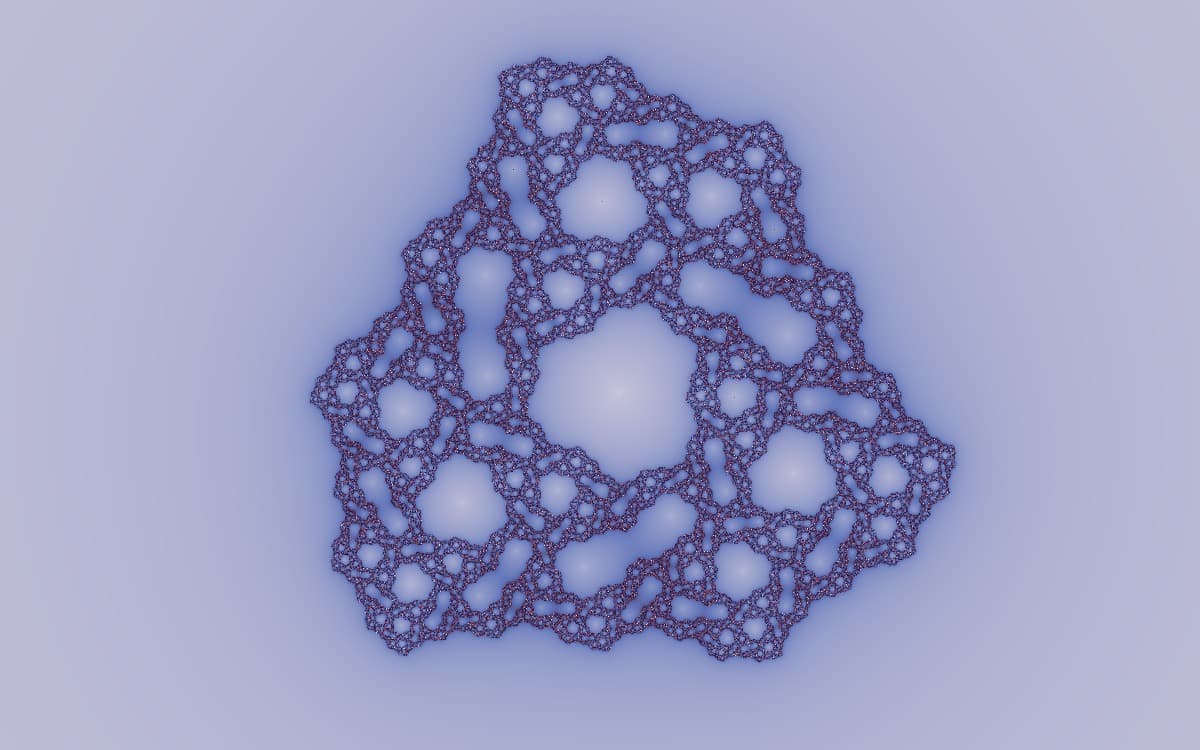
Spider 프랙탈: 어두운 중앙 핵에서 방사형으로 뻗는 긴 다리와 심연 같은 실
FractalPark이 렌더링한 Spider 프랙탈: 어두운 핵에서 긴 다리와 거미줄 같은 실이 나오고, 짙은 심연의 파랑과 검정으로 채색돼요.

개요

Spider 공식은 익숙한 제곱 항 z²에 c/z를 결합해요. 서로 경쟁하는 두 끌림을 가진 2차 유리 사상이에요. 0에서 멀리 떨어지면 z²이 이차 만델브로 탈출에서처럼 궤도를 이끌어요. 가까이 다가가면 c/z가 주도권을 잡아 원점의 극을 향하게 해요.

그 경쟁이 매개변수 경계를 단순히 옮겨진 탈출 문턱이 아니라 가지치는 실로 늘여 놓아요. 좁은 중심, 방사형으로 뻗는 다리, 어두운 틈이 이름을 설명해 줘요.

규칙이 z로 나누기 때문에 z = 0은 특이점이에요. 렌더러는 0에 아주 가까운 값을 수치적 폴백으로 처리해야 해요. c 자체가 0일 수도 있는데, 그러면 사상은 z²이 되어 평범한 이차 줄리아 동역학으로 돌아가요.

수학

Spider iteration

z(n+1) = z(n)^2 + c / z(n)

The reciprocal term gives a quadratic orbit a sharp tug around the pole at zero.

Start with c = 0. The reciprocal term vanishes, leaving z², the standard quadratic Julia map; initial values inside the unit disk can still have bounded orbits.

Now take c = 1 and z₀ = (1, 0). The first iteration gives z₁ = 1² + 1/1 = 2, already far from the origin; the next gives z₂ = 4 + 1/2 = 4.5, and escape is rapid. Begin near zero instead—say z₀ = (0.01, 0)—and 1/0.01 = 100 dominates, throwing the orbit out at once. The spider filaments live on the boundary between those regimes.
시각적 특징

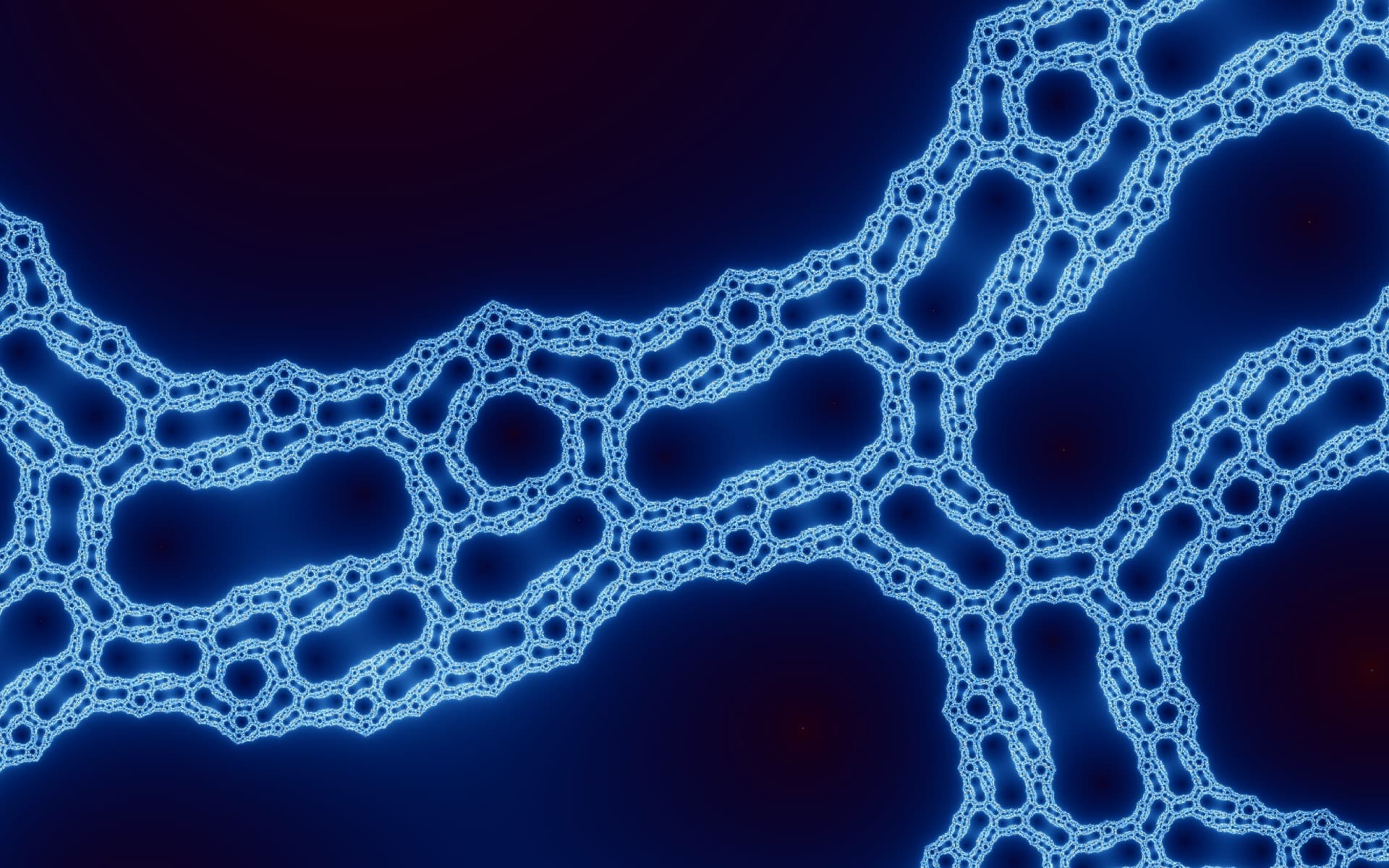
Long legs, dark filaments, and web-like junctions run out from a narrow centre. The origin's singularity makes a dark core; from it the threads branch and thin.

The canonical FractalPark rendering uses deep blues and blacks. The rational term breaks full symmetry, leaving the set slightly twisted rather than neatly balanced.

리믹스와 예제

표준 문서에서 시작하기

이 가이드가 사용하는 동일한 승인된 수식 상태를 연 다음, 인터랙티브 탐색기에서 뷰, 컬러링, 변환, 애니메이션을 바꿔보세요.

자주 묻는 질문

What happens at z = 0?

At z = 0 the reciprocal term asks for division by zero, which is undefined. The implementation uses a stable fallback for extremely small values, by clamping the magnitude or substituting a small constant. This does not change the visible structure: points entering that near-zero zone are normally flung outward by the large reciprocal value on the next step.

What creates the spider‑like legs?

The legs form where quadratic expansion and reciprocal attraction are nearly balanced. There an orbit can alternate between a pull toward zero and a throw outward, drawing the boundary between bounded and escaping behaviour into long threads. The effect is strongest near the origin, where the reciprocal term is largest; farther out, z² regains control and the threads taper.