FractalPark
뉴턴어려움

Newton Cosh

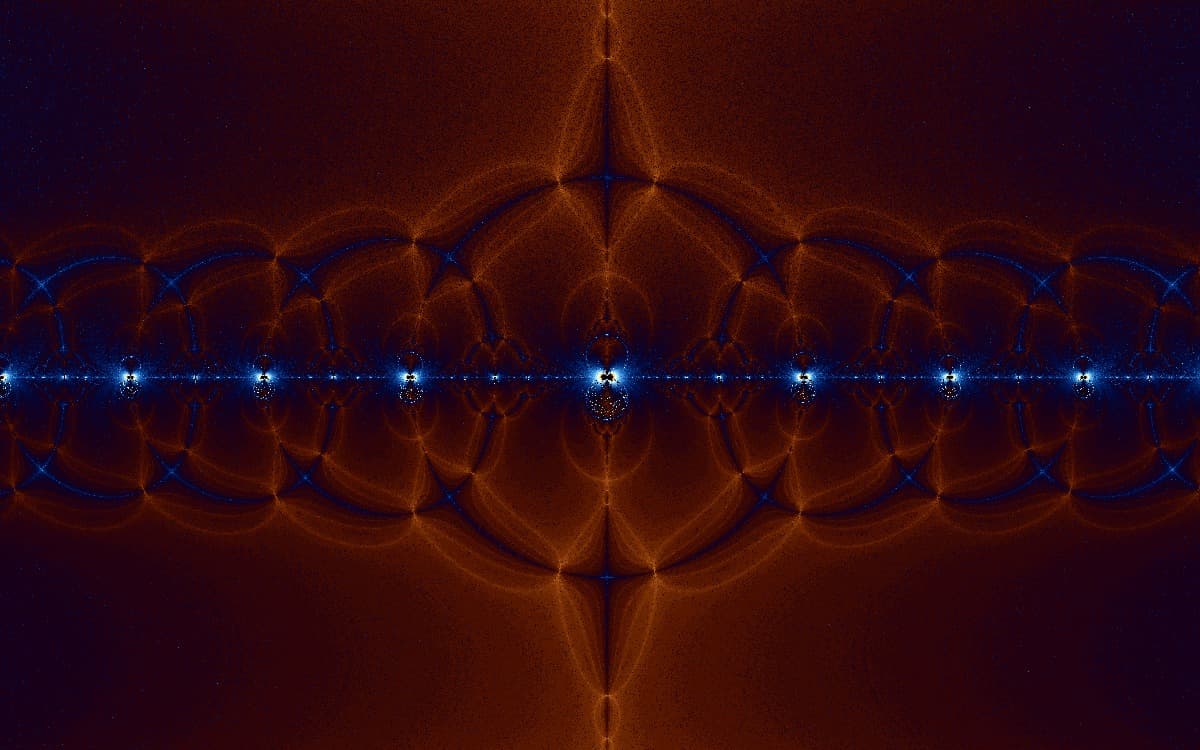
cosh z = 1에 뉴턴 방법을 적용한 거예요. 무한히 많은 등간격 근이 평면을 반복되는 수렴 띠로 만들어요.

탐색기에서 열기
cosh z = 1에 대한 뉴턴 프랙탈, 허수축을 따라 반복되는 수평 띠와 휘어진 경계가 쌓여 있어요
FractalPark의 cosh z = 1 뉴턴 뷰: 허수축을 따라 반복되는 수렴 띠가 접힌 실 모양 경계로 나뉘어요.

개요

뉴턴의 평범한 근 찾기 단계는 f(z) = cosh z − 1일 때 성격이 달라져요. 근은 모든 정수 k에 대해 2πik예요. 다항식은 궤도에 유한한 목적지만 제공하지만, 이 근들은 허수축을 따라 같은 간격으로 계속 나아가요. 그래서 프랙탈은 몇 개의 분지에 머물지 않고 위아래로 이어지는 띠 모양으로 배열돼요.

사상 N(z) = z − (cosh z − 1) / sinh z는 유리형(meromorphic) 함수예요. 특이점을 제외한 복소평면 전체에서 정의돼요. 두 종류의 반복되는 점 집합을 눈여겨보세요. cosh z − 1의 근과, 정수 k에 대해 z = πik에서 나타나는 분모 sinh z의 영점이에요. 분모 영점 근처에서는 시작점을 살짝 움직이는 것만으로 궤도가 도달하는 근이 바뀔 수 있어요.

허수축을 따라 반복되는 주기성은 수학 지식 없이도 한눈에 보여요. 수평 띠가 위아래로 서로를 반복하는데, 근의 주기마다 하나씩이에요. 띠가 만나는 자리에는 한 분지가 궤도를 다음 분지로 넘겨주는 지점을 가느다란 세로 실이 기록해요.

수학

Newton’s cosh iteration

z(n+1) = z(n) - (cosh(z(n)) - 1) / sinh(z(n))

Newton's rule is N(z) = z − f(z) / f′(z). Here f(z) = cosh z − 1 and f′(z) = sinh z. Each step finds the correction (cosh z − 1) / sinh z, then takes it away from z.

The equation cosh z = 1 has infinitely many solutions: z = 2πik for every integer k. Each is a simple root: cosh z grows linearly close by, so Newton's method converges quadratically there. Far from the real axis, cosh and sinh grow exponentially. Their quotient may be tiny or enormous, and that is where the image's sensitive seams take shape.

Try z₀ = 0.2i. Since i·sinh(0.2) ≈ 0.201i and cosh(0.2) ≈ 1.020, the first correction is small; the orbit quickly reaches the root at z = 0. Now move to z₀ = (0.5 + 3.0i), farther from every root. The correction now contains large exponential terms. The orbit can cross several basin boundaries before settling, or wander chaotically between roots for many iterations before one captures it.

The function repeats with period 2πi in the imaginary direction, and the Newton map does too: N(z + 2πi) = N(z) + 2πi. That repeated rule is the source of the horizontal banding.
시각적 특징

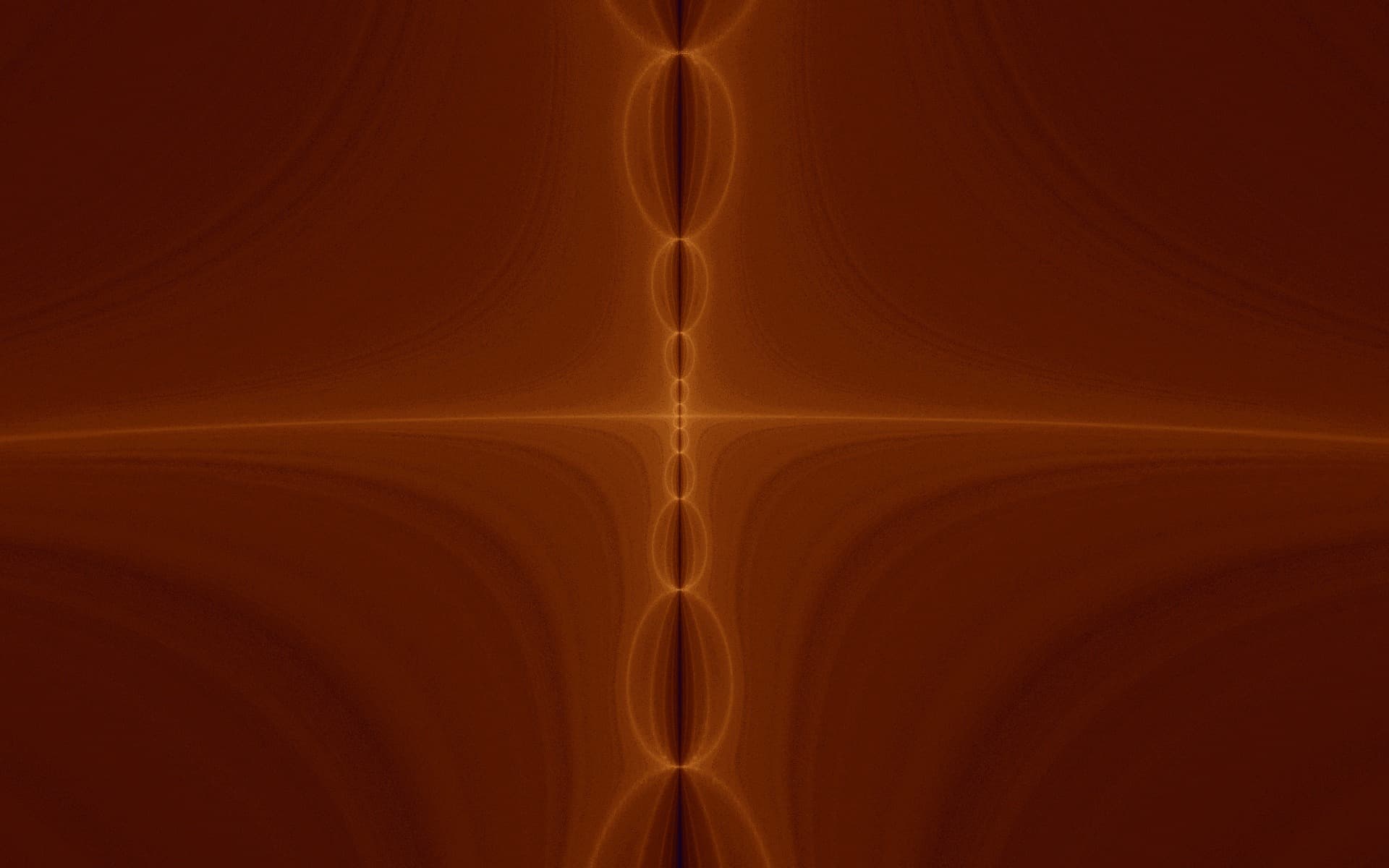
Start with the horizontal bands along the imaginary axis. A period of roots makes one band, and the convergence pattern returns in the next. The borders do not run straight: they bend and fold, then pull out fine vertical filaments like taut threads.

Within each band, the basin geometry resembles its neighbours, with small distortions. Think of a ribbon folded repeatedly. The warm and cool zones come from the colouring; the sharp breaks arise where singularities of sinh z destabilise the Newton correction.

리믹스와 예제

표준 문서에서 시작하기

이 가이드가 사용하는 동일한 승인된 수식 상태를 연 다음, 인터랙티브 탐색기에서 뷰, 컬러링, 변환, 애니메이션을 바꿔보세요.

자주 묻는 질문

What equation is being solved?

It seeks the complex solutions of cosh(z) = 1: z = 2πik for every integer k. The equally spaced roots line the imaginary axis. Each draws in nearby Newton orbits, and their repeating arrangement creates the horizontal bands.

Why are some regions extremely sensitive?

The correction divides by sinh(z), which vanishes at z = πik for integer k. Close to one of these points, the correction can become huge, sending an orbit across several basin boundaries before it converges. These singularities are not roots; they pull the fine vertical filaments and unsettled border zones into view.