FractalPark
초월보통

Cosh Mandelbrot

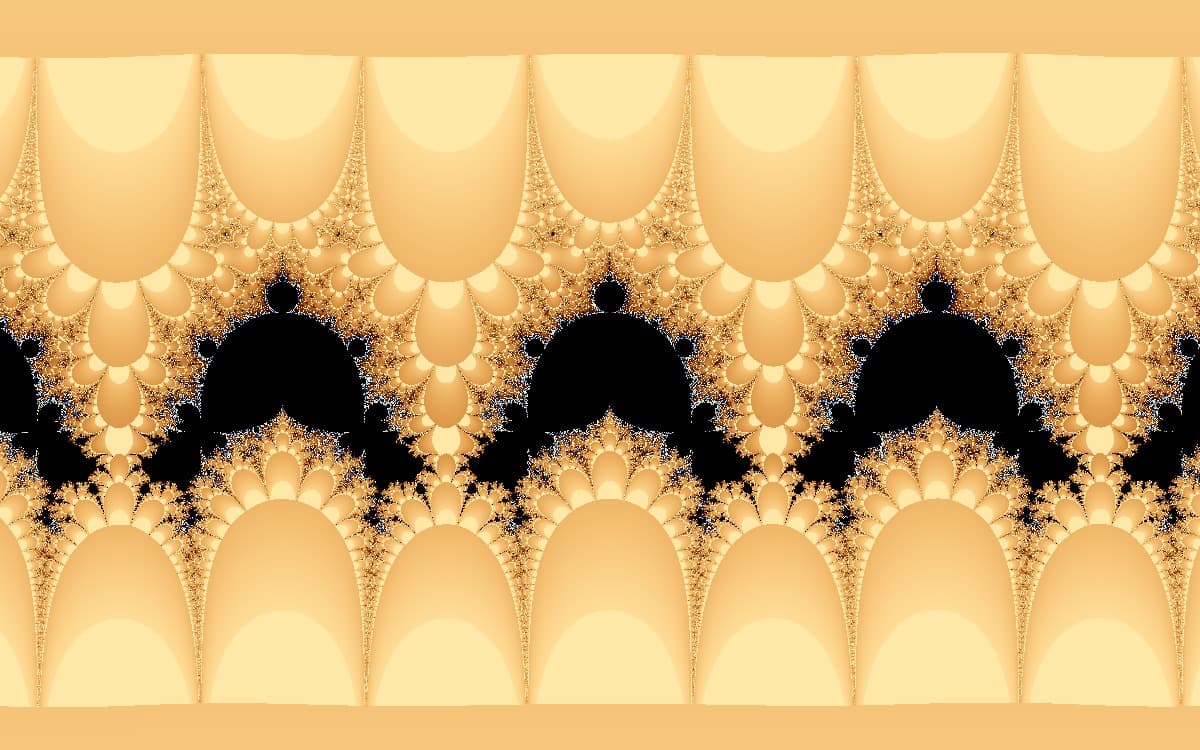
초월적 탈출 시간 사상이에요. 쌍곡코사인이 제곱을 대신하고, 세로로 반복되는 깃털과 층층의 부채가 그 자리를 차지해요.

탐색기에서 열기
Cosh Mandelbrot 프랙탈에서 일정한 세로 간격으로 반복되는 층층의 금빛 깃털과 부채
FractalPark의 Cosh Mandelbrot: 금빛 깃털과 층층의 부채가 cosh의 허수 방향 주기 2π에 맞춰 세로로 되돌아와요.

개요

Cosh Mandelbrot는 익숙한 다항식 단계를 벗어나요. z² + c 대신 z → cosh(z) + c를 반복해요. 제곱은 실수축 방향의 지수적 성장과 허수축 방향의 2π 반복을 가진 쌍곡코사인으로 대체돼요.

복소 코사인과 쌍곡코사인은 가까운 친척이에요. 둘 다 한 방향으로는 반복되고 다른 방향으로는 끝없이 자라요. cosh(z)의 허수축 주기는 2π라서, 디테일 띠가 위아래로 자신을 되풀이해요. |Re(z)|가 크면 지수 항들이 바깥으로 치달아요. 대부분의 시작점은 빨리 탈출하고, 가느다란 띠만이 궤도를 붙잡아 여러 단계 동안 연속된 값을 유계로 유지해요.

매개변수 평면은 더 이상 만델브로 집합의 심장형과 돌기처럼 보이지 않아요. 대신 부채, 금빛 깃털, 세로로 울리는 메아리를 쌓아 올려요. 탈출과 비탈출 사이의 경계는 초월 반복 자체가 그려 내며, 간단한 대수적 탈출 반지름은 존재하지 않아요.

수학

Hyperbolic cosine iteration

z(n+1) = cosh(z(n)) + c

Each turn evaluates complex hyperbolic cosine at the current z, then adds c. The definition cosh(z) = (eᶻ + e⁻ᶻ)/2 puts exponential growth on the real axis beside imaginary-axis repetition with period 2π.

Try z = iπ/2 on the imaginary axis. Since cosh(iπ/2) = cos(π/2) = 0, starting there with c = 0 leaves the recurrence at zero. Nudge the point off that axis and the eᶻ term can drive exponential growth and rapid escape. That sharp divide—bounded behavior in a narrow strip, rapid escape elsewhere—is typical of transcendental iteration. Unlike a polynomial, this map has no universal escape radius; FractalPark uses a bailout threshold chosen to detect divergence in practice.

역사

In 1988, Clifford A. Pickover, a computer scientist and author at IBM's Thomas J. Watson Research Center, published the short paper "Chaotic behavior of the transcendental mapping (Z → cosh(Z) + μ)" in The Visual Computer. He presented images of chaotic behavior produced by this transcendental function, alongside maps such as z → sin(z) + c and z → eᶻ + c.

Pickover’s work brought the cosh-based map into the fractal-rendering community, where it became a standard transcendental escape-time example. Earlier, mathematicians including Robert Devaney and Michał Krych had developed the broader study of transcendental complex dynamics—exponential, trigonometric, and hyperbolic families—and analyzed the dynamics of exp(z) in the 1980s.

시각적 특징

First notice the vertical repetition. Because cosh(z) repeats in the imaginary direction every 2π, fine plumes, layered fans, and gilt filaments return at regular intervals. The result is striped and tiered, far from the radial branching of polynomial Mandelbrot sets.

In the canonical rendering, plumes and fans often carry warm tones. The finest detail concentrates in narrow horizontal bands, where an orbit lingers near the boundary between escape and non-escape. Above and below, escape accelerates and the image becomes smoother.

리믹스와 예제

표준 문서에서 시작하기

이 가이드가 사용하는 동일한 승인된 수식 상태를 연 다음, 인터랙티브 탐색기에서 뷰, 컬러링, 변환, 애니메이션을 바꿔보세요.

자주 묻는 질문

Why do patterns repeat vertically?

Complex hyperbolic cosine repeats along the imaginary axis with period 2π. Because every step uses cosh(z), the orbit structure repeats too: bounded and escaping behavior returns at regular vertical intervals in the parameter plane.

Why do many points escape rapidly?

Hyperbolic cosine is built from exponentials: cosh(z) = (eᶻ + e⁻ᶻ)/2. At a point with a substantial real part, the eᶻ term takes over and the orbit can grow extremely fast. There is no simple polynomial-style escape radius, so the bailout threshold is a practical computational choice.

참고 자료