FractalPark
ExóticaDifícil

McMullen 2–3 Map

Um mapa racional onde a quadratura empurra os pontos para fora e um termo cúbico inverso os envia através do polo na origem.

Abrir no Explorar
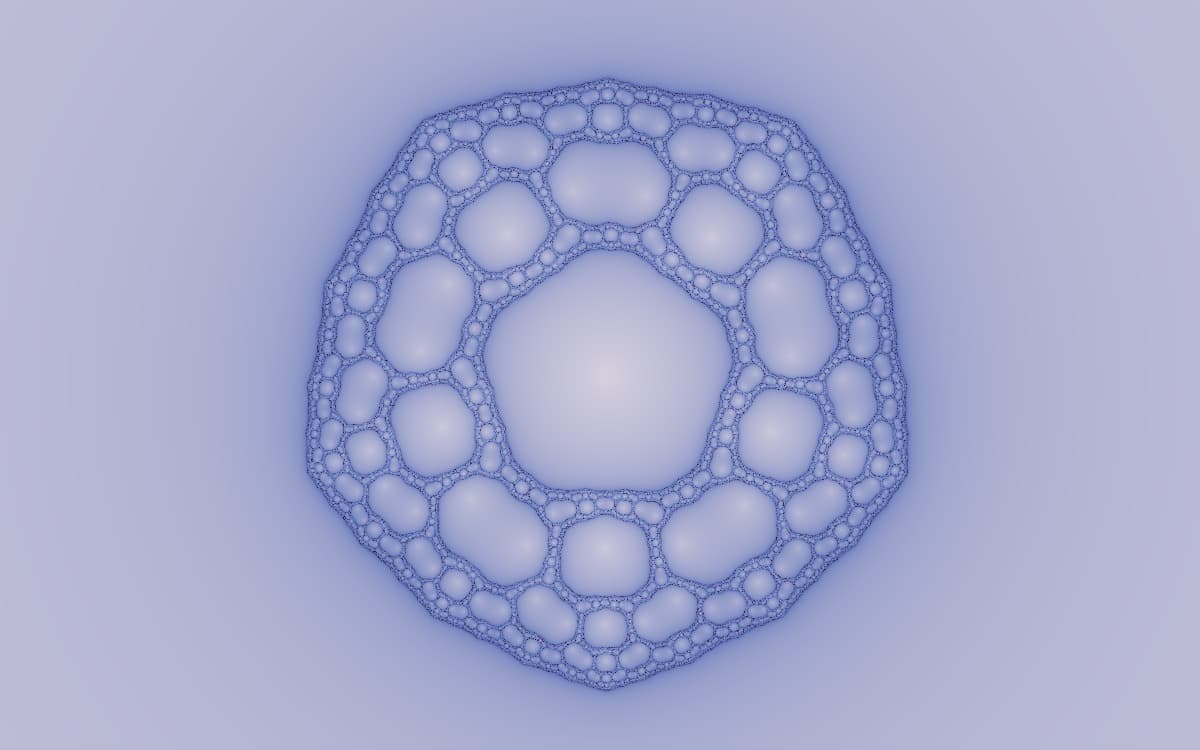
Um fractal McMullen azul-claro formando um anel de muitos lados feito de células arredondadas ao redor de uma grande abertura central
A renderização do McMullen 2–3 do FractalPark: bordas aninhadas semelhantes a contas circulando uma ampla abertura central.

Visão geral

O mapa McMullen 2–3 pertence à família geralmente escrita como \(f_\lambda(z)=z^n+\lambda/z^d\). O FractalPark chama o parâmetro de \(c\) e escolhe \(n=2\), \(d=3\). À primeira vista, ele se assemelha a um mapa quadrático com um termo extra. Então \(z^3\) aparece no denominador e muda as regras do jogo: a origem é um polo, não um ponto comum.

Uma única fórmula agora tem dois territórios. Lá longe, \(z^2\) domina e empurra valores grandes para mais longe. Perto de zero, \(c/z^3\) assume e envia pontos em direção ao infinito através do polo. Entre eles há uma fronteira móvel onde nenhum dos termos vence de forma decisiva.

Essa fronteira pode se fechar em anéis, quebrar-se em células arredondadas ou unir-se em uma teia conexa. Isso depende de \(c\) e das órbitas dos pontos críticos. Não existe um único contorno McMullen.

A Matemática

A quadratic term and a cubic pole

z(n+1) = z(n)^2 + c / z(n)^3

At each step, square the current complex value, then add \(c/z^3\). When \(|z|\) is large, the first term grows roughly like \(|z|^2\), while the reciprocal term fades like \(1/|z|^3\). Near zero the balance flips: the reciprocal term becomes enormous.

The same expression can be written as

$$ f_c(z)=\frac{z^5+c}{z^3}. $$

The map has a pole of order three at \(z=0\), and—when \(c\neq0\)—is a rational map of degree five. The “2–3” names the exponents in the original expression, not the rational-map degree.

In the exact definition, the pole sends zero to infinity on the Riemann sphere. A numerical renderer cannot divide by zero, so FractalPark replaces values extremely close to the origin with a tiny nonzero value and guards the denominator. That is a computational safety rail, not a different definition.
História

The family takes its name from Curtis T. McMullen. In Section 7 of his 1988 paper *Automorphisms of Rational Maps*, McMullen constructed rational maps whose Julia sets break into a Cantor set of Jordan curves—infinitely many disjoint loops arranged with Cantor-set structure. Later authors adopted “McMullen maps” for the family \(z^n+\lambda/z^d\) associated with this construction. McMullen is now Cabot Professor of Mathematics at Harvard, where his personal academic homepage and publication list remain available.

The 2–3 choice is the smallest pair of exponents satisfying the characteristic inequality

$$ \frac{1}{n}+\frac{1}{d}<1, $$

because \(1/2+1/3=5/6\). It also gives the lowest possible degree, \(n+d=5\), in this part of the theory. The inequality alone does not guarantee that every parameter produces circles: the relevant critical orbits must also enter the appropriate escape region.

Work after McMullen mapped out that dependence in much greater detail. Robert Devaney, Daniel Look, and David Uminsky proved an “escape trichotomy” in 2005: when the free critical orbit escapes, the Julia set can be a Cantor set, a Cantor set of circles, or a Sierpiński curve, depending on how it reaches infinity.

Características Visuais

One large pale opening anchors the image. An uneven ring of rounded cells circles it; farther out, smaller cells make a fine lace. What looks like a smooth blue band at first resolves into a crowded rim.

The outer edge is gently faceted rather than round, and no two cells quite match. That belongs to this parameter, frame, and colouring—not every McMullen map. The pale palette favours relief and nested boundaries over an escape-speed gradient.

Remix e Exemplos

Comece pelo Documento canônico

Abra o mesmo estado de fórmula aprovado usado por este guia e depois altere a visualização, a coloração, as transformações ou a animação no Explorar interativo.

Perguntas Frequentes

What do 2 and 3 mean in the name?

They name the two powers in \(z^2+c/z^3\): the polynomial side squares \(z\), while the reciprocal side divides by its cube. In the general McMullen family they are \(n\) and \(d\).

Do not read them as “degree two to degree three.” Combine the terms and the map is \((z^5+c)/z^3\), so for nonzero \(c\) its rational-map degree is five.

What happens at z = 0?

The denominator \(z^3\) vanishes, so zero is a pole, not an ordinary starting point. On the extended complex plane it maps to infinity. Nearby points are flung away with strength growing like \(1/|z|^3\).

That pole is not a rendering accident; it is the feature that distinguishes this family from a polynomial such as \(z^2+c\). FractalPark only adds a tiny numerical guard near zero so the shader can represent the same limiting behavior without performing an undefined division.

Referências