FractalPark
ExóticaDifícil

Rational Map 1

Uma iteração racional de grau 2, z²/(z + c), com um zero e um polo que viaja conforme c muda.

Abrir no Explorar
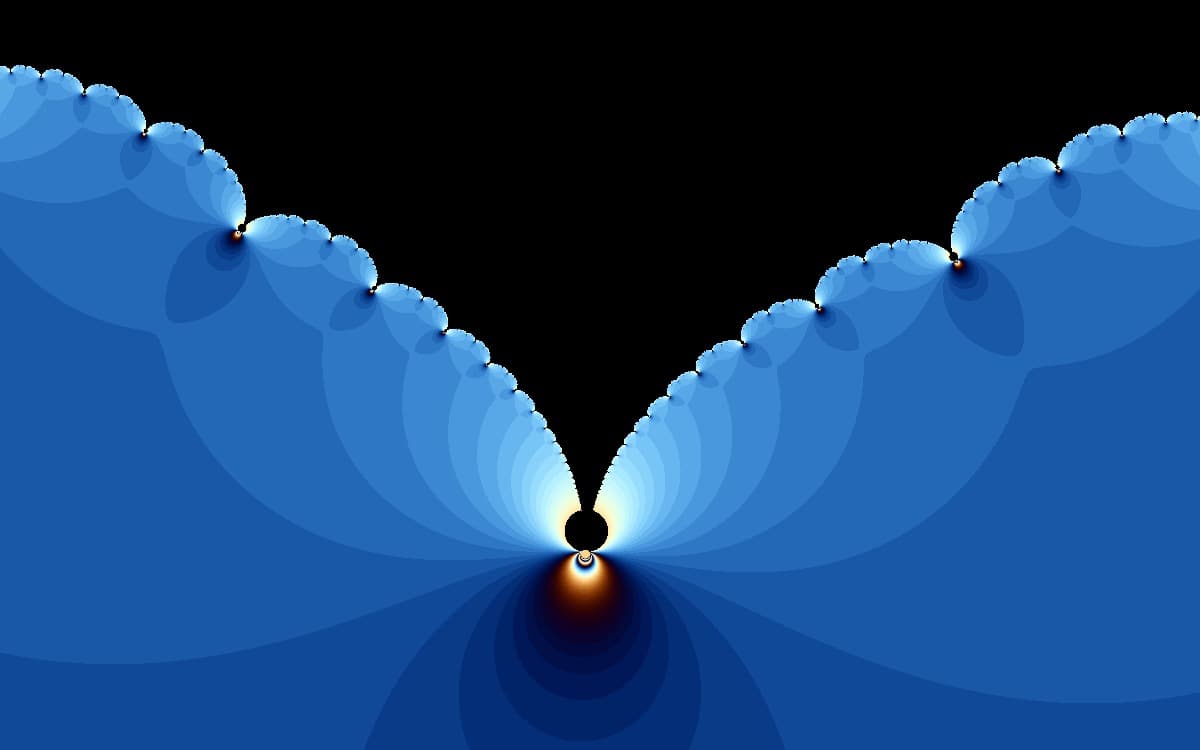
Close-up de Julia do Rational Map 1: um leque de lâminas curvas e canais amplos irradiando do polo
O Rational Map 1 renderizado pelo FractalPark: um leque de lâminas curvas que gira lentamente irradia do polo, com faixas estreitas registrando órbitas próximas ao polo.

Visão geral

O Rational Map 1 itera z² / (z + c). Um polinômio como z² + c não tem nenhum lugar onde seu denominador falha; este mapa tem. Em z = −c há um polo móvel. Uma órbita que o roça pode ser arremessada para fora e depois seguir um caminho bem diferente nos passos seguintes.

Há um zero, em z = 0, e um polo, em z = −c. A função ainda tem grau dois, mas esse polo redesenha o plano. Lá longe, z² / (z + c) cresce aproximadamente como z (para |z| grande, z² / (z + c) ≈ z), então o infinito não é o ponto fixo dominante. Bacias se reúnem em torno de um conjunto finito de ciclos atratores, enquanto o polo corta canais curvos e setores em forma de leque entre elas.

O FractalPark mostra planos de parâmetros, onde c se move, e visões de Julia, onde c permanece parado. Esta imagem-guia é um close-up de Julia: lâminas curvas se abrem ao redor do polo, enquanto finas faixas de cor seguem órbitas que roçam a singularidade.

A Matemática

Rational iteration

z(n+1) = z(n)^2 / (z(n) + c)

Each step squares z, then divides by z + c. The numerator is zero at z = 0; the denominator is zero at z = −c, which makes that point a pole. The map has degree two: (z²)/(z + c) is degree‑2 over degree‑1, and after cancelling a common factor it has one zero and one pole, each counted with multiplicity.

Try the pole at close range. Take c = 0.5, so the pole is at z = −0.5, and start at z₀ = −0.49, just to its right. Then z₁ = (−0.49)² / (−0.49 + 0.5) = 0.2401 / 0.01 = 24.01. One step has thrown the orbit far out. Since |z₁| is large, the next step gives z₂ ≈ z₁² / z₁ = z₁ = 24.01: the large value persists instead of snapping back as in the magnet family. Pixel colour records the steps before the orbit crosses the escape threshold.

Unlike polynomial maps, where infinity always attracts escaping orbits, this map is nearly linear far out (z → z). Thrown-out orbits may drift. The escape-time colours therefore spread into broad, gradual bands rather than the abrupt jumps familiar from z² + c.
Características Visuais

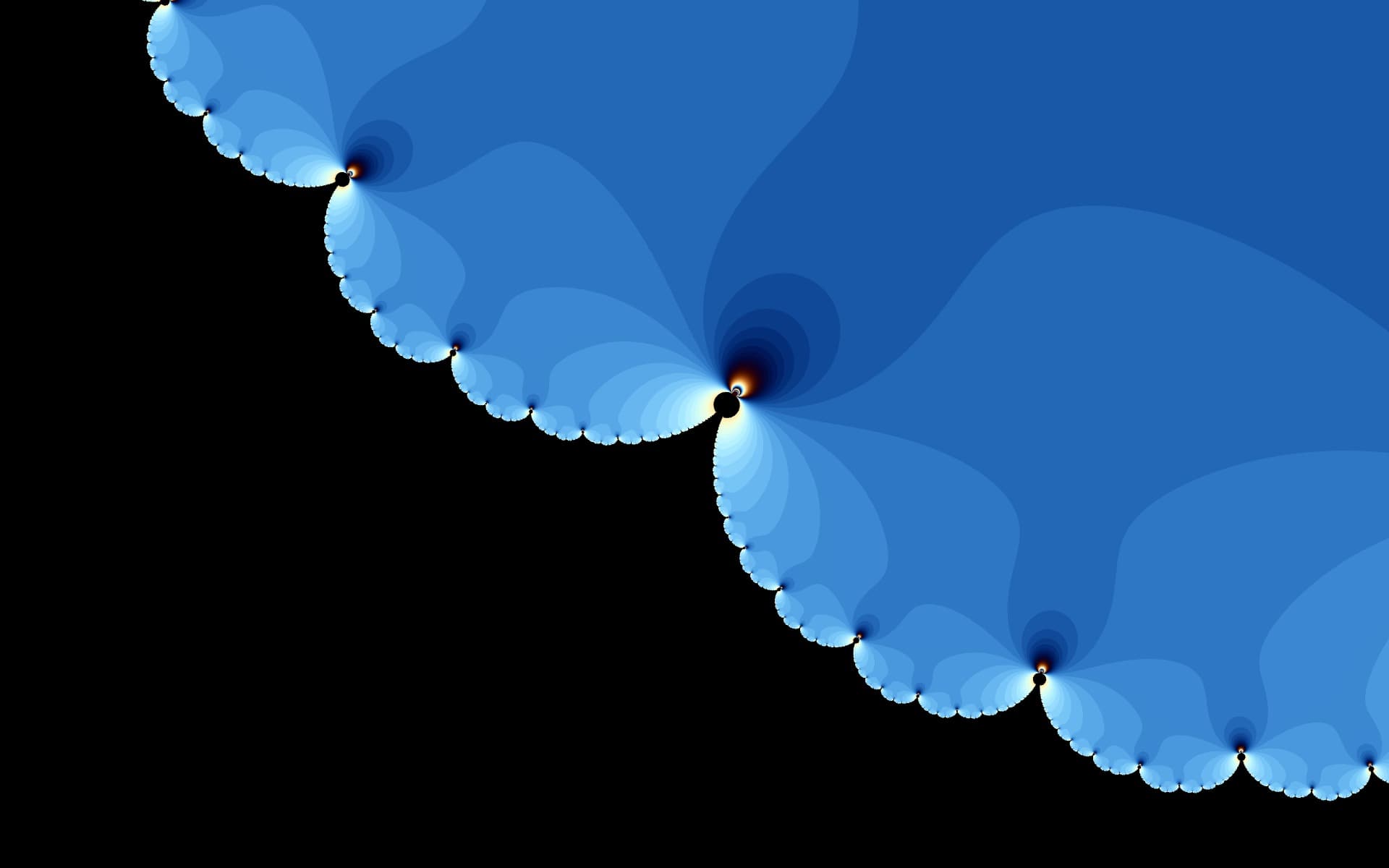
This is a Julia close-up. Around the pole, curved blades open into sweeping channels that follow the map's local direction. Tight colour bands between them mark orbits that graze the pole and need many steps to cross the escape threshold.

Because large-z motion is nearly linear rather than explosive, the bands change colour slowly and broadly. It reads as a turning fan with the pole for its hub. Move c and the pole moves too; the whole fan reorganizes.

Remix e Exemplos

Comece pelo Documento canônico

Abra o mesmo estado de fórmula aprovado usado por este guia e depois altere a visualização, a coloração, as transformações ou a animação no Explorar interativo.

Perguntas Frequentes

What makes this a rational map?

Its rule is a quotient of two complex polynomials, z² divided by z + c, not one polynomial alone. That permits poles: places where the denominator vanishes and the value becomes infinite. Polynomial maps have no such places, so their dynamics lack this particular detour.

Where is the pole?

Set z + c to zero: the pole is at z = −c. It moves with c and helps draw the curved fan and blades. An orbit passing close by is thrown to a large value, then may drift because the map grows only linearly far from the origin.