FractalPark
КлассическиеСредне

Mandelbox

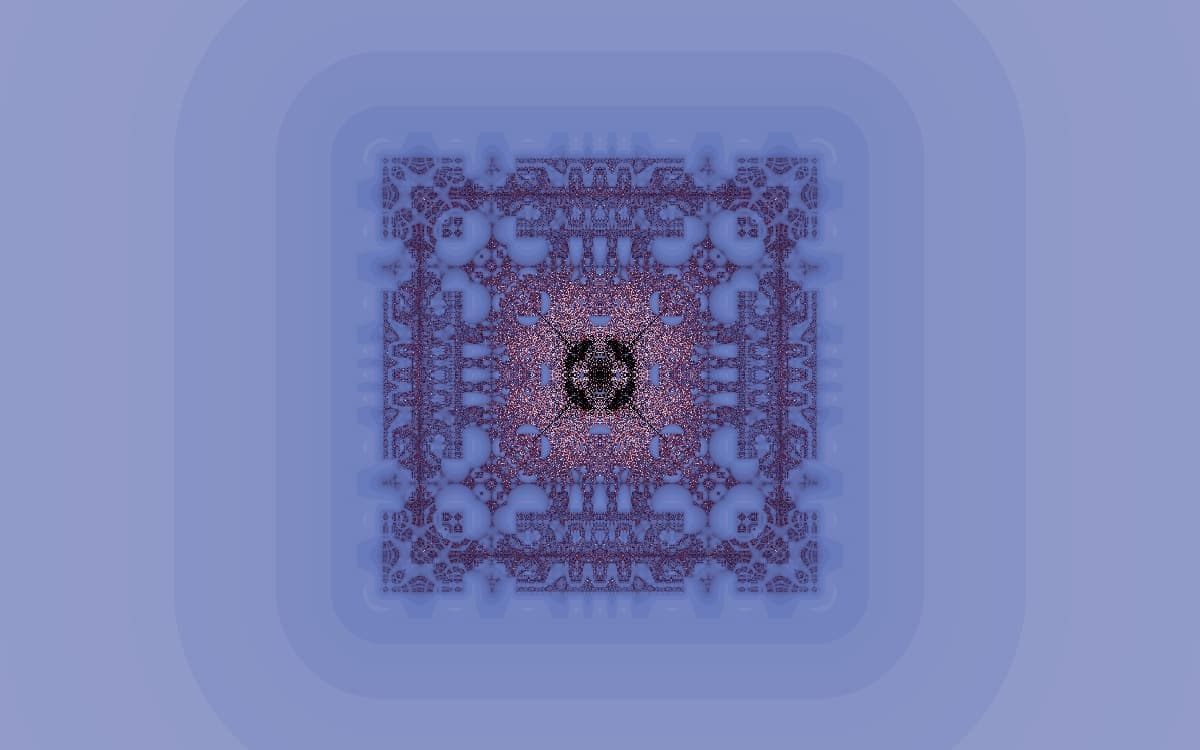
Отображение «складывание и масштабирование», вдохновлённое Mandelbox Тома Лоу 2010 года: отражения от куба, радиальное складывание и масштабирование превращают итерацию в комнаты и стены.

Открыть в Обзоре
Двумерная карта Mandelbox с камерами с резкими гранями и вложенными крепостными углублениями в холодных синих тонах
Карта FractalPark, вдохновлённая Mandelbox: прямые стены, прямые углы и слоистые углубления, словно интерьер кристаллической крепости.

Обзор

Большинство фрактальных формул начинаются с возведения в квадрат, как в z² + c. Mandelbox выбирает другой путь: складывание куба возвращает координаты за пределами фиксированного куба к его граням; радиальное складывание (складывание шара) затем инвертирует или масштабирует точку в зависимости от её расстояния до начала координат; равномерное масштабирование растягивает или сжимает результат, прежде чем будет прибавлено c. Повторяйте последовательность — и структуру строят складывания, а не возведение в квадрат.

Отражения и инверсии не требуют конкретного числа измерений, поэтому конструкцию можно построить в любом из них. FractalPark отображает двумерный вариант, сохраняющий то же ядро «складывание и масштабирование» на комплексной плоскости.

Эта карта параметра не смягчается до привычных кривых многочленов. Она высекает камеры с резкими гранями, вложенные укрепления и проходы, будто взятые с чертежа. Её граница разделяет ограниченные орбиты — те, что остаются в пределах досягаемости, — и уходящие. Приблизьтесь — и зазубренный самоподобный край воспроизводит мотив куба в меньшем масштабе.

Математика

Fold-and-scale iteration

z(n+1) = scale times ballFold(boxFold(z(n))) + c

Each round puts the orbit through four moves: box fold, radial fold, scale, then a shift by c.

The box fold handles one coordinate at a time. Take a component a of z. Above 1, it reflects as a → 2 − a; below −1, as a → −2 − a. Components in [−1, 1] stay put. The outer plane folds back into the central square.

Next comes the ball fold, checking the squared magnitude r² = |z|². If r² < 0.25 (|z| < 0.5), scale the point by 4 and push it away from the origin. If 0.25 ≤ r² < 1, invert it through the unit sphere: z → z/r², so a radius of m becomes 1/m. Points with r² ≥ 1 stay put. The near points move outward; the middle band turns across the unit sphere. These moves make the unsettled interface behind the Mandelbox's boxy layers.

Try z₀ = (1.5, 0) with scale s = 2. The box fold reflects x = 1.5 to x = 0.5. Since r² = 0.25 falls in the middle band, the ball fold inverts it: z = z/r² = (2, 0). Scaling by 2 gives (4, 0), and adding c completes the step. Start at the origin instead and you are in the innermost band: the ball fold multiplies it by 4—still the origin—so the first iterate lands exactly on c.
История

The Mandelbox was first presented by Tom Lowe (known online as Tglad) in early 2010 on the FractalForums community. Lowe was experimenting with iterative folding operations in three dimensions — box reflections and spherical inversions — to see whether they could produce bounded, self‑similar structures analogous to the Mandelbrot set. The results were immediately recognised as a new class of fractal, and the name "Mandelbox" was adopted both as an homage to the Mandelbrot set and because of the boxlike shape of the set when visualised.

The discovery followed closely on the 2009 Mandelbulb by Daniel White and Paul Nylander, which had sparked renewed hobbyist interest in finding non‑trivial 3D fractals. Within months, contributors on FractalForums — including Knighty, Jesse, and others — extended the Mandelbox idea to different symmetry planes and polyhedral folds.

Despite its popularity in fractal art software (Mandelbulber, Mandelbulb3D, Fragmentarium, Ultra Fractal), the Mandelbox has received relatively little formal mathematical analysis. One of the few peer‑reviewed treatments is Gregg Helt's 2018 Bridges Conference paper, which generalises the spherical inversion step to arbitrary shape inversions.

Визуальные особенности

Repeated folds produce hard-edged chambers, nested fortifications, and corridors with depth. The default parameter s = 2 gives the structure straight walls, right-angle corners, and layered recesses like the inside of a crystalline fortress.

At finer scales, the box theme returns: small copies of the overall shape appear in recesses and along boundaries, all with the same rectilinear geometry. The canonical image uses cool blues and cyans, which suit the mechanical geometry of the folds.

Параметры

Масштаб
Scale sets how strongly the folded orbit expands or reverses before c is added. A scale of 2 (the default) roughly doubles the folded value; negative values reverse direction and produce mirror-image variations.

Ремиксы и примеры

Начните с канонического документа

Откройте то же утверждённое состояние формулы, которое используется в этом руководстве, а затем измените вид, раскраску, трансформации или анимацию в интерактивном Обзоре.

Часто задаваемые вопросы

What are box and ball folds?

A box fold reflects coordinates outside a fixed interval toward the origin—like folding a sheet’s edges inward. A ball fold (or sphere fold) makes a conditional inversion: points too close to the origin are pushed outward, points at an intermediate distance invert through a sphere, and distant points remain unchanged. Together they redirect the orbit at every step and make the Mandelbox’s layered geometry.

Is this the three‑dimensional Mandelbox?

No. FractalPark renders a two-dimensional map inspired by the same fold-and-scale construction. The original Mandelbox is most often explored in 3D, where the box fold reflects across a cube’s faces; here the same logic works in the complex plane with a square boundary.

Ссылки