FractalPark
ФениксСредне

Multi-Phoenix

Квадратичная рекуррентность с памятью: комплексный коэффициент переносит предыдущее значение орбиты в следующий шаг, рождая перистые, пламеподобные формы.

Открыть в Обзоре
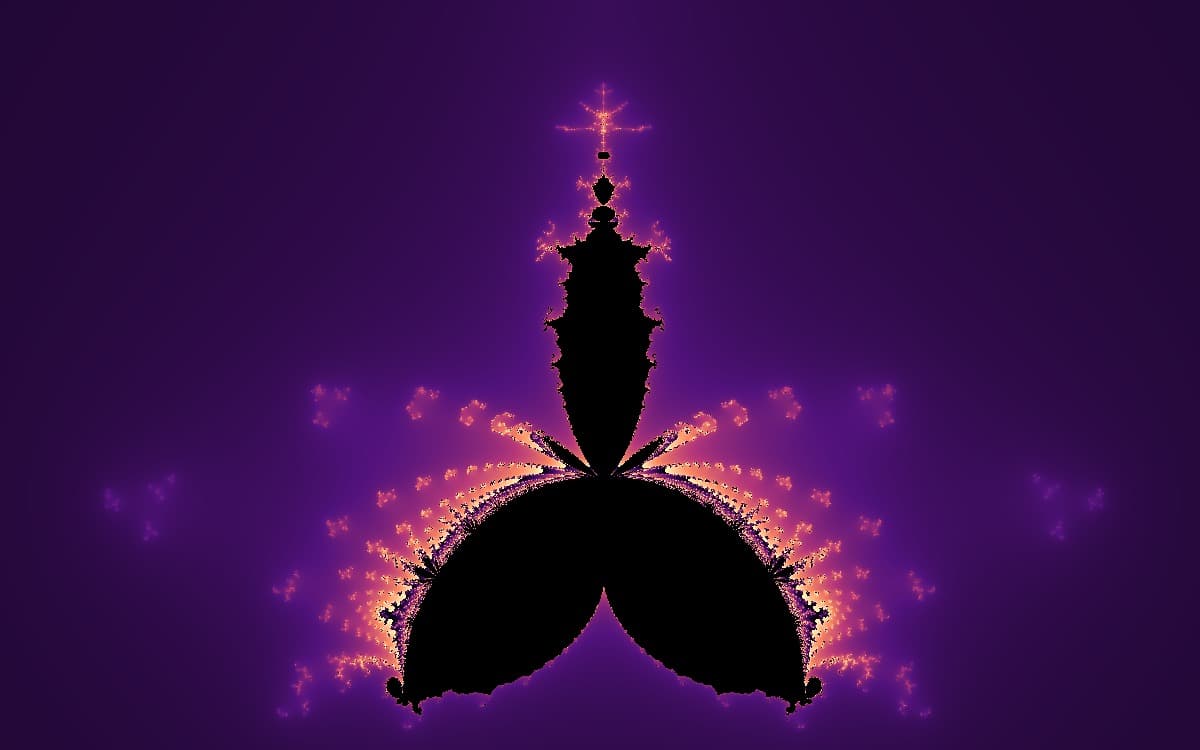
Фрактал Multi-Phoenix с перистыми спицами и тлеющими скоплениями нитей ("Ember Compass")
Multi-Phoenix от FractalPark ("Ember Compass"): спицы, подобные стрелкам компаса, расходятся сквозь светящиеся скопления нитей.

Обзор

Multi-Phoenix помнит свой последний шаг. Эта рекуррентность второго порядка использует и текущее z, и непосредственно предыдущее значение орбиты, взвешивая последнее комплексным коэффициентом памяти p. Эта память меняет направление детали и то, как долго она сохраняется.

Стандартный шаг Жюлиа, z → z² + c, памяти не имеет. Phoenix подтягивает прежнее z вперёд как p·zₙ₋₁. Меняйте p — и прошлое получает другой вес; поскольку p комплексное, этот вес может и поворачивать, и расти, и убывать. Далее следуют перистые спицы, пламеподобные веера, розетки-компасы и тлеющие скопления.

Нити подсказали крылья и хвост мифической птицы — отсюда «Phoenix». Сигэхиро Усики из Киотского университета открыл его и опубликовал в 1988 году.

Математика

Phoenix recurrence

z(n+1) = z(n)^2 + c + p times z(n-1)

Take the standard quadratic step zₙ² + c, then add p times the value from two steps ago. A second-order recurrence needs two starting values before its first iteration: z₀ and the “previous” value, usually 0. FractalPark exposes p as an adjustable complex control.

Try the classic Phoenix parameter pair c = 0.5667 and p = −0.5. Starting with z₀ = 0 and z₋₁ = 0, the first few values stay bounded and trace angular, wing-like arcs. Make p positive with a similar magnitude and the feathered structure can break apart or rotate: the memory term now reinforces the earlier direction instead of opposing it.
История

Shigehiro Ushiki, a mathematician in Kyoto University’s Graduate School of Human and Environmental Studies, discovered the Phoenix fractal. In 1988, he published the Phoenix iteration in IEEE Transactions on Circuits and Systems. He presented it as a complex-one-dimensional section of a Julia-like set derived from a complexified Hénon map. The paper is simply titled "Phoenix." The classic parameter pair (c = 0.5667, p = −0.5) produces the named Phoenix curve, later well known in fractal-rendering communities.

Ushiki’s broader research covers complex dynamical systems, Julia sets with polyhedral symmetries, higher-dimensional complex Hénon maps, and the dynamics of surface automorphisms. His Kyoto University homepage lists publications from the 1980s to the present.

The Phoenix family later appeared in Ultra Fractal and other fractal software in both Julia-mode and Mandelbrot-mode variants. FractalPark’s Multi-Phoenix uses the same core recurrence and adds a multi-preview parameter interface.

Визуальные особенности

That one-step memory is visible in feathered spokes radiating from centres, flame-like fans curling along filaments, and compass forms with a sense of direction. A standard quadratic Julia does not make these in the same way; they rely on the directional persistence of p·zₙ₋₁.

With different parameters, the same rule can close into ember-like clusters, open into radiating pinwheels, or dissolve into dust-like regions. FractalPark’s “Ember Compass” foregrounds the compass spokes and warm filament clusters.

Параметры

Память
The complex memory coefficient p sets both the strength and the rotational direction of the previous orbit value’s influence on the next step.

Ремиксы и примеры

Начните с канонического документа

Откройте то же утверждённое состояние формулы, которое используется в этом руководстве, а затем измените вид, раскраску, трансформации или анимацию в интерактивном Обзоре.

Часто задаваемые вопросы

Why does this formula need the previous value?

The recurrence is second-order: its next state depends on the current and immediately preceding orbit values. It is a discrete analogue of a delay differential equation, where the past feeds back into the present. The extra parameter p sets how much of that past continues forward.

Does the initial previous value matter?

Yes. A second-order recurrence requires two initial conditions — z₀ and the value of z before iteration begins (z₋₁) — for a deterministic orbit. FractalPark initializes z₋₁ to zero by default, the standard convention for the Phoenix family.

Ссылки