FractalPark
НьютонСредне

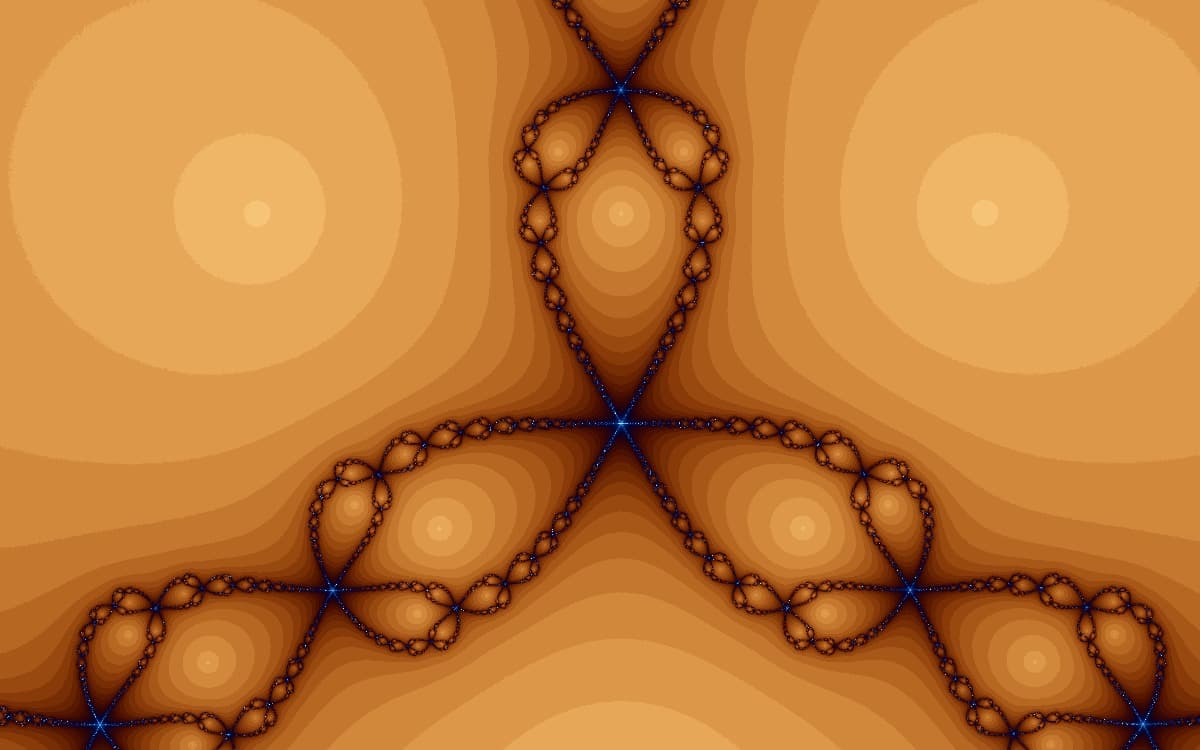
Newton Fractal for z³ − 1

Метод Ньютона для z³ − 1: три бассейна сходимости, разделённые границей, которая никогда не успокаивается.

Открыть в Обзоре
Фрактал Ньютона для z³ − 1: три бассейна встречаются вдоль спицеобразных линий со спиральными деталями на границе
Фрактал Ньютона для z³ − 1 от FractalPark: три бассейна сходимости в симметрии третьего порядка, соединённые вложенными спиральными границами.

Обзор

Эта формула превращает знакомый алгоритм поиска корней в карту комплексной плоскости. В отличие от множества Мандельброта, она не спрашивает, уходит ли орбита на бесконечность. Она спрашивает, к какому корню z³ − 1 приводит метод Ньютона из заданного старта. Каждый из трёх кубических корней из единицы (1, e^{2πi/3}, e^{4πi/3}) заявляет свой бассейн притяжения: все стартовые значения, чья орбита сходится к этому корню.

Три бассейна легко различить. А вот их общую границу — нет. Точка ровно на ней не достигает ни одного корня; вместо этого она следует по хаотическому, неповторяющемуся пути. Эта граница — множество Жюлиа ньютоновского отображения, рациональной функции N(z) = z − (z³ − 1)/(3z²). Приближайтесь — и структура продолжает прибывать.

Это классический фрактал сходимости: повседневный численный алгоритм с беспокойной границей внутри. Артур Кэли сформулировал задачу классификации бассейнов Ньютона в 1879 году. Он решил квадратичный случай, но кубический «представляется сопряжённым со значительными трудностями». Позднейшая комплексная динамика Фату и Жюлиа сделала задачу обозримой; первые компьютерные визуализации появились в начале 1980-х годов.

Математика

Newton iteration

z(n+1) = z(n) - (z(n)^3 - 1) / (3 z(n)^2)

For a function f(z), Newton iteration is N(z) = z − f(z) / f′(z). Here f(z) = z³ − 1 and f′(z) = 3z². Each step subtracts the polynomial value divided by its derivative, nudging z toward a root. For the cubic z³ − 1, the iteration simplifies to:

N(z) = z − (z³ − 1) / (3z²) = (2z³ + 1) / (3z²).

This is a degree‑2 rational map of the Riemann sphere. Its fixed points are exactly the three cube roots of unity, and they are all superattracting—once an orbit is close enough to a root, convergence is extremely fast. The Julia set is the boundary where basins meet, and the map is chaotic there.

Try a concrete starting point: z₀ = 0.5. Then z₁ = (2·0.125 + 1) / (3·0.25) = (0.25 + 1) / 0.75 ≈ 1.667, z₂ ≈ 1.107, z₃ ≈ 1.001, and the orbit rapidly converges to the root at 1. Now try z₀ = 0.5i: z₁ ≈ −0.417 + 0.583i, z₂ ≈ −0.495 + 0.865i, and the orbit converges to e^{2πi/3} = −0.5 + 0.866i. A third starting point, say z₀ = −0.5 − 0.5i, converges to the remaining root e^{4πi/3} = −0.5 − 0.866i. The basins are large and well separated, but close to a boundary a tiny nudge in the starting value can switch the destination entirely.

FractalPark uses a stability threshold: an orbit counts as converged when consecutive iterates differ by less than a chosen tolerance. The pixel is then coloured by the root reached and the number of steps needed.
История

At the heart of this image is Newton's method, discovered by Isaac Newton in 1669 and independently refined by Joseph Raphson in 1690. For real functions it is a practical root‑finding tool; for complex polynomials it reveals fractal basins no one could have foreseen at the time.

The mathematical study of those basins began in 1879 with Arthur Cayley's paper "The Newton–Fourier imaginary problem" (American Journal of Mathematics, vol. 2, p. 97). For a complex quadratic polynomial, Cayley showed that the basins of attraction are simply the two half-planes separated by the perpendicular bisector of the line segment joining the two roots. At cubic polynomials, though, he found the problem "considerable difficult." His inability to extend the simple quadratic result to the cubic case became known as Cayley's problem.

The resolution came through complex dynamics, developed by Pierre Fatou and Gaston Julia in the years around 1918. Their theory of iterated rational functions supplied the language for the basins and their infinitely convoluted boundaries. But the first pictures of the Newton fractal for z³ − 1 had to wait for computer graphics in the early 1980s.

In 1986, Heinz-Otto Peitgen and Peter H. Richter included a chapter titled "Newton's Method for Complex Polynomials: Cayley's Problem" (Chapter 6, pp. 93–106) in *The Beauty of Fractals: Images of Complex Dynamical Systems*. It presents some of the earliest published computer renderings of these basins and helped introduce a wide audience to the fractal structure hidden inside Newton's method.

Визуальные особенности

Three large basins, one for each cube root of unity, occupy the image. They meet in wheel-spoke lines from the centre, making the three-part symmetry plain. Inside each basin, convergence is quick and the colour stays smooth.

Between any two basins—and especially at the central three-way meeting—spirals, miniature three-basin copies, and dendritic threads crowd in. Follow a spiral arm inward: the three-basin arrangement returns at smaller scales, bent by local dynamics. Broad calm regions; then a restless frontier.

Ремиксы и примеры

Начните с канонического документа

Откройте то же утверждённое состояние формулы, которое используется в этом руководстве, а затем измените вид, раскраску, трансформации или анимацию в интерактивном Обзоре.

Часто задаваемые вопросы

What do the main regions represent?

Each coloured region is a basin of attraction: it contains the starting points whose Newton iteration converges to the same root of z³ − 1. The three cube roots of unity are 1, e^{2πi/3} = −0.5 + 0.866i, and e^{4πi/3} = −0.5 − 0.866i. A point’s colour records the root it reaches and how quickly convergence happens.

Is this an escape-time fractal?

It is primarily a convergence fractal. The classification is not about whether the orbit escapes to infinity (as in the Mandelbrot set), but which root it approaches and how many steps it takes. There is no escape-radius test. Instead, the renderer checks whether consecutive iterates have become very close—indicating convergence to a root—and, if so, which root they are near.

Ссылки