FractalPark
НьютонСложно

Newton Cosh

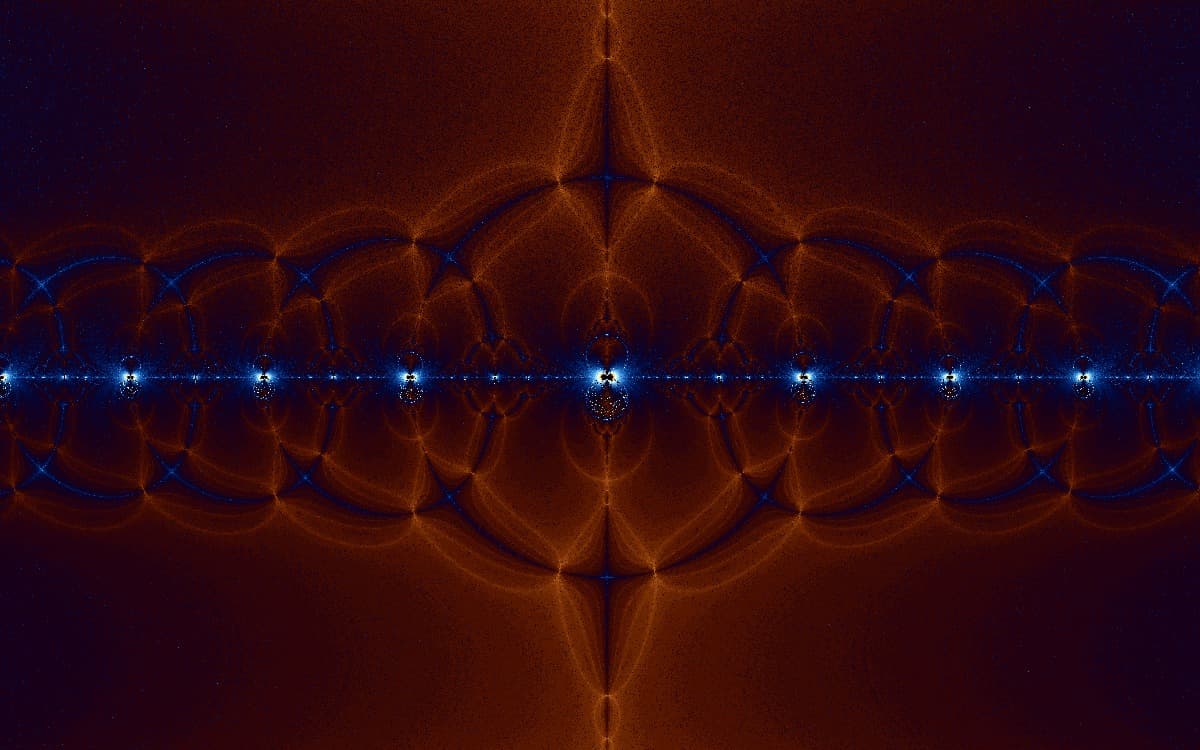
Метод Ньютона для cosh z = 1: бесконечно много равномерно расположенных корней превращают плоскость в повторяющиеся полосы сходимости.

Открыть в Обзоре
Фрактал Ньютона для cosh z = 1 с повторяющимися горизонтальными полосами и искривлёнными границами, сложенными вдоль мнимой оси
Ньютоновский вид cosh z = 1 от FractalPark: повторяющиеся полосы сходимости вдоль мнимой оси, разделённые сложенными нитевидными границами.

Обзор

Обычный шаг поиска корня по Ньютону меняет характер, когда f(z) = cosh z − 1. Его корни — 2πik для каждого целого k. Многочлен даёт орбите лишь конечное число возможных назначений; эти корни продолжают маршировать вдоль мнимой оси через равные интервалы. Поэтому фрактал устраивается полосами, идущими вверх и вниз, а не укладывается в несколько бассейнов.

Отображение N(z) = z − (cosh z − 1) / sinh z мероморфно: оно работает на всей комплексной плоскости, кроме своих особенностей. Следите за двумя повторяющимися наборами точек: корни cosh z − 1 и нули знаменателя sinh z при z = πik для целого k. Вблизи нуля знаменателя лёгкий сдвиг стартовой точки может переключить корень, которого достигнет орбита.

Периодичность вдоль мнимой оси видна с первого взгляда — математическая подготовка не нужна. Горизонтальные полосы повторяются одна над другой, по одной на каждый период корней. На их стыках тонкие вертикальные нити отмечают, где один бассейн передаёт орбиту следующему.

Математика

Newton’s cosh iteration

z(n+1) = z(n) - (cosh(z(n)) - 1) / sinh(z(n))

Newton's rule is N(z) = z − f(z) / f′(z). Here f(z) = cosh z − 1 and f′(z) = sinh z. Each step finds the correction (cosh z − 1) / sinh z, then takes it away from z.

The equation cosh z = 1 has infinitely many solutions: z = 2πik for every integer k. Each is a simple root: cosh z grows linearly close by, so Newton's method converges quadratically there. Far from the real axis, cosh and sinh grow exponentially. Their quotient may be tiny or enormous, and that is where the image's sensitive seams take shape.

Try z₀ = 0.2i. Since i·sinh(0.2) ≈ 0.201i and cosh(0.2) ≈ 1.020, the first correction is small; the orbit quickly reaches the root at z = 0. Now move to z₀ = (0.5 + 3.0i), farther from every root. The correction now contains large exponential terms. The orbit can cross several basin boundaries before settling, or wander chaotically between roots for many iterations before one captures it.

The function repeats with period 2πi in the imaginary direction, and the Newton map does too: N(z + 2πi) = N(z) + 2πi. That repeated rule is the source of the horizontal banding.
Визуальные особенности

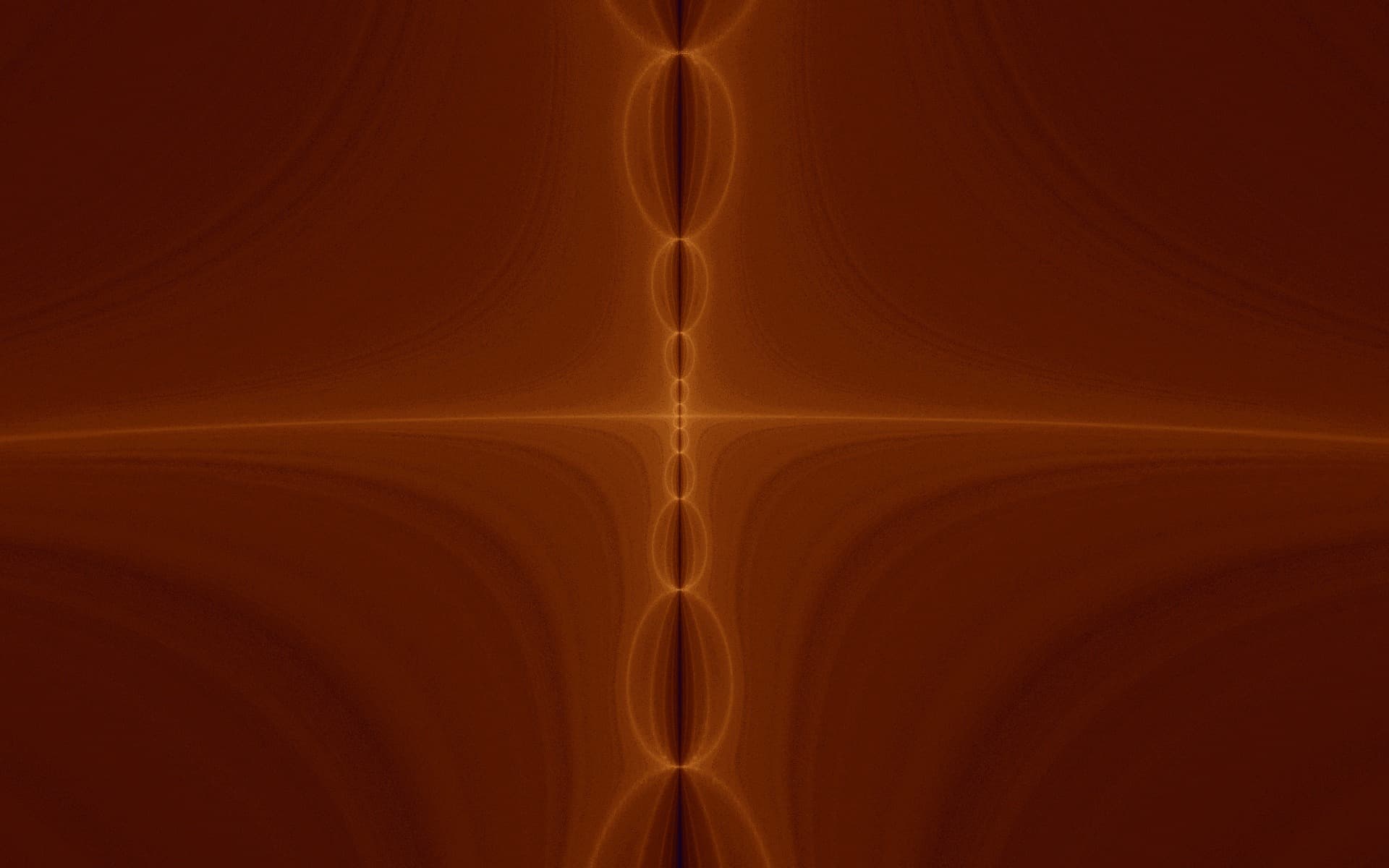
Start with the horizontal bands along the imaginary axis. A period of roots makes one band, and the convergence pattern returns in the next. The borders do not run straight: they bend and fold, then pull out fine vertical filaments like taut threads.

Within each band, the basin geometry resembles its neighbours, with small distortions. Think of a ribbon folded repeatedly. The warm and cool zones come from the colouring; the sharp breaks arise where singularities of sinh z destabilise the Newton correction.

Ремиксы и примеры

Начните с канонического документа

Откройте то же утверждённое состояние формулы, которое используется в этом руководстве, а затем измените вид, раскраску, трансформации или анимацию в интерактивном Обзоре.

Часто задаваемые вопросы

What equation is being solved?

It seeks the complex solutions of cosh(z) = 1: z = 2πik for every integer k. The equally spaced roots line the imaginary axis. Each draws in nearby Newton orbits, and their repeating arrangement creates the horizontal bands.

Why are some regions extremely sensitive?

The correction divides by sinh(z), which vanishes at z = πik for integer k. Close to one of these points, the correction can become huge, sending an orbit across several basin boundaries before it converges. These singularities are not roots; they pull the fine vertical filaments and unsettled border zones into view.