FractalPark
ТрансцендентныеСредне

Cosh Mandelbrot

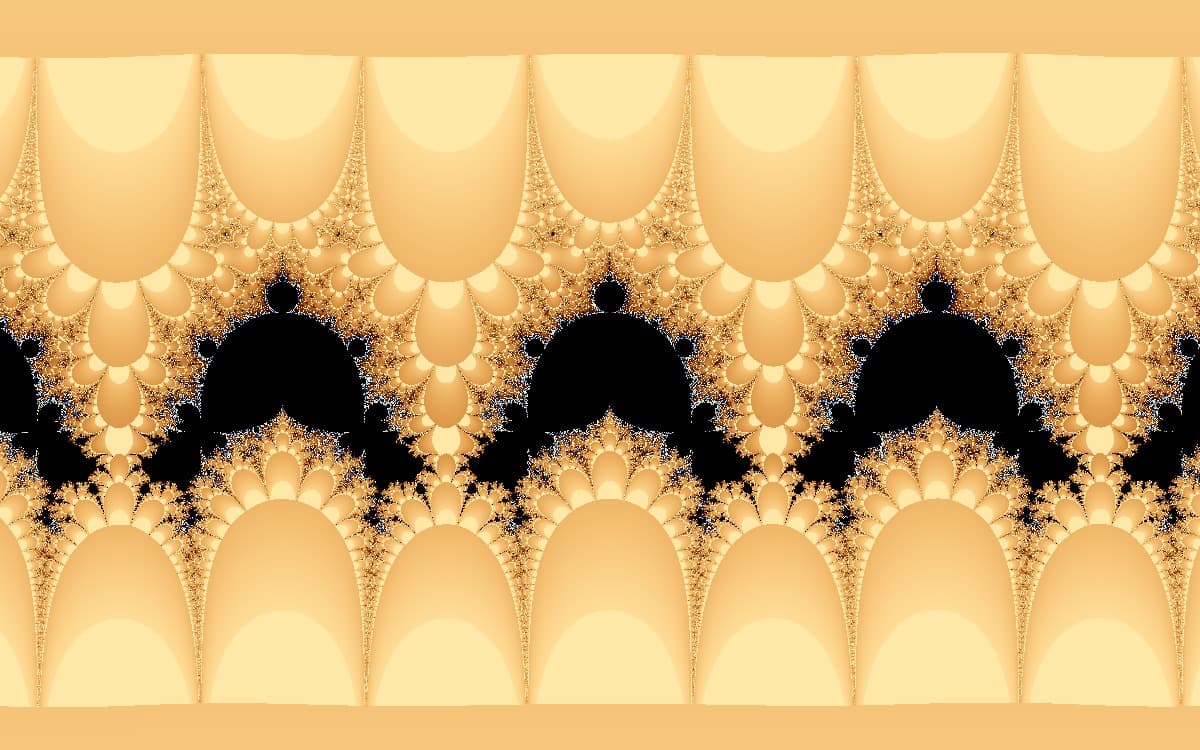
Трансцендентное отображение времени ухода на бесконечность: гиперболический косинус заменяет возведение в квадрат, а его место занимают вертикально повторяющиеся перья и слоистые веера.

Открыть в Обзоре
Слоистые золотые перья и веера, повторяющиеся через равные вертикальные промежутки во фрактале Cosh Mandelbrot
Cosh Mandelbrot от FractalPark: золочёные перья и слоистые веера возвращаются по вертикали с периодом cosh 2π в мнимом направлении.

Обзор

Cosh Mandelbrot оставляет знакомый полиномиальный шаг позади. Вместо повторения z² + c он повторяет z → cosh(z) + c. Возведение в квадрат заменяется экспоненциальным ростом гиперболического косинуса вдоль вещественной оси и его 2π-периодичностью вдоль мнимой оси.

Комплексный косинус и гиперболический косинус — близкие родственники: каждый повторяется вдоль одного направления и неограниченно растёт вдоль другого. Для cosh(z) период по мнимой оси равен 2π, поэтому полоса деталей возвращается над и под собой. Когда |Re(z)| велико, его экспоненциальные слагаемые устремляются наружу. Большинство стартовых точек уходят быстро; лишь тонкие полосы удерживают орбиту — сохраняя её последовательные значения ограниченными на протяжении многих шагов.

Плоскость параметра больше не напоминает кардиоиду и «почки» множества Мандельброта. Вместо этого она складывает веера, золочёные перья и вертикальные эхо. Линия между уходом и неуходом проведена самой трансцендентной итерацией; простого алгебраического радиуса ухода здесь нет.

Математика

Hyperbolic cosine iteration

z(n+1) = cosh(z(n)) + c

Each turn evaluates complex hyperbolic cosine at the current z, then adds c. The definition cosh(z) = (eᶻ + e⁻ᶻ)/2 puts exponential growth on the real axis beside imaginary-axis repetition with period 2π.

Try z = iπ/2 on the imaginary axis. Since cosh(iπ/2) = cos(π/2) = 0, starting there with c = 0 leaves the recurrence at zero. Nudge the point off that axis and the eᶻ term can drive exponential growth and rapid escape. That sharp divide—bounded behavior in a narrow strip, rapid escape elsewhere—is typical of transcendental iteration. Unlike a polynomial, this map has no universal escape radius; FractalPark uses a bailout threshold chosen to detect divergence in practice.

История

In 1988, Clifford A. Pickover, a computer scientist and author at IBM's Thomas J. Watson Research Center, published the short paper "Chaotic behavior of the transcendental mapping (Z → cosh(Z) + μ)" in The Visual Computer. He presented images of chaotic behavior produced by this transcendental function, alongside maps such as z → sin(z) + c and z → eᶻ + c.

Pickover’s work brought the cosh-based map into the fractal-rendering community, where it became a standard transcendental escape-time example. Earlier, mathematicians including Robert Devaney and Michał Krych had developed the broader study of transcendental complex dynamics—exponential, trigonometric, and hyperbolic families—and analyzed the dynamics of exp(z) in the 1980s.

Визуальные особенности

First notice the vertical repetition. Because cosh(z) repeats in the imaginary direction every 2π, fine plumes, layered fans, and gilt filaments return at regular intervals. The result is striped and tiered, far from the radial branching of polynomial Mandelbrot sets.

In the canonical rendering, plumes and fans often carry warm tones. The finest detail concentrates in narrow horizontal bands, where an orbit lingers near the boundary between escape and non-escape. Above and below, escape accelerates and the image becomes smoother.

Ремиксы и примеры

Начните с канонического документа

Откройте то же утверждённое состояние формулы, которое используется в этом руководстве, а затем измените вид, раскраску, трансформации или анимацию в интерактивном Обзоре.

Часто задаваемые вопросы

Why do patterns repeat vertically?

Complex hyperbolic cosine repeats along the imaginary axis with period 2π. Because every step uses cosh(z), the orbit structure repeats too: bounded and escaping behavior returns at regular vertical intervals in the parameter plane.

Why do many points escape rapidly?

Hyperbolic cosine is built from exponentials: cosh(z) = (eᶻ + e⁻ᶻ)/2. At a point with a substantial real part, the eᶻ term takes over and the orbit can grow extremely fast. There is no simple polynomial-style escape radius, so the bailout threshold is a practical computational choice.

Ссылки