FractalPark
КлассическиеЛегко

Quartic Julia

Множество Жюлиа четвёртой степени: возведите z в четвёртую степень, прибавьте фиксированное c — и начнётся ветвление на четыре.

Открыть в Обзоре
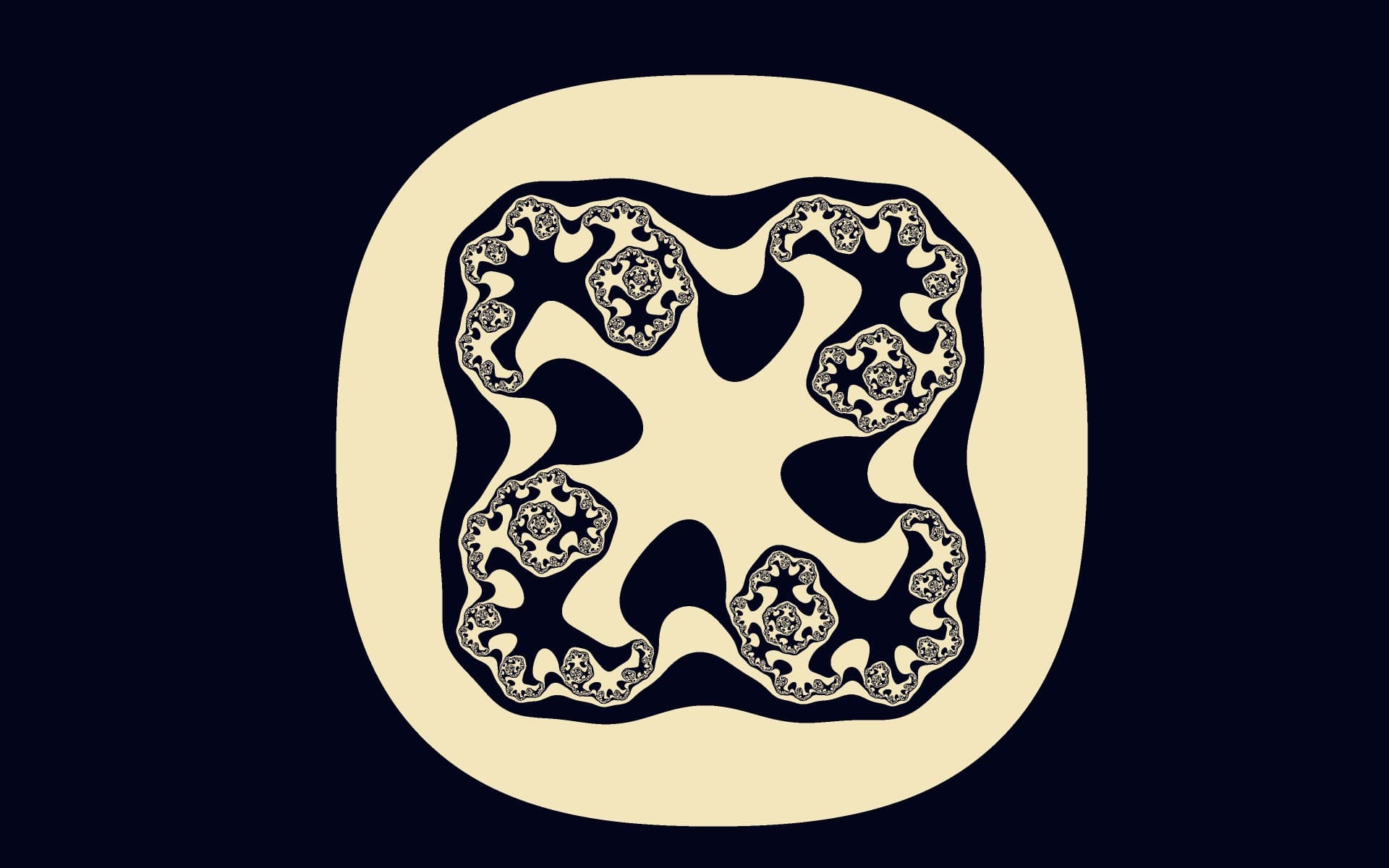
Множество Жюлиа четвёртой степени с кромкой цвета слоновой кости, розетками четвёртого порядка и ветвящейся филигранью
Quartic Julia от FractalPark: филигрань цвета слоновой кости повторяет ветвящиеся розетки и четырёхкратные нити.

Обзор

Возьмите обычный рецепт Жюлиа и поверните рукоятку на один шаг: зафиксируйте одну комплексную постоянную c и повторяйте z → z⁴ + c. Каждое возведение в четвёртую степень умножает комплексный аргумент на четыре. Направление, которое у квадратичного отображения могло раздвоиться, здесь может раскрыться на четыре — отсюда и ветвление на четыре.

При том же c это отображение более высокой степени обычно умещает в множество больше поворотов, чем его квадратичный родственник. Останется ли заполненное множество Жюлиа единым или распадётся, по-прежнему зависит от c, согласно классификации Фату–Жюлиа для многочленов высших степеней. Следите за критической орбитой — здесь она управляется критической точкой z = 0 и критическими точками производной, — и она даст ключ к этой связности.

На экране это читается не столько как облако, сколько как тиснёный орнамент: тонкая филигрань, розетки и печатеподобные узлы повторяются с симметрией четвёртого порядка. Дополнительная степень уплотняет детали, однако угловатая компоновка остаётся поразительно упорядоченной.

Математика

Quartic iteration

z(n+1) = z(n)^4 + c

One step has the effect of four squarings: the argument is multiplied by four, so a point near the boundary can split four ways. Try c = 0. The recurrence becomes zₙ₊₁ = zₙ⁴, simply a fourth-power map. From z₀ = 0.5 + 0i, the values shrink toward zero and remain bounded; from z₀ = 1.5 + 0i, they grow rapidly and escape. As in the quadratic case, |zₙ| signals escape: once it passes a fixed threshold (about 2 for this quartic), the orbit must diverge. The fourth power hastens the outward flight; it also speeds the angular splitting that creates the four-fold shape.

FractalPark holds c fixed across the image and varies the starting point z₀ from pixel to pixel—the usual Julia-family setup.
История

The theory came first. Pierre Fatou and Gaston Julia developed the classical framework for iterated rational functions in 1917–1918, and it applies to polynomials of any degree. Quartic Julia sets inherit its principles for connectivity and dynamical classification. When fractal-rendering software moved beyond quadratics in the 1980s and 1990s, computer exploration of higher-degree Julia sets became common. The named quartic variant belongs to that line; no single discoverer is attributed to it.

FractalPark uses the standard fourth-degree recurrence as a fixed-parameter Julia-family formula.

Визуальные особенности

Angles multiplied by four leave a recognizable trace: fine seals, branching rosettes, and filaments arranged on a quartic grid. A quadratic Julia may grow a spiral or one pair of arms; here, feature centers often send out four matching arms or lobes.

More detail fits into the same space than in a quadratic Julia, but it arrives in a tidier order. Turn ninety degrees around a prominent point and a motif often returns. The canonical FractalPark image picks out those edges with ivory filigree.

Ремиксы и примеры

Начните с канонического документа

Откройте то же утверждённое состояние формулы, которое используется в этом руководстве, а затем измените вид, раскраску, трансформации или анимацию в интерактивном Обзоре.

Часто задаваемые вопросы

Why is this called Quartic Julia?

Its rule uses the fourth power of z, so it is a quartic, or degree-four, polynomial. The name distinguishes it from the standard quadratic Julia set and other higher-degree variants.

What does c change?

The fixed complex constant c decides whether the filled Julia set is connected or disconnected, then shapes its fine geometry. Nudge c and four-way branches rearrange, seals and filaments shift, and a connected set can fall into disconnected dust.

Ссылки