FractalPark
PhoenixMedium

Multi-Phoenix

A quadratic recurrence with memory: a complex coefficient carries the previous orbit value into the next step, producing feathered, flame-like forms.

Open in Explorer
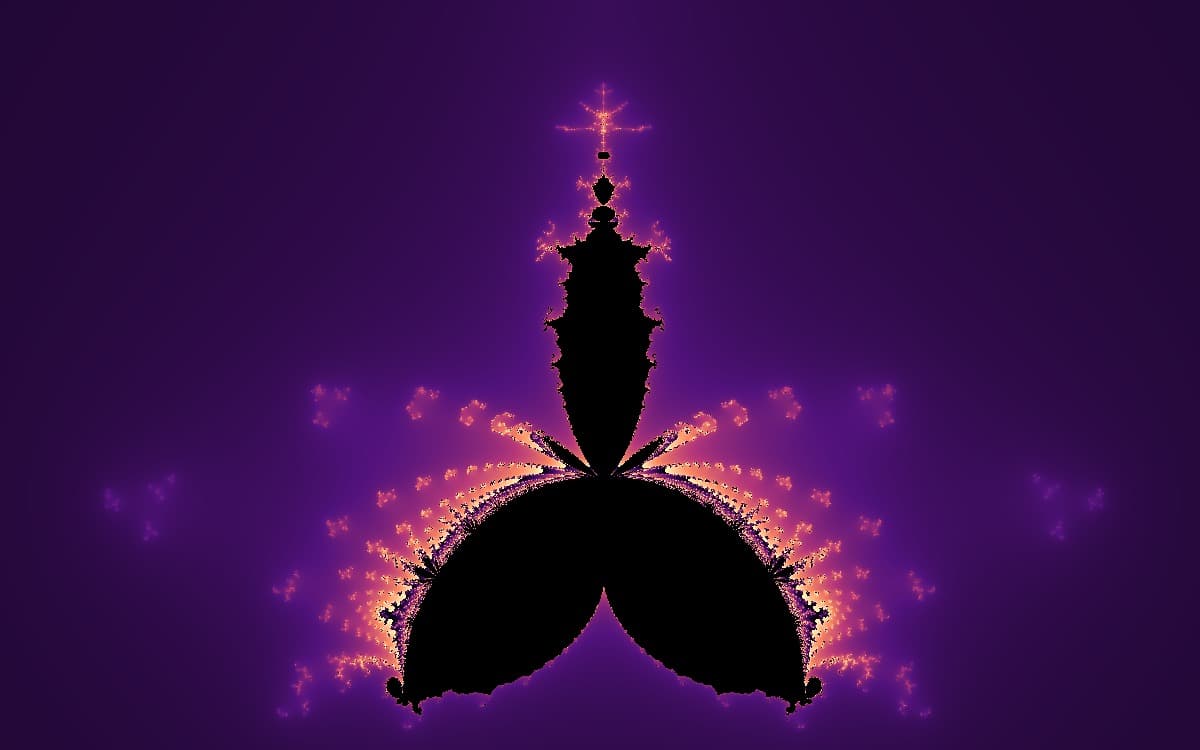
Multi-Phoenix fractal with feathered spokes and ember-like filament clusters ("Ember Compass")
FractalPark’s Multi-Phoenix ("Ember Compass"): compass-like spokes radiate through glowing clusters of filaments.

Overview

Multi-Phoenix remembers its last step. This second-order recurrence uses both the current z and the immediately previous orbit value, weighting the latter by the complex memory coefficient p. That memory changes a feature’s direction and how long it persists.

The standard Julia step, z → z² + c, has no memory. Phoenix brings the earlier z forward as p·zₙ₋₁. Change p and the past carries a different weight; because p is complex, that weight can rotate as well as grow or shrink. Feathered spokes, flame-like fans, compass rosettes, and ember-like clusters follow.

The filaments suggested the wings and tail of the mythical bird, hence “Phoenix.” Shigehiro Ushiki of Kyoto University discovered it and published it in 1988.

The Mathematics

Phoenix recurrence

z(n+1) = z(n)^2 + c + p times z(n-1)

Take the standard quadratic step zₙ² + c, then add p times the value from two steps ago. A second-order recurrence needs two starting values before its first iteration: z₀ and the “previous” value, usually 0. FractalPark exposes p as an adjustable complex control.

Try the classic Phoenix parameter pair c = 0.5667 and p = −0.5. Starting with z₀ = 0 and z₋₁ = 0, the first few values stay bounded and trace angular, wing-like arcs. Make p positive with a similar magnitude and the feathered structure can break apart or rotate: the memory term now reinforces the earlier direction instead of opposing it.
History

Shigehiro Ushiki, a mathematician in Kyoto University’s Graduate School of Human and Environmental Studies, discovered the Phoenix fractal. In 1988, he published the Phoenix iteration in IEEE Transactions on Circuits and Systems. He presented it as a complex-one-dimensional section of a Julia-like set derived from a complexified Hénon map. The paper is simply titled "Phoenix." The classic parameter pair (c = 0.5667, p = −0.5) produces the named Phoenix curve, later well known in fractal-rendering communities.

Ushiki’s broader research covers complex dynamical systems, Julia sets with polyhedral symmetries, higher-dimensional complex Hénon maps, and the dynamics of surface automorphisms. His Kyoto University homepage lists publications from the 1980s to the present.

The Phoenix family later appeared in Ultra Fractal and other fractal software in both Julia-mode and Mandelbrot-mode variants. FractalPark’s Multi-Phoenix uses the same core recurrence and adds a multi-preview parameter interface.

Visual Characteristics

That one-step memory is visible in feathered spokes radiating from centres, flame-like fans curling along filaments, and compass forms with a sense of direction. A standard quadratic Julia does not make these in the same way; they rely on the directional persistence of p·zₙ₋₁.

With different parameters, the same rule can close into ember-like clusters, open into radiating pinwheels, or dissolve into dust-like regions. FractalPark’s “Ember Compass” foregrounds the compass spokes and warm filament clusters.

Parameters

Memory
The complex memory coefficient p sets both the strength and the rotational direction of the previous orbit value’s influence on the next step.

Remix and Examples

Start from the canonical Document

Open the same approved formula state used by this guide, then change the view, coloring, transforms, or animation in the interactive Explorer.

Frequently Asked Questions

Why does this formula need the previous value?

The recurrence is second-order: its next state depends on the current and immediately preceding orbit values. It is a discrete analogue of a delay differential equation, where the past feeds back into the present. The extra parameter p sets how much of that past continues forward.

Does the initial previous value matter?

Yes. A second-order recurrence requires two initial conditions — z₀ and the value of z before iteration begins (z₋₁) — for a deterministic orbit. FractalPark initializes z₋₁ to zero by default, the standard convention for the Phoenix family.

References