FractalPark
ExoticMedium

Spider

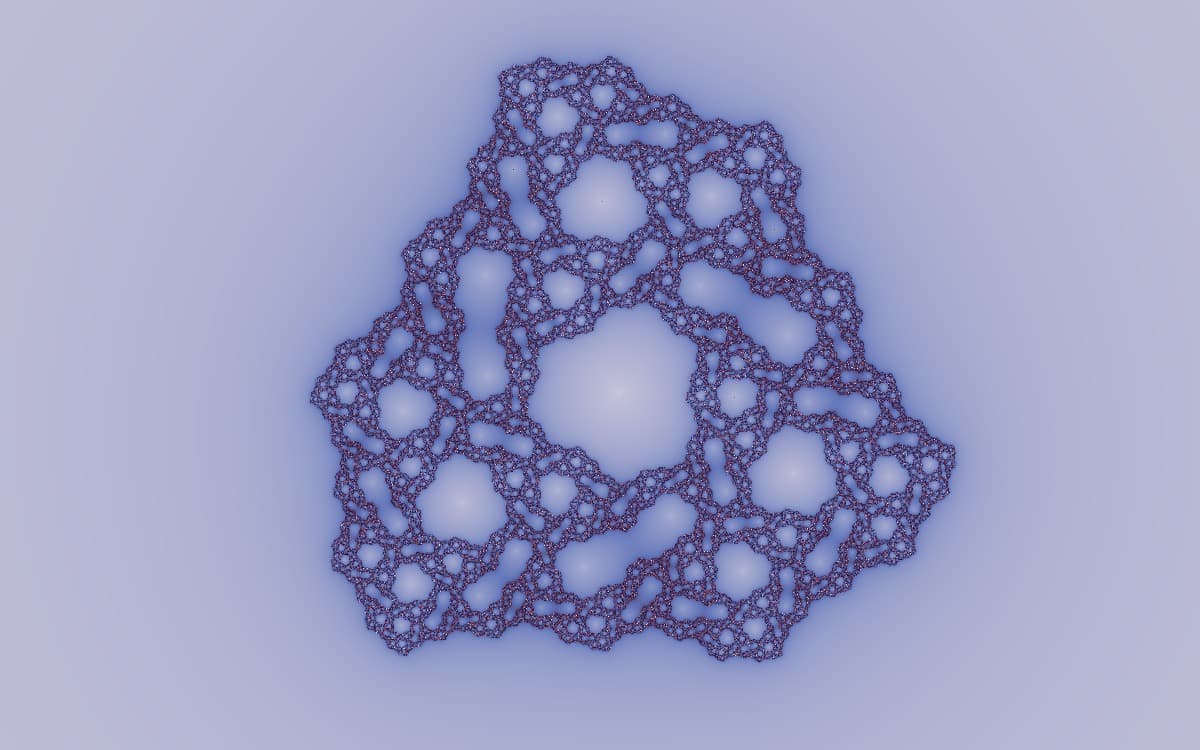
A rational map that adds c/z to a quadratic orbit; the pole at zero pulls out long legs and web-like filaments.

Open in Explorer
The Spider fractal: long legs and abyssal filaments radiating from a dark central core
The Spider fractal rendered by FractalPark: long legs and web-like filaments emerge from a dark core, in deep abyssal blues and blacks.

Overview

The Spider formula joins the familiar squared term z² to c/z. It is a degree-2 rational map with two competing pulls. Far from zero, z² runs the orbit much as it does in a quadratic Mandelbrot escape. Close in, c/z takes over and points toward the pole at the origin.

That contest stretches the parameter boundary into branching filaments, not merely a shifted escape threshold. A narrow centre, radiating legs, and dark gaps explain the name.

Because the rule divides by z, z = 0 is singular. Renderers must handle values extremely close to zero with a numerical fallback. c itself may be zero; then the map becomes z² and ordinary quadratic Julia dynamics return.

The Mathematics

Spider iteration

z(n+1) = z(n)^2 + c / z(n)

The reciprocal term gives a quadratic orbit a sharp tug around the pole at zero.

Start with c = 0. The reciprocal term vanishes, leaving z², the standard quadratic Julia map; initial values inside the unit disk can still have bounded orbits.

Now take c = 1 and z₀ = (1, 0). The first iteration gives z₁ = 1² + 1/1 = 2, already far from the origin; the next gives z₂ = 4 + 1/2 = 4.5, and escape is rapid. Begin near zero instead—say z₀ = (0.01, 0)—and 1/0.01 = 100 dominates, throwing the orbit out at once. The spider filaments live on the boundary between those regimes.
Visual Characteristics

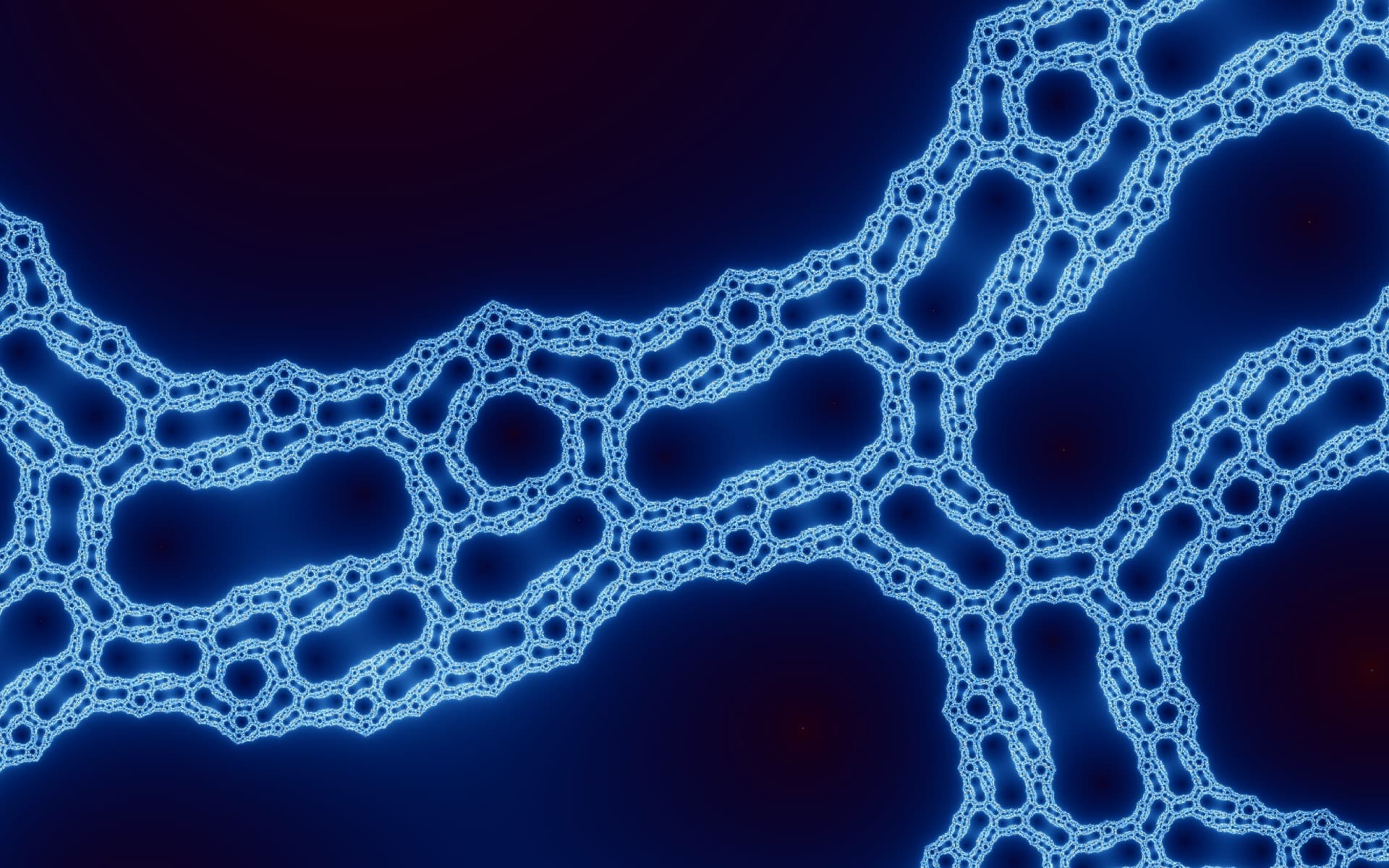
Long legs, dark filaments, and web-like junctions run out from a narrow centre. The origin's singularity makes a dark core; from it the threads branch and thin.

The canonical FractalPark rendering uses deep blues and blacks. The rational term breaks full symmetry, leaving the set slightly twisted rather than neatly balanced.

Remix and Examples

Start from the canonical Document

Open the same approved formula state used by this guide, then change the view, coloring, transforms, or animation in the interactive Explorer.

Frequently Asked Questions

What happens at z = 0?

At z = 0 the reciprocal term asks for division by zero, which is undefined. The implementation uses a stable fallback for extremely small values, by clamping the magnitude or substituting a small constant. This does not change the visible structure: points entering that near-zero zone are normally flung outward by the large reciprocal value on the next step.

What creates the spider‑like legs?

The legs form where quadratic expansion and reciprocal attraction are nearly balanced. There an orbit can alternate between a pull toward zero and a throw outward, drawing the boundary between bounded and escaping behaviour into long threads. The effect is strongest near the origin, where the reciprocal term is largest; farther out, z² regains control and the threads taper.