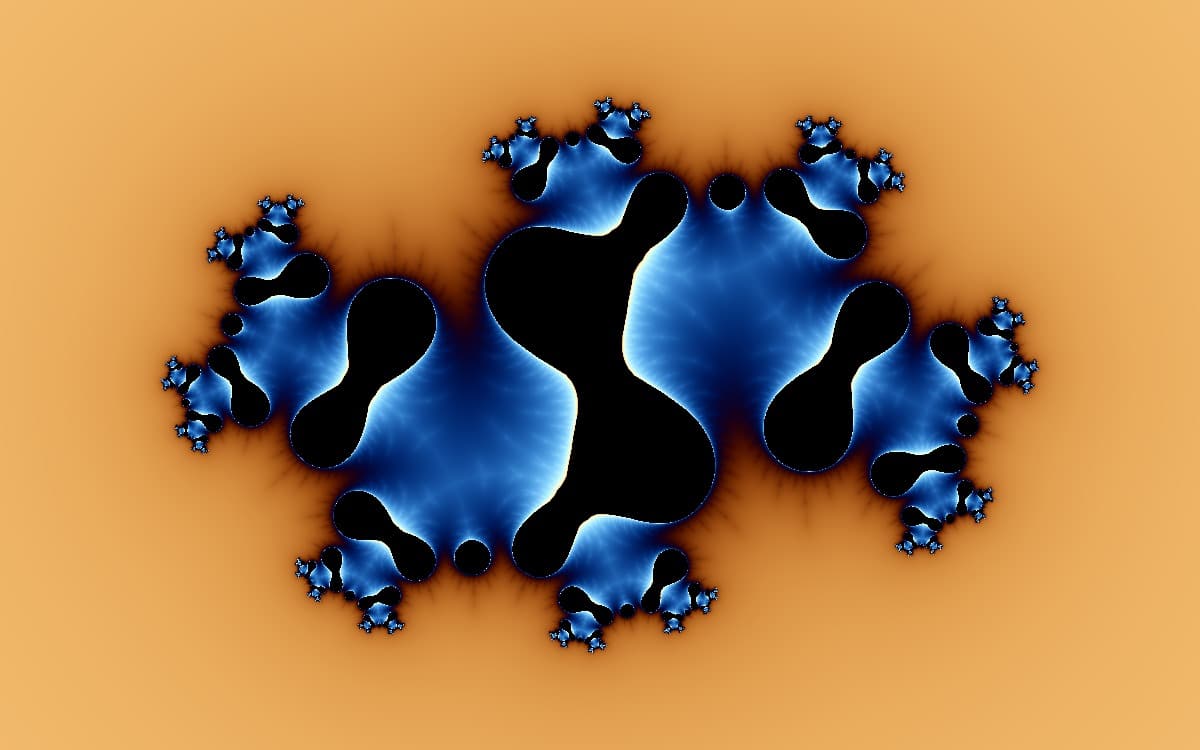
FractalPark
ExoticEasy

Zubieta

A quadratic map that folds both parts of z² + c into the nonnegative quadrant each step, producing double mirror symmetry and compact mandala-like forms.

Open in Explorer
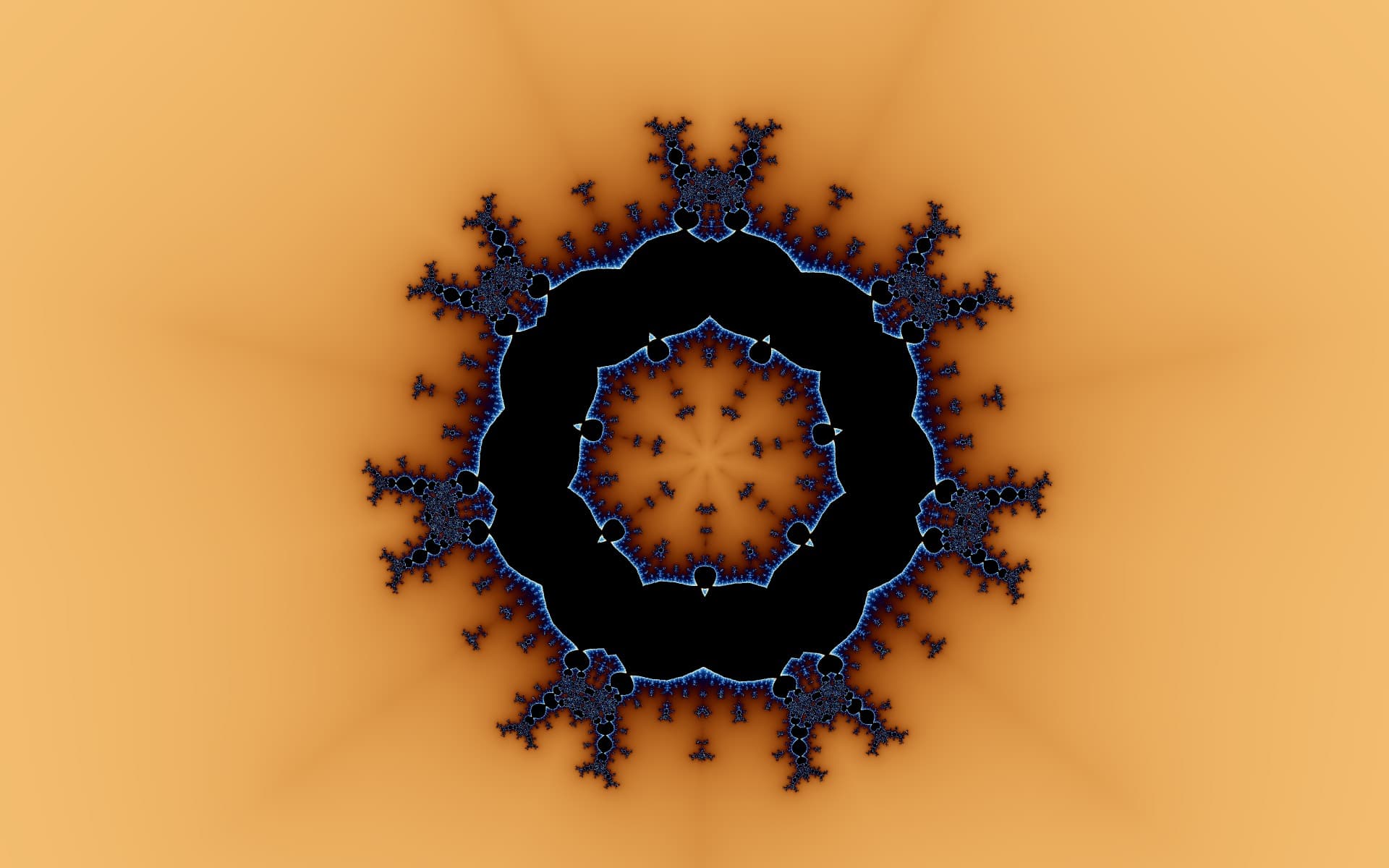
The Zubieta fractal: mirrored wedges and mandala-like lobes in warm amber ("Kaleido Amber Mandala")
The Zubieta fractal rendered by FractalPark ("Kaleido Amber Mandala"): double-mirror symmetry arranges compact lobes and tiled filaments into a kaleidoscopic mandala.

Overview

Zubieta is an “absolute-value” cousin of the classic Mandelbrot iteration. It performs the usual update zₙ² + c, then takes absolute value separately on the real and imaginary parts. This is not complex magnitude, which would squash the two parts into one real number. Think of folding a sheet along both axes: the complex structure remains, but each coordinate returns to the nonnegative quadrant.

Repeat that fold and an orbit keeps returning to, or passing through, the first quadrant. Mirror symmetry piles up. The standard Mandelbrot set has one mirror axis, the real axis; Zubieta reflects across both axes, laying out four mirrored quadrants like a kaleidoscope.

Burning Ship and Buffalo use similar component-wise folds at other moments in the iteration. Zubieta folds after both squaring and adding c. That timing gives it its own compact lobes, tiled wedges, and mirrored filaments.

The Mathematics

Component-folded iteration

z(n+1) is the component-wise absolute value of z(n)^2 + c

Here the bars mean component-wise absolute value, not complex magnitude. For u = x + iy, |u| means |x| + i|y|: take the absolute value of each part. Picture folding the point into the first quadrant.

Try c = −0.5 + 0i. In the standard Mandelbrot iteration, z₀ = 0 produces z₁ = −0.5, z₂ = −0.25, z₃ ≈ −0.4375, and so on, converging to a fixed point. Zubieta folds those same values: after one step, |−0.5| = 0.5, so z₁ is 0.5 rather than −0.5. One small fold redirects the orbit—and changes how c is classified.

The escape threshold comes from the quadratic Mandelbrot test: once |zₙ| exceeds 2, divergence is guaranteed. The component-wise fold can keep some orbits bounded longer than the unfolded rule would.
History

Zubieta belongs to a broader family of "abs" fractal variants — maps that apply absolute-value folds at different stages of the quadratic iteration. The best-known member of this family is the Burning Ship fractal, discovered by Michael Michelitsch and Otto E. Rössler in 1992, which folds the components before squaring. The Buffalo fractal, another relative, applies the fold after squaring but before adding c.

The Zubieta variant applies the component-wise absolute value after both squaring and the addition of c. Its precise origin is difficult to pin to a single published academic source. Variants of this kind circulated among fractal-rendering communities and software packages (Ultra Fractal, Fractint, XaoS) in the 1990s and 2000s, often named after whoever first implemented or popularized them in a given program.

FractalPark's implementation follows the standard component-wise fold and renders the parameter plane in Mandelbrot mode.

Visual Characteristics

Repeated component-wise folding imposes double-mirror symmetry. The image reflects across both real and imaginary axes, making mirrored wedges, compact mandala-like lobes, and tiled filaments.

Compared with Buffalo, which folds before squaring, Zubieta's post-update fold packs its lobes more tightly. In FractalPark's canonical rendering ("Kaleido Amber Mandala"), amber colour fills boundaries patterned with repeated angular motifs.

Remix and Examples

Start from the canonical Document

Open the same approved formula state used by this guide, then change the view, coloring, transforms, or animation in the interactive Explorer.

Frequently Asked Questions

Is the absolute value a complex magnitude?

No. FractalPark takes absolute value separately on the real and imaginary parts. It takes |x| and |y| independently, reflecting each coordinate into the nonnegative range without collapsing the complex number to one real value.

Why is the image strongly mirrored?

Folding both output components into the first quadrant on every iteration imposes double reflection symmetry. The orbit is repeatedly sent back toward the nonnegative region, and the parameter map mirrors across both axes. Burning Ship gains its flame-like symmetry by a related fold, though Zubieta packs the result into tighter mandala-like patterns.

References