FractalPark
ExotiqueDifficile

McMullen 2–3 Map

Une application rationnelle où la mise au carré pousse les points vers l'extérieur et un terme inverse-cubique les envoie à travers le pôle à l'origine.

Ouvrir dans l'Explorateur
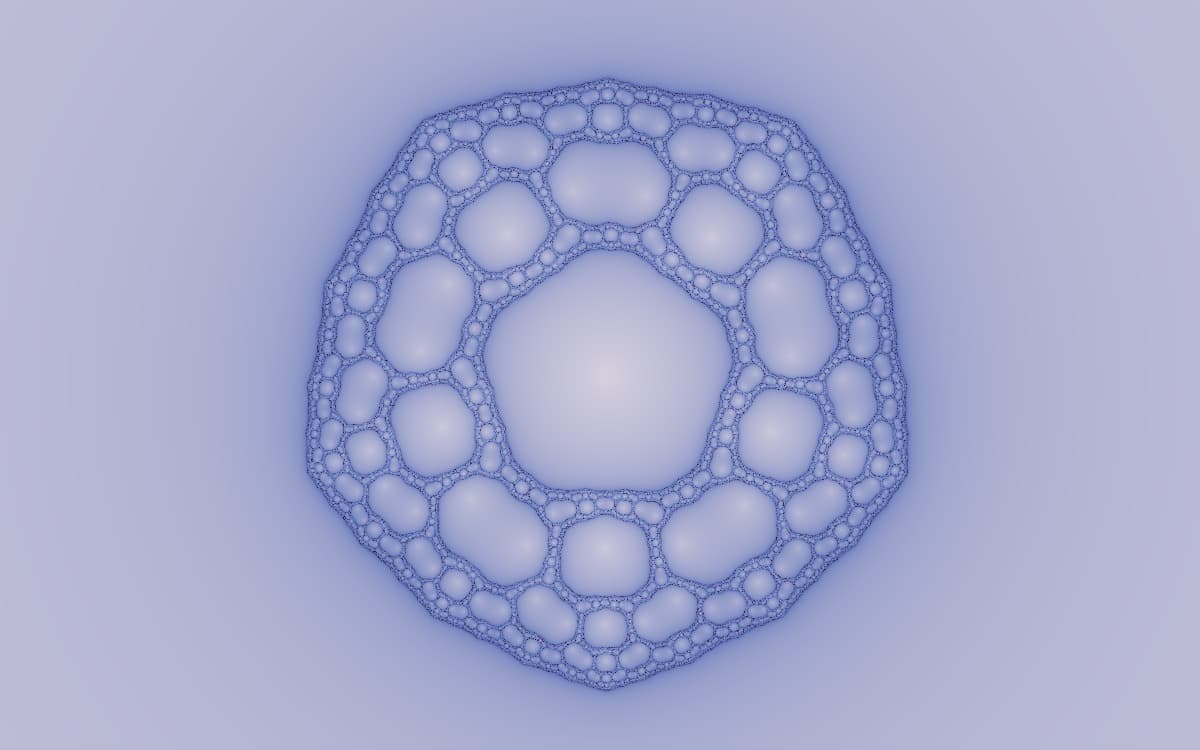
Une fractale McMullen bleu pâle formant un anneau à multiples côtés de cellules arrondies autour d'une grande ouverture centrale
Le rendu McMullen 2–3 de FractalPark : des frontières imbriquées en perles tournant autour d'une large ouverture centrale.

Vue d'ensemble

L'application de McMullen 2–3 appartient à la famille habituellement écrite \(f_\lambda(z)=z^n+\lambda/z^d\). FractalPark nomme le paramètre \(c\) et choisit \(n=2\), \(d=3\). Elle ressemble d'abord à une application quadratique avec un terme en plus. Puis \(z^3\) apparaît au dénominateur et change les règles : l'origine est un pôle, pas un point ordinaire.

Une seule formule a désormais deux territoires. Au loin, \(z^2\) domine et pousse les grandes valeurs plus loin. Près de zéro, \(c/z^3\) prend le relais et envoie les points vers l'infini à travers le pôle. Entre les deux se trouve une frontière mouvante où aucun des deux termes ne l'emporte franchement.

Cette frontière peut se refermer en anneaux, se briser en cellules arrondies ou se rejoindre en un réseau connexe. Cela dépend de \(c\) et des orbites des points critiques. Il n'existe pas de contour McMullen unique.

Les mathématiques

A quadratic term and a cubic pole

z(n+1) = z(n)^2 + c / z(n)^3

At each step, square the current complex value, then add \(c/z^3\). When \(|z|\) is large, the first term grows roughly like \(|z|^2\), while the reciprocal term fades like \(1/|z|^3\). Near zero the balance flips: the reciprocal term becomes enormous.

The same expression can be written as

$$ f_c(z)=\frac{z^5+c}{z^3}. $$

The map has a pole of order three at \(z=0\), and—when \(c\neq0\)—is a rational map of degree five. The “2–3” names the exponents in the original expression, not the rational-map degree.

In the exact definition, the pole sends zero to infinity on the Riemann sphere. A numerical renderer cannot divide by zero, so FractalPark replaces values extremely close to the origin with a tiny nonzero value and guards the denominator. That is a computational safety rail, not a different definition.
Histoire

The family takes its name from Curtis T. McMullen. In Section 7 of his 1988 paper *Automorphisms of Rational Maps*, McMullen constructed rational maps whose Julia sets break into a Cantor set of Jordan curves—infinitely many disjoint loops arranged with Cantor-set structure. Later authors adopted “McMullen maps” for the family \(z^n+\lambda/z^d\) associated with this construction. McMullen is now Cabot Professor of Mathematics at Harvard, where his personal academic homepage and publication list remain available.

The 2–3 choice is the smallest pair of exponents satisfying the characteristic inequality

$$ \frac{1}{n}+\frac{1}{d}<1, $$

because \(1/2+1/3=5/6\). It also gives the lowest possible degree, \(n+d=5\), in this part of the theory. The inequality alone does not guarantee that every parameter produces circles: the relevant critical orbits must also enter the appropriate escape region.

Work after McMullen mapped out that dependence in much greater detail. Robert Devaney, Daniel Look, and David Uminsky proved an “escape trichotomy” in 2005: when the free critical orbit escapes, the Julia set can be a Cantor set, a Cantor set of circles, or a Sierpiński curve, depending on how it reaches infinity.

Caractéristiques visuelles

One large pale opening anchors the image. An uneven ring of rounded cells circles it; farther out, smaller cells make a fine lace. What looks like a smooth blue band at first resolves into a crowded rim.

The outer edge is gently faceted rather than round, and no two cells quite match. That belongs to this parameter, frame, and colouring—not every McMullen map. The pale palette favours relief and nested boundaries over an escape-speed gradient.

Remix et exemples

Pars du Document canonique

Ouvre le même état de formule approuvé utilisé par ce guide, puis modifie la vue, la colorisation, les transformations ou l'animation dans l'Explorateur interactif.

Questions fréquentes

What do 2 and 3 mean in the name?

They name the two powers in \(z^2+c/z^3\): the polynomial side squares \(z\), while the reciprocal side divides by its cube. In the general McMullen family they are \(n\) and \(d\).

Do not read them as “degree two to degree three.” Combine the terms and the map is \((z^5+c)/z^3\), so for nonzero \(c\) its rational-map degree is five.

What happens at z = 0?

The denominator \(z^3\) vanishes, so zero is a pole, not an ordinary starting point. On the extended complex plane it maps to infinity. Nearby points are flung away with strength growing like \(1/|z|^3\).

That pole is not a rendering accident; it is the feature that distinguishes this family from a polynomial such as \(z^2+c\). FractalPark only adds a tiny numerical guard near zero so the shader can represent the same limiting behavior without performing an undefined division.

Références