FractalPark
ExotiqueDifficile

Rational Map 1

Une itération rationnelle de degré 2, z²/(z + c), avec un zéro et un pôle qui se déplace quand c change.

Ouvrir dans l'Explorateur
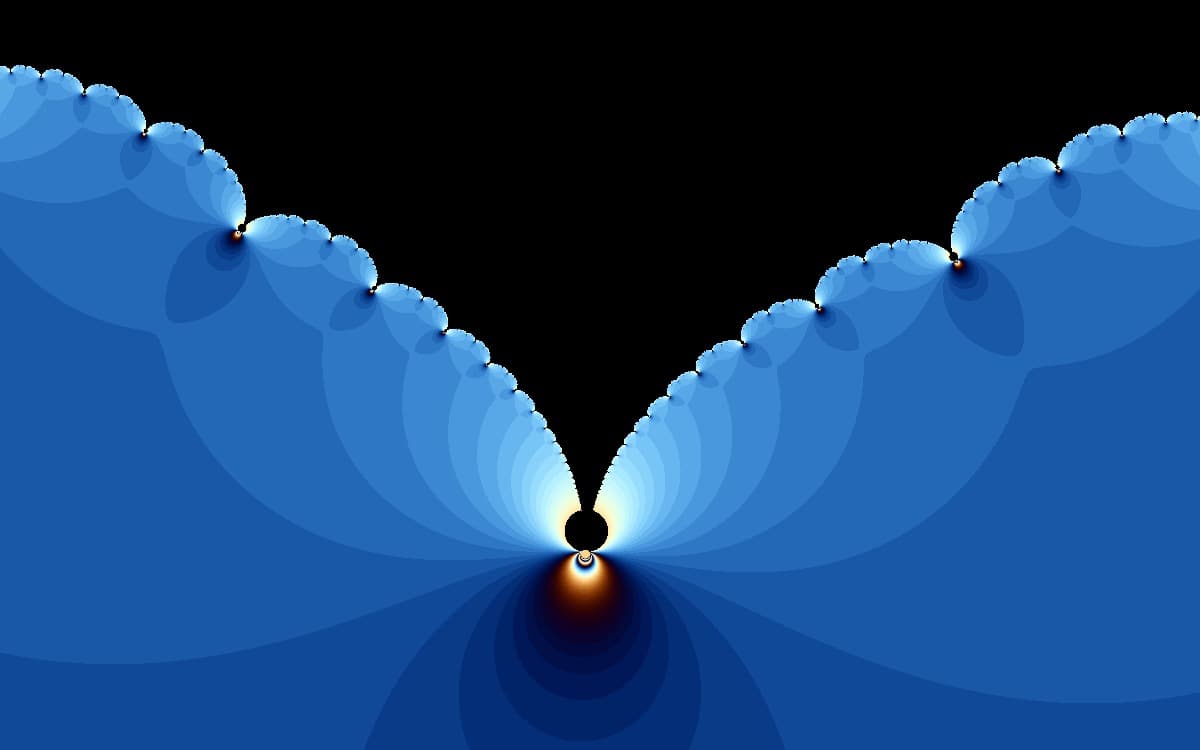
Gros plan de Julia de Rational Map 1 : un éventail de lames incurvées et de canaux balayants rayonnant depuis le pôle
Rational Map 1 rendu par FractalPark : un éventail de lames incurvées tournant lentement rayonne depuis le pôle, avec d'étroites bandes enregistrant les orbites proches du pôle.

Vue d'ensemble

Rational Map 1 itère z² / (z + c). Un polynôme comme z² + c n'a aucun endroit où son dénominateur défaille ; cette application, si. En z = −c se trouve un pôle mobile. Une orbite qui le frôle peut être projetée vers l'extérieur, puis emprunter une route bien différente aux étapes suivantes.

Il y a un zéro, en z = 0, et un pôle, en z = −c. La fonction reste de degré deux, et pourtant ce pôle redessine le plan. Au loin, z² / (z + c) croît à peu près comme z (pour |z| grand, z² / (z + c) ≈ z), si bien que l'infini n'est pas ce point fixe qui commande tout. Les bassins se rassemblent autour d'un ensemble fini de cycles attractifs tandis que le pôle découpe des canaux incurvés et des secteurs en éventail entre eux.

FractalPark affiche des plans de paramètres, où c bouge, et des vues de Julia, où c est maintenu fixe. Cette image de référence est un gros plan de Julia : des lames incurvées s'ouvrent autour du pôle, tandis que de fines bandes de couleur suivent des orbites qui frôlent la singularité.

Les mathématiques

Rational iteration

z(n+1) = z(n)^2 / (z(n) + c)

Each step squares z, then divides by z + c. The numerator is zero at z = 0; the denominator is zero at z = −c, which makes that point a pole. The map has degree two: (z²)/(z + c) is degree‑2 over degree‑1, and after cancelling a common factor it has one zero and one pole, each counted with multiplicity.

Try the pole at close range. Take c = 0.5, so the pole is at z = −0.5, and start at z₀ = −0.49, just to its right. Then z₁ = (−0.49)² / (−0.49 + 0.5) = 0.2401 / 0.01 = 24.01. One step has thrown the orbit far out. Since |z₁| is large, the next step gives z₂ ≈ z₁² / z₁ = z₁ = 24.01: the large value persists instead of snapping back as in the magnet family. Pixel colour records the steps before the orbit crosses the escape threshold.

Unlike polynomial maps, where infinity always attracts escaping orbits, this map is nearly linear far out (z → z). Thrown-out orbits may drift. The escape-time colours therefore spread into broad, gradual bands rather than the abrupt jumps familiar from z² + c.
Caractéristiques visuelles

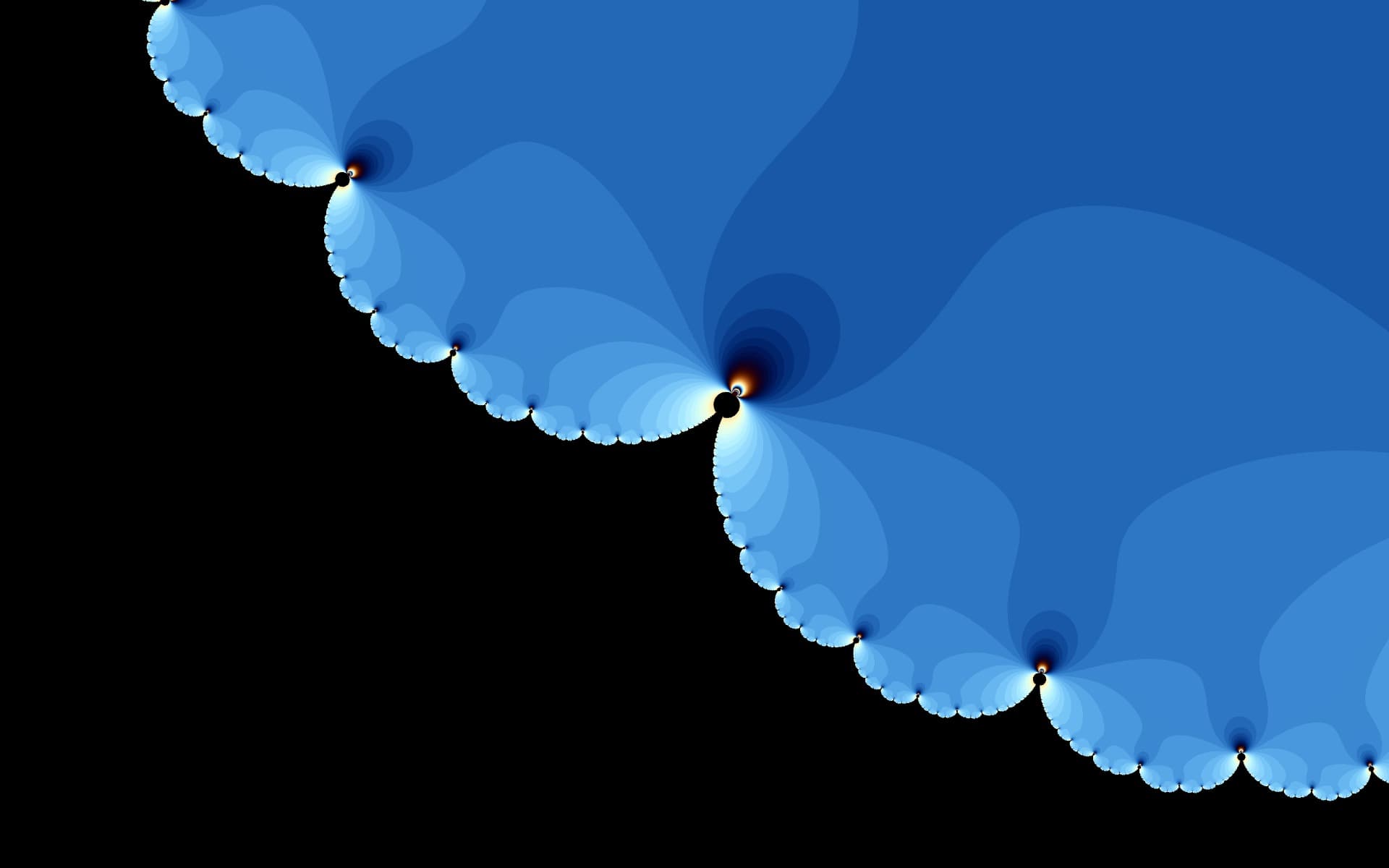
This is a Julia close-up. Around the pole, curved blades open into sweeping channels that follow the map's local direction. Tight colour bands between them mark orbits that graze the pole and need many steps to cross the escape threshold.

Because large-z motion is nearly linear rather than explosive, the bands change colour slowly and broadly. It reads as a turning fan with the pole for its hub. Move c and the pole moves too; the whole fan reorganizes.

Remix et exemples

Pars du Document canonique

Ouvre le même état de formule approuvé utilisé par ce guide, puis modifie la vue, la colorisation, les transformations ou l'animation dans l'Explorateur interactif.

Questions fréquentes

What makes this a rational map?

Its rule is a quotient of two complex polynomials, z² divided by z + c, not one polynomial alone. That permits poles: places where the denominator vanishes and the value becomes infinite. Polynomial maps have no such places, so their dynamics lack this particular detour.

Where is the pole?

Set z + c to zero: the pole is at z = −c. It moves with c and helps draw the curved fan and blades. An orbit passing close by is thrown to a large value, then may drift because the map grows only linearly far from the origin.