FractalPark
ExotiqueDifficile

Zaslavsky Map

Une application sinusoïdale complexe : le sinus courbe l'orbite, une rotation fixe de 0,55 radian la fait pivoter, et c la décale — une adaptation inspirée de l'application dissipative du rotor frappé de George Zaslavsky (1978).

Ouvrir dans l'Explorateur
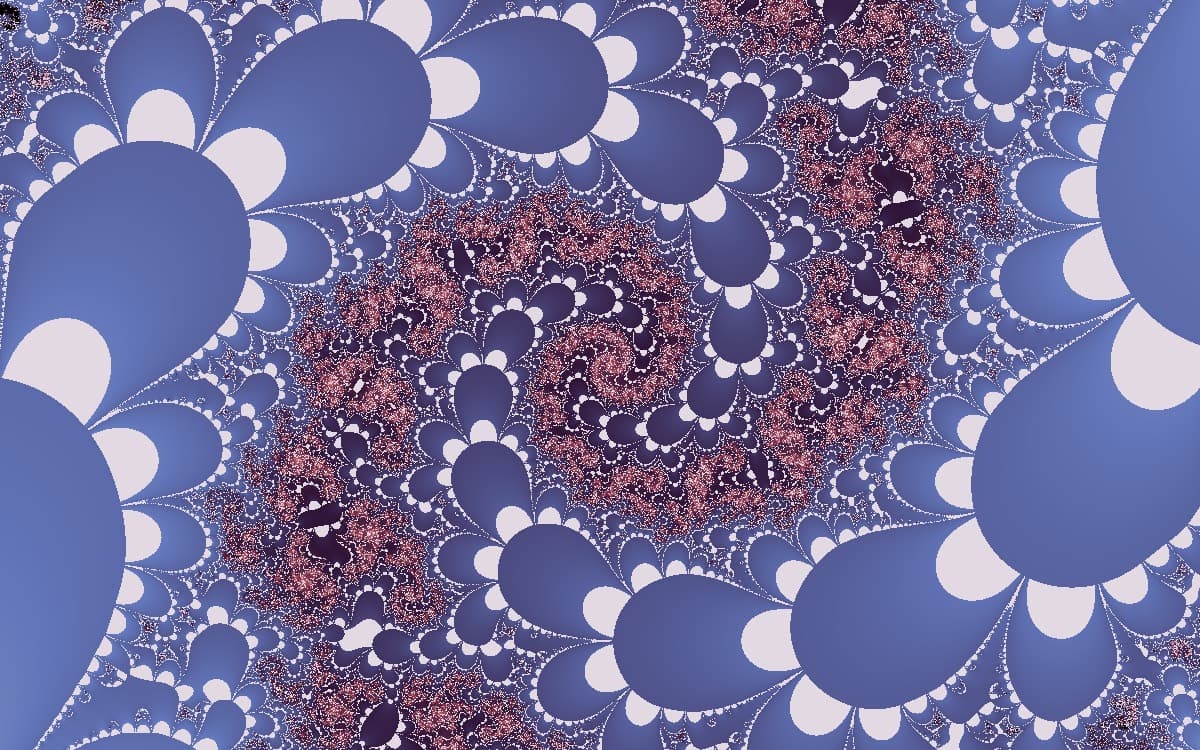
L'application de Zaslavsky : bras tourbillonnants et anneaux façon mandala dans des tons chauds d'orange et d'or
L'application de Zaslavsky rendue par FractalPark : des arcs concentriques et des rayons rayonnants forment un mandala lumineux dans des oranges et des ors chauds.

Vue d'ensemble

L'application de Zaslavsky courbe une orbite avec le sinus, fait pivoter le résultat de la phase complexe fixe (e^{0.55i}), puis ajoute c. Une application polynomiale de fuite tire son caractère de puissances de z de plus en plus grandes. Ici, l'intrigue vient de courbures périodiques rencontrant une rotation constante.

En 1978, George M. Zaslavsky a introduit l'application originale pour modéliser un rotor frappé dissipatif : un corps en rotation frappé à répétition pendant que la friction draine l'énergie. Cette application classique est bidimensionnelle et utilise de vraies variables action-angle. FractalPark reformule l'idée avec une seule variable complexe : le sinus fournit la frappe non linéaire, le multiplicateur complexe fixe fournit la rotation, et c rend possibles des images à temps de fuite en balayant les paramètres.

Le sinus complexe peut croître sans borne le long de l'axe imaginaire, ce n'est donc pas une simple fuite polynomiale. Une orbite peut tourner en rond un moment, puis voler en éclats. Cette hésitation laisse des bras tourbillonnants et des anneaux concentriques, surtout après une transformation spatiale kaléidoscopique.

Les mathématiques

Sinusoidal rotation map

z(n+1) = exp(0.55 i) times (z(n) + 0.28 sin(z(n))) + c

Sine bends z; the fixed complex multiplier turns it; c shifts the result.

Start on the real axis. For z₀ = (0, 0), sin(0) = 0, so z₁ = e^{0.55i} × 0 + c = c. After that, complex sine can grow: the magnitude of sin(a + ib) contains terms up to cosh(b). A point with a large imaginary coordinate gets a large kick from sine, and is more likely to escape.

The 0.55-radian rotation (about 31.5°) is not a parameter; it is hard-coded in the formula. Every orbit gets the same angular twist each time. Hence the swirls.
Histoire

George M. Zaslavsky (1929–2008) was a Soviet‑born mathematical physicist who made foundational contributions to the theory of dynamical chaos. He introduced the map that now bears his name in a 1978 paper titled "The Simplest Case of a Strange Attractor," published in Physics Letters A. The map was derived as a stroboscopic description of a dissipative kicked rotor — a rotating system that receives periodic impulses and loses energy through friction.

Zaslavsky later moved to the United States, joining New York University's physics department and the Courant Institute of Mathematical Sciences. He authored several books on Hamiltonian chaos and fractional dynamics. The Scholarpedia article on the Zaslavsky map, written by Zaslavsky himself in 2007, provides an authoritative technical reference.

Classical Zaslavsky maps operate on two real variables (action and angle). The complex variant used by FractalPark, with its sine perturbation and fixed complex multiplier, is a creative adaptation suitable for escape‑time rendering rather than a direct transcription of the original dissipative system.

Caractéristiques visuelles

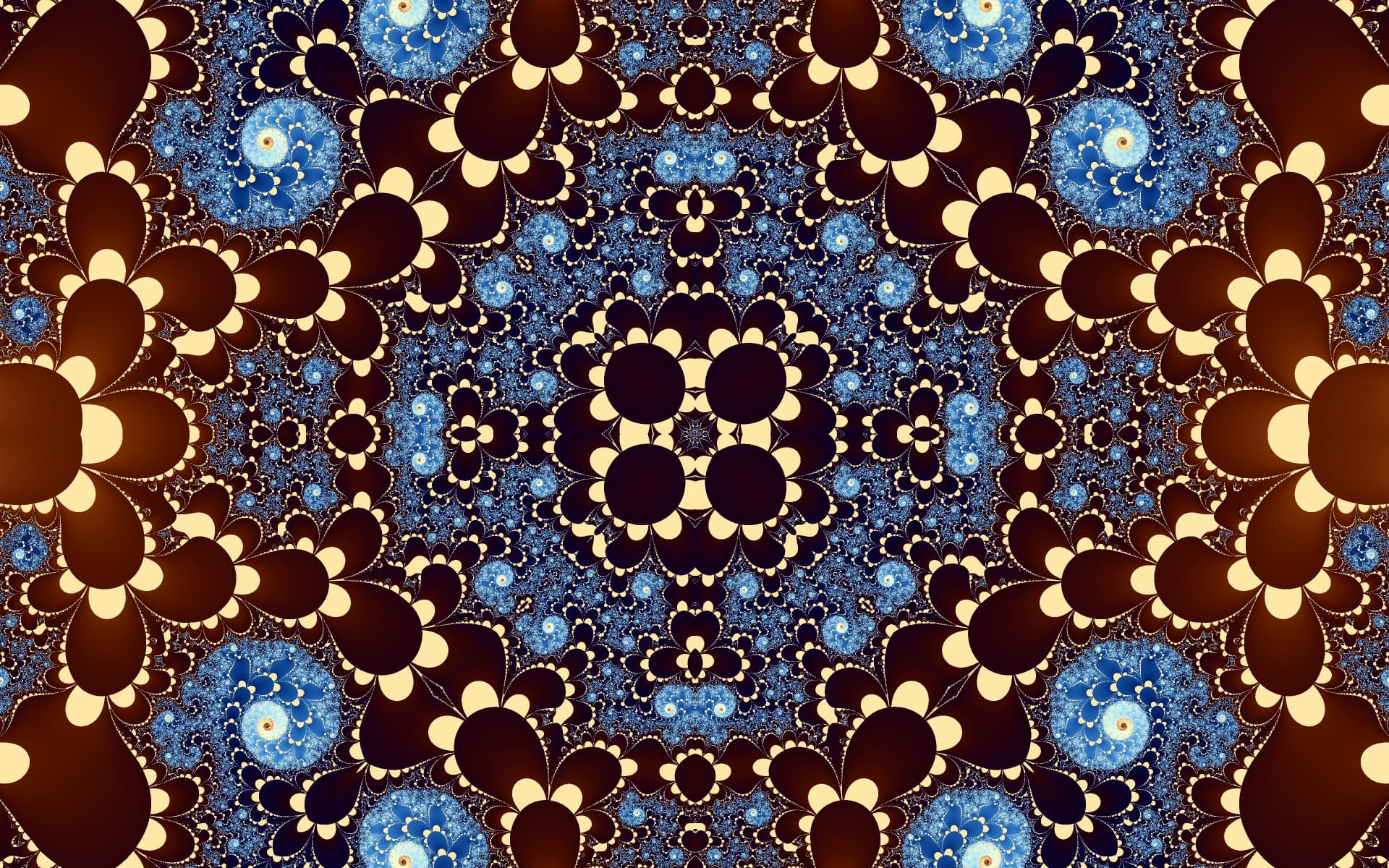
Kaleidoscopic transforms make the swirling arms and mandala-like rings especially clear. The canonical image sets concentric arcs and radiating spokes around a central region where the sine perturbation keeps orbits bounded.

Warm oranges and golds sit against deep black in the canonical rendering. Constant rotation curves the arms; sine puts fine ripples along the ring edges.

Remix et exemples

Pars du Document canonique

Ouvre le même état de formule approuvé utilisé par ce guide, puis modifie la vue, la colorisation, les transformations ou l'animation dans l'Explorateur interactif.

Questions fréquentes

Where does the rotation come from?

The map multiplies the perturbed orbit by e^{0.55i}, the unit complex number that turns the plane about 31.5° counter-clockwise. It happens on every iteration and is fixed in the formula, not adjustable by the user. The 0.55-radian value was chosen empirically for balanced swirls.

Is kaleidoscope part of the formula?

No. Kaleidoscope is an optional spatial transform outside the iteration. It reflects or copies sectors of the parameter plane. The Zaslavsky Map has no built-in reflection symmetry; the kaleidoscope is a separate rendering step that can be switched independently.

Références