FractalPark
ExotiqueFacile

Zubieta

Une application quadratique qui replie chaque étape les deux parties de z² + c dans le quadrant non négatif, produisant une double symétrie en miroir et des formes compactes façon mandala.

Ouvrir dans l'Explorateur
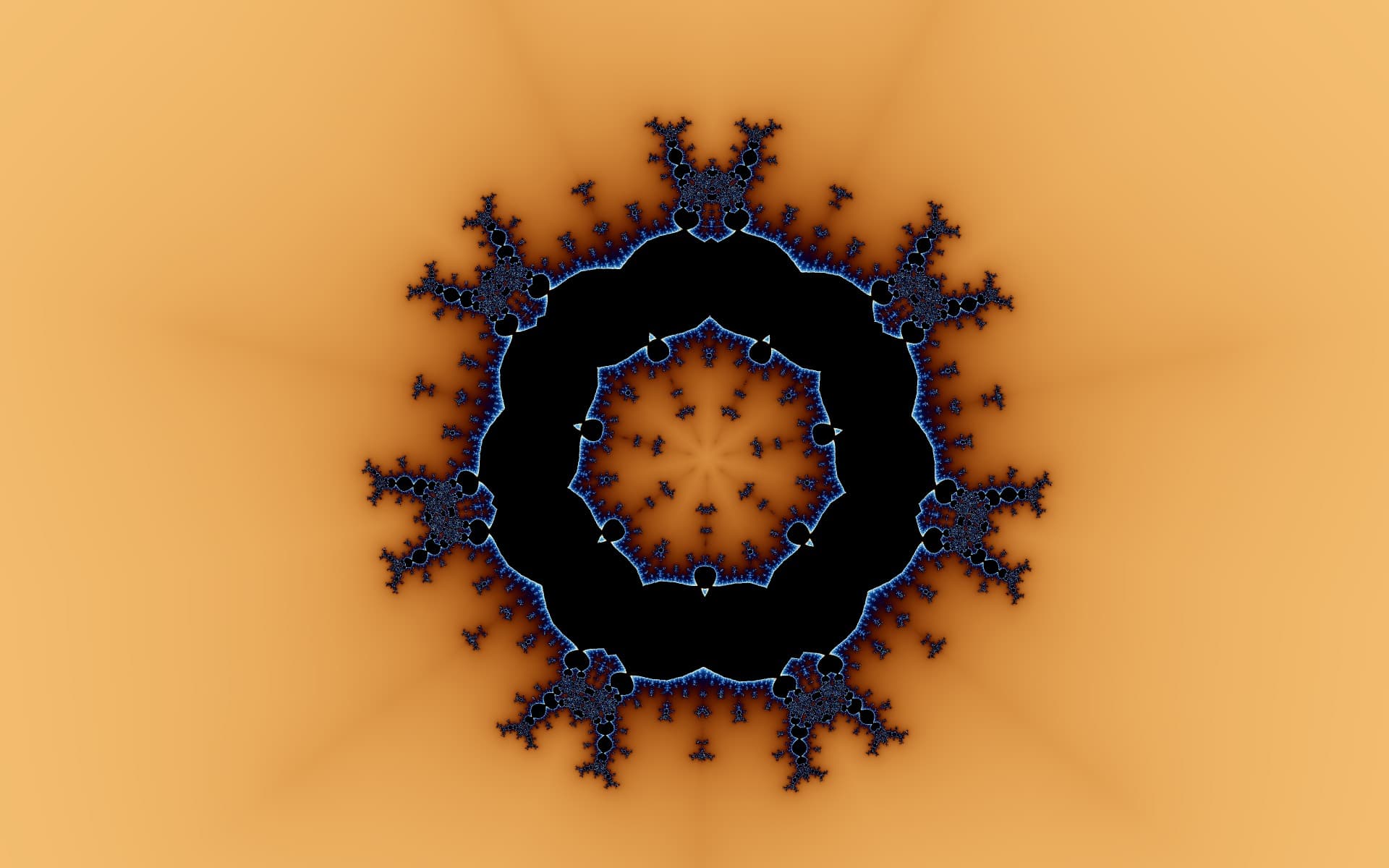
La fractale Zubieta : coins en miroir et lobes façon mandala dans un ambre chaleureux (« Kaleido Amber Mandala »)
La fractale Zubieta rendue par FractalPark (« Kaleido Amber Mandala ») : la double symétrie en miroir organise lobes compacts et filaments en mosaïque en un mandala kaléidoscopique.

Vue d'ensemble

Zubieta est une cousine « valeur absolue » de l'itération de Mandelbrot classique. Elle effectue la mise à jour habituelle zₙ² + c, puis prend la valeur absolue séparément sur les parties réelle et imaginaire. Ce n'est pas le module complexe, qui écraserait les deux parties en un seul nombre réel. Imagine plier une feuille le long des deux axes : la structure complexe demeure, mais chaque coordonnée revient dans le quadrant non négatif.

Répète ce pli et une orbite ne cesse de revenir dans, ou de traverser, le premier quadrant. La symétrie en miroir s'accumule. L'ensemble de Mandelbrot standard a un seul axe de symétrie, l'axe réel ; Zubieta réfléchit selon les deux axes, déployant quatre quadrants en miroir comme un kaléidoscope.

Burning Ship et Buffalo utilisent des plis composante par composante similaires à d'autres moments de l'itération. Zubieta plie après la mise au carré et l'ajout de c. Ce minutage lui donne ses propres lobes compacts, ses coins en mosaïque et ses filaments en miroir.

Les mathématiques

Component-folded iteration

z(n+1) is the component-wise absolute value of z(n)^2 + c

Here the bars mean component-wise absolute value, not complex magnitude. For u = x + iy, |u| means |x| + i|y|: take the absolute value of each part. Picture folding the point into the first quadrant.

Try c = −0.5 + 0i. In the standard Mandelbrot iteration, z₀ = 0 produces z₁ = −0.5, z₂ = −0.25, z₃ ≈ −0.4375, and so on, converging to a fixed point. Zubieta folds those same values: after one step, |−0.5| = 0.5, so z₁ is 0.5 rather than −0.5. One small fold redirects the orbit—and changes how c is classified.

The escape threshold comes from the quadratic Mandelbrot test: once |zₙ| exceeds 2, divergence is guaranteed. The component-wise fold can keep some orbits bounded longer than the unfolded rule would.
Histoire

Zubieta belongs to a broader family of "abs" fractal variants — maps that apply absolute-value folds at different stages of the quadratic iteration. The best-known member of this family is the Burning Ship fractal, discovered by Michael Michelitsch and Otto E. Rössler in 1992, which folds the components before squaring. The Buffalo fractal, another relative, applies the fold after squaring but before adding c.

The Zubieta variant applies the component-wise absolute value after both squaring and the addition of c. Its precise origin is difficult to pin to a single published academic source. Variants of this kind circulated among fractal-rendering communities and software packages (Ultra Fractal, Fractint, XaoS) in the 1990s and 2000s, often named after whoever first implemented or popularized them in a given program.

FractalPark's implementation follows the standard component-wise fold and renders the parameter plane in Mandelbrot mode.

Caractéristiques visuelles

Repeated component-wise folding imposes double-mirror symmetry. The image reflects across both real and imaginary axes, making mirrored wedges, compact mandala-like lobes, and tiled filaments.

Compared with Buffalo, which folds before squaring, Zubieta's post-update fold packs its lobes more tightly. In FractalPark's canonical rendering ("Kaleido Amber Mandala"), amber colour fills boundaries patterned with repeated angular motifs.

Remix et exemples

Pars du Document canonique

Ouvre le même état de formule approuvé utilisé par ce guide, puis modifie la vue, la colorisation, les transformations ou l'animation dans l'Explorateur interactif.

Questions fréquentes

Is the absolute value a complex magnitude?

No. FractalPark takes absolute value separately on the real and imaginary parts. It takes |x| and |y| independently, reflecting each coordinate into the nonnegative range without collapsing the complex number to one real value.

Why is the image strongly mirrored?

Folding both output components into the first quadrant on every iteration imposes double reflection symmetry. The orbit is repeatedly sent back toward the nonnegative region, and the parameter map mirrors across both axes. Burning Ship gains its flame-like symmetry by a related fold, though Zubieta packs the result into tighter mandala-like patterns.

Références