FractalPark
이색어려움

Zaslavsky Map

복소 사인 사상이에요. 사인이 궤도를 휘게 하고, 고정된 0.55라디안 회전이 방향을 돌리며, c가 이동시켜요. 조지 자슬라프스키(George Zaslavsky)의 1978년 소산성 킥 로터 사상에서 영감을 받은 변형이에요.

탐색기에서 열기
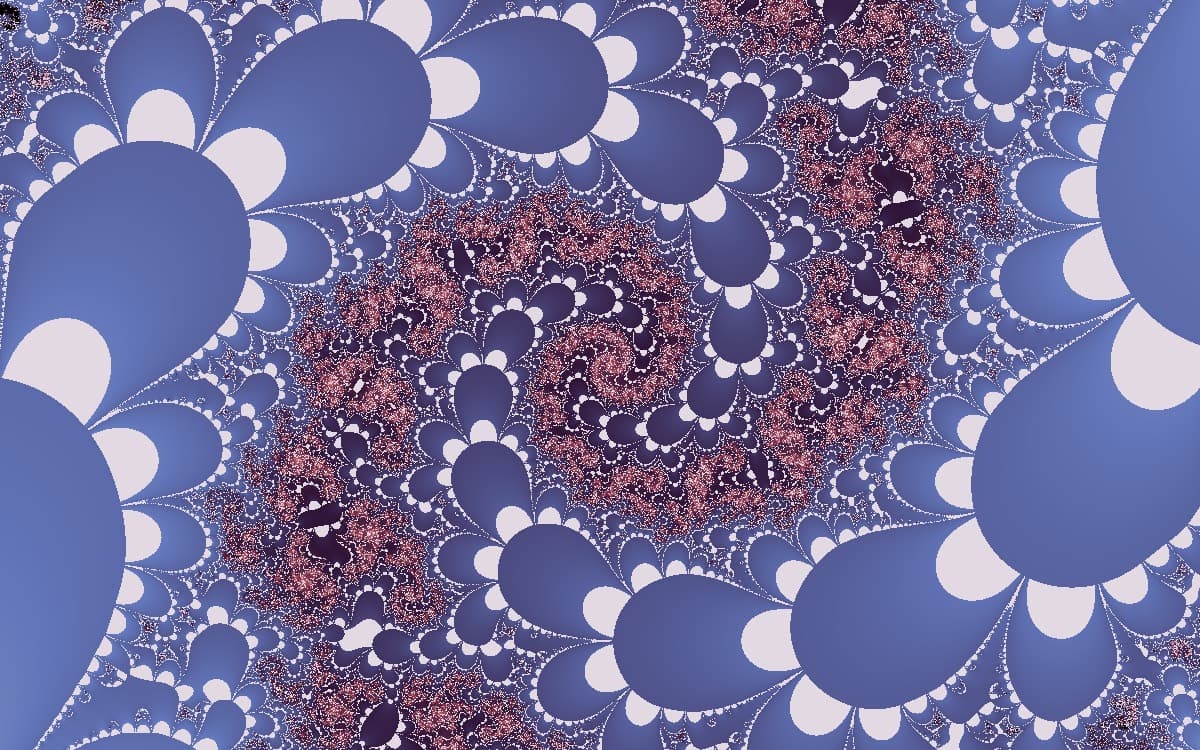
Zaslavsky Map: 따뜻한 주황과 금빛의 소용돌이치는 팔과 만다라 같은 고리
FractalPark이 렌더링한 Zaslavsky Map: 동심원 호와 방사형 살이 따뜻한 주황과 금빛으로 빛나는 만다라를 이뤄요.

개요

Zaslavsky Map은 사인으로 궤도를 휘게 하고, 고정된 복소 위상 (e^{0.55i})만큼 결과를 회전시킨 다음 c를 더해요. 다항식 탈출 사상은 점점 커지는 z의 거듭제곱에서 성격을 얻지만, 여기서는 주기적인 휨이 꾸준한 회전을 만나는 데서 이야기가 만들어져요.

1978년, 조지 M. 자슬라프스키가 소산성 킥 로터, 즉 마찰이 에너지를 빼앗는 동안 반복적으로 차여지는 회전체를 모델링하기 위해 원래 사상을 소개했어요. 그 고전적 사상은 실수 작용-각 변수를 쓰는 2차원 사상이에요. FractalPark은 그 아이디어를 하나의 복소 변수로 다시 만들었어요. 사인이 비선형 킥을, 고정된 복소 승수가 회전을 담당하고, c가 매개변수를 훑는 탈출 시간 이미지를 가능하게 해요.

복소 사인은 허수축을 따라 무한히 자랄 수 있어서, 이건 단순한 다항식 탈출이 아니에요. 궤도는 잠시 원을 그리다가 흩어질 수 있어요. 그 머뭇거림이 소용돌이치는 팔과 동심원 고리를 남기는데, 특히 만화경 같은 공간 변환 후에 두드러져요.

수학

Sinusoidal rotation map

z(n+1) = exp(0.55 i) times (z(n) + 0.28 sin(z(n))) + c

Sine bends z; the fixed complex multiplier turns it; c shifts the result.

Start on the real axis. For z₀ = (0, 0), sin(0) = 0, so z₁ = e^{0.55i} × 0 + c = c. After that, complex sine can grow: the magnitude of sin(a + ib) contains terms up to cosh(b). A point with a large imaginary coordinate gets a large kick from sine, and is more likely to escape.

The 0.55-radian rotation (about 31.5°) is not a parameter; it is hard-coded in the formula. Every orbit gets the same angular twist each time. Hence the swirls.

역사

George M. Zaslavsky (1929–2008) was a Soviet‑born mathematical physicist who made foundational contributions to the theory of dynamical chaos. He introduced the map that now bears his name in a 1978 paper titled "The Simplest Case of a Strange Attractor," published in Physics Letters A. The map was derived as a stroboscopic description of a dissipative kicked rotor — a rotating system that receives periodic impulses and loses energy through friction.

Zaslavsky later moved to the United States, joining New York University's physics department and the Courant Institute of Mathematical Sciences. He authored several books on Hamiltonian chaos and fractional dynamics. The Scholarpedia article on the Zaslavsky map, written by Zaslavsky himself in 2007, provides an authoritative technical reference.

Classical Zaslavsky maps operate on two real variables (action and angle). The complex variant used by FractalPark, with its sine perturbation and fixed complex multiplier, is a creative adaptation suitable for escape‑time rendering rather than a direct transcription of the original dissipative system.

시각적 특징

Kaleidoscopic transforms make the swirling arms and mandala-like rings especially clear. The canonical image sets concentric arcs and radiating spokes around a central region where the sine perturbation keeps orbits bounded.

Warm oranges and golds sit against deep black in the canonical rendering. Constant rotation curves the arms; sine puts fine ripples along the ring edges.

리믹스와 예제

표준 문서에서 시작하기

이 가이드가 사용하는 동일한 승인된 수식 상태를 연 다음, 인터랙티브 탐색기에서 뷰, 컬러링, 변환, 애니메이션을 바꿔보세요.

자주 묻는 질문

Where does the rotation come from?

The map multiplies the perturbed orbit by e^{0.55i}, the unit complex number that turns the plane about 31.5° counter-clockwise. It happens on every iteration and is fixed in the formula, not adjustable by the user. The 0.55-radian value was chosen empirically for balanced swirls.

Is kaleidoscope part of the formula?

No. Kaleidoscope is an optional spatial transform outside the iteration. It reflects or copies sectors of the parameter plane. The Zaslavsky Map has no built-in reflection symmetry; the kaleidoscope is a separate rendering step that can be switched independently.

참고 자료