
FractalPark
ExóticaFácil

Buffalo

Um parente dobrado do Burning Ship: os termos quadrados das coordenadas recebem valores absolutos, enquanto o termo cruzado mantém x com sinal e abre chifres largos com portões internos espelhados.

Abrir no Explorar
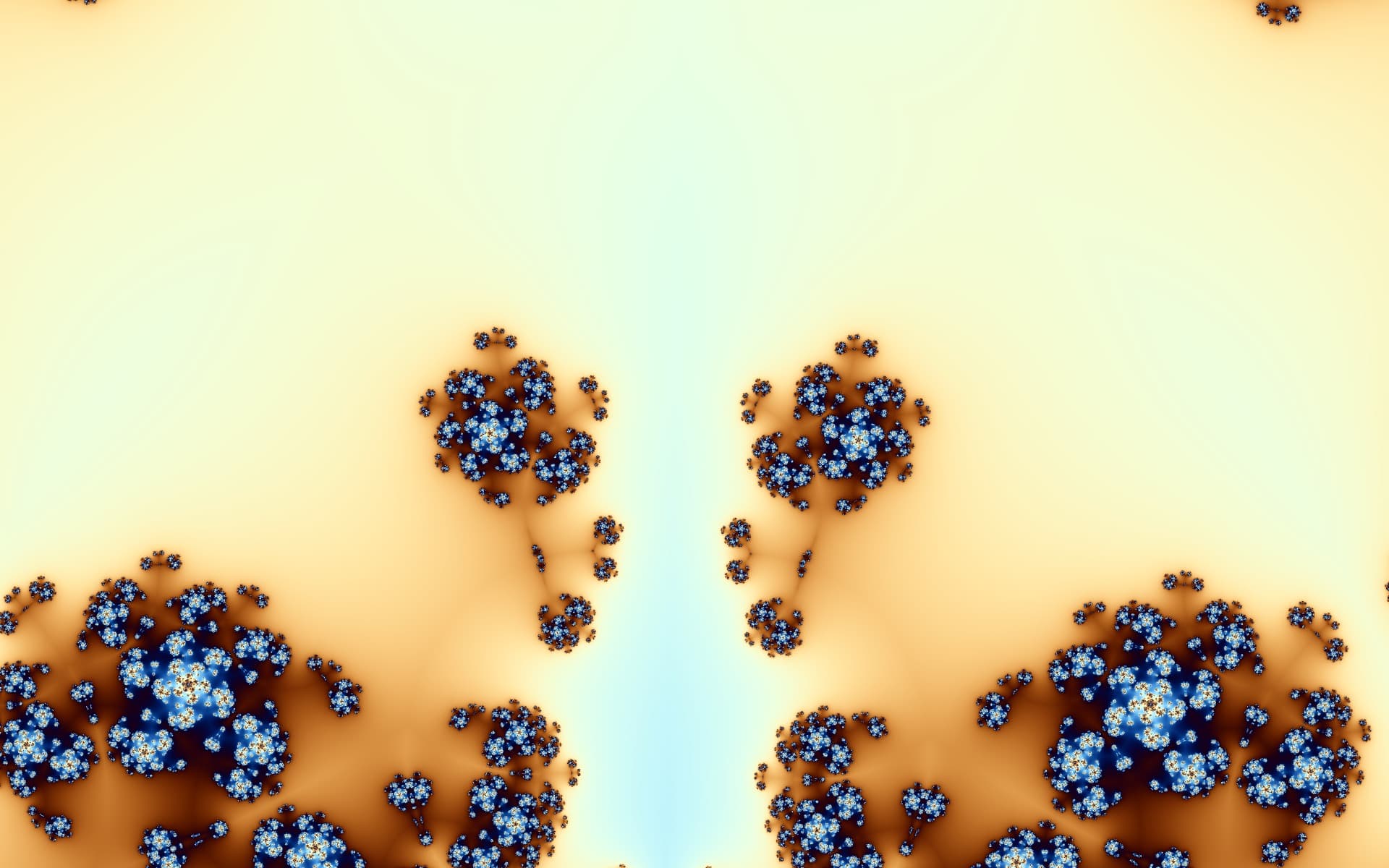
Fractal Buffalo com lobos curvos em forma de chifre, portões espelhados e filamentos torcidos
O Buffalo: chifres largos, portões internos espelhados e bordas de filamentos torcidos.

Visão geral

O Buffalo move as dobras do Burning Ship para novos lugares. Ele eleva ao quadrado as partes real e imaginária separadamente, toma os valores absolutos dessas magnitudes quadradas e mantém x com sinal no termo cruzado. O resultado é distinto tanto do Burning Ship quanto das variantes celtas mais simples.

O conjunto de parâmetros se abre em chifres largos e curvos. No interior ficam arcos espelhados e bolsões em forma de eclipse, muitas vezes com bordas de filamentos torcidos. Dobre sobre o eixo real e as metades superior e inferior respondem uma à outra de perto.

O Burning Ship prefere cristas retangulares, semelhantes a chamas. O Buffalo arredonda seus grandes lobos externos e reserva as curvas acentuadas para os portões internos e as bordas dos filamentos.

A Matemática

Buffalo iteration

z(n+1) = absolute x(n) squared minus absolute y(n) squared + 2 i x(n) absolute y(n) + c

The squared coordinate magnitudes make the real part: xₙ₊₁ = |xₙ|² − |yₙ|² + Re(c). The imaginary part pairs signed xₙ with folded yₙ: yₙ₊₁ = 2·xₙ·|yₙ| + Im(c). The difference from Burning Ship sits exactly there: Buffalo folds squared terms one by one, rather than folding raw coordinates before squaring. Keeping xₙ signed preserves a directional imbalance that Burning Ship’s fully folded cross term erases.

Try c = −0.5. Starting from z₀ = 0, the first iteration gives z₁ = |0|² − |0|² + 2i·0·|0| − 0.5 = −0.5. The second iteration: z₂ = |−0.5|² − |0|² + 2i·(−0.5)·|0| − 0.5 = 0.25 − 0.5 = −0.25. The orbit settles into a bounded oscillation between negative real values. With the same c, Burning Ship gives (|−0.5| + i|0|)² − 0.5 = 0.25 − 0.5 = −0.25 at the second step; the paths already differ because it folded the real part before squaring.

História

After Burning Ship appeared in 1992, Buffalo surfaced in the fractal exploration community as one of several variants. It belongs to folded quadratic maps, where shifting an absolute-value operation to another spot in the recurrence reshapes the escape-time geometry.

Buffalo has no single published introduction. It appears to have come from online fractal-software communities, where programs such as Ultra Fractal and Fractal Extreme let people define custom iterations. “Buffalo” likely refers to the large horn-like lobes, resembling a buffalo-head silhouette.

The earliest documented reference is the theory.org fractal dynamics page, which calls Buffalo a Burning Ship derivative. FractalPark uses the HPDZ Buffalo iteration rather than the original Buffalo formula described there.

Características Visuais

Broad horns establish the outline, with smooth outer curves cut by sharp inner detail. Inside are mirrored eclipse-like gates and twisted filament edges. The set reflects across the real axis.

Remix e Exemplos

Comece pelo Documento canônico

Abra o mesmo estado de fórmula aprovado usado por este guia e depois altere a visualização, a coloração, as transformações ou a animação no Explorar interativo.

Perguntas Frequentes

Which part of the orbit is folded?

Buffalo takes absolute values of the squared coordinate magnitudes. In the cross term it folds only the imaginary component and keeps x signed. So its folds act after squaring on each coordinate’s magnitude; Burning Ship instead folds both raw components first and squares one complex number.

Can Buffalo produce Julia sets?

Yes. Fix c and vary the starting point z₀ to reveal Buffalo Julia sets. As in the parameter set, the chosen c controls the balance of smooth and angular features. Both connected and disconnected Julia structures appear.

Referências