FractalPark
TranscendentalMédio

Cosh Mandelbrot

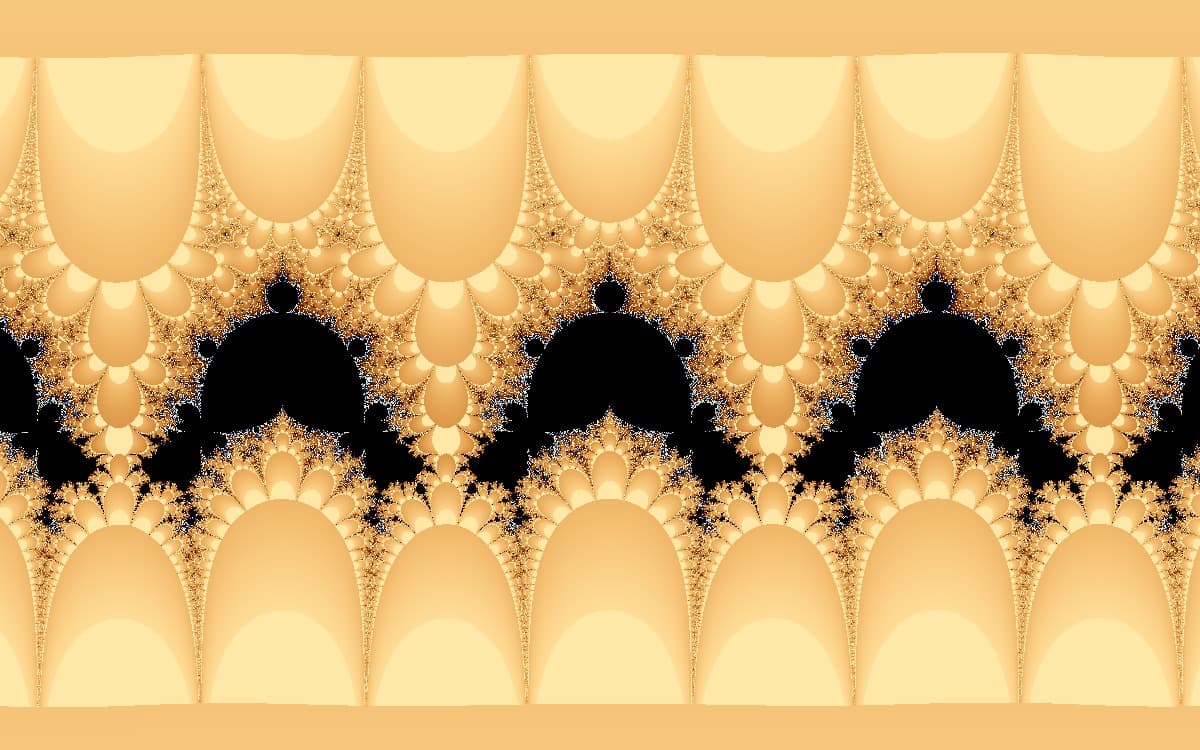
Um mapa transcendental de tempo de escape: o cosseno hiperbólico substitui a quadratura, e plumas que se repetem verticalmente e leques em camadas ocupam seu lugar.

Abrir no Explorar
Plumas douradas em camadas e leques se repetindo em intervalos verticais regulares no fractal Cosh Mandelbrot
O Cosh Mandelbrot do FractalPark: plumas douradas e leques em camadas retornam verticalmente com o período de 2π de cosh na direção imaginária.

Visão geral

O Cosh Mandelbrot deixa para trás o passo polinomial familiar. Em vez de repetir z² + c, ele repete z → cosh(z) + c. A quadratura é substituída pelo crescimento exponencial do cosseno hiperbólico ao longo do eixo real e pela repetição de 2π ao longo do eixo imaginário.

O cosseno complexo e o cosseno hiperbólico são parentes próximos: cada um se repete em uma direção e cresce sem limite em outra. Para cosh(z), o período no eixo imaginário é 2π, então uma faixa de detalhes retorna acima e abaixo de si mesma. Quando |Re(z)| é grande, seus termos exponenciais disparam para fora. A maioria dos pontos iniciais escapa rapidamente; apenas faixas finas seguram uma órbita — mantendo seus valores sucessivos limitados por muitos passos.

O plano de parâmetros não se assemelha mais à cardioide e aos bulbos do conjunto de Mandelbrot. Ele empilha leques, plumas douradas e ecos verticais. Sua linha entre escapar e não escapar é traçada pela própria iteração transcendental; não há um raio de escape algébrico simples disponível.

A Matemática

Hyperbolic cosine iteration

z(n+1) = cosh(z(n)) + c

Each turn evaluates complex hyperbolic cosine at the current z, then adds c. The definition cosh(z) = (eᶻ + e⁻ᶻ)/2 puts exponential growth on the real axis beside imaginary-axis repetition with period 2π.

Try z = iπ/2 on the imaginary axis. Since cosh(iπ/2) = cos(π/2) = 0, starting there with c = 0 leaves the recurrence at zero. Nudge the point off that axis and the eᶻ term can drive exponential growth and rapid escape. That sharp divide—bounded behavior in a narrow strip, rapid escape elsewhere—is typical of transcendental iteration. Unlike a polynomial, this map has no universal escape radius; FractalPark uses a bailout threshold chosen to detect divergence in practice.

História

In 1988, Clifford A. Pickover, a computer scientist and author at IBM's Thomas J. Watson Research Center, published the short paper "Chaotic behavior of the transcendental mapping (Z → cosh(Z) + μ)" in The Visual Computer. He presented images of chaotic behavior produced by this transcendental function, alongside maps such as z → sin(z) + c and z → eᶻ + c.

Pickover’s work brought the cosh-based map into the fractal-rendering community, where it became a standard transcendental escape-time example. Earlier, mathematicians including Robert Devaney and Michał Krych had developed the broader study of transcendental complex dynamics—exponential, trigonometric, and hyperbolic families—and analyzed the dynamics of exp(z) in the 1980s.

Características Visuais

First notice the vertical repetition. Because cosh(z) repeats in the imaginary direction every 2π, fine plumes, layered fans, and gilt filaments return at regular intervals. The result is striped and tiered, far from the radial branching of polynomial Mandelbrot sets.

In the canonical rendering, plumes and fans often carry warm tones. The finest detail concentrates in narrow horizontal bands, where an orbit lingers near the boundary between escape and non-escape. Above and below, escape accelerates and the image becomes smoother.

Remix e Exemplos

Comece pelo Documento canônico

Abra o mesmo estado de fórmula aprovado usado por este guia e depois altere a visualização, a coloração, as transformações ou a animação no Explorar interativo.

Perguntas Frequentes

Why do patterns repeat vertically?

Complex hyperbolic cosine repeats along the imaginary axis with period 2π. Because every step uses cosh(z), the orbit structure repeats too: bounded and escaping behavior returns at regular vertical intervals in the parameter plane.

Why do many points escape rapidly?

Hyperbolic cosine is built from exponentials: cosh(z) = (eᶻ + e⁻ᶻ)/2. At a point with a substantial real part, the eᶻ term takes over and the orbit can grow extremely fast. There is no simple polynomial-style escape radius, so the bailout threshold is a practical computational choice.

Referências