FractalPark
ClássicaFácil

Lambda Fractal

Um mapa logístico complexo centralizado: um único parâmetro estica a órbita e a dobra sobre si mesma.

Abrir no Explorar
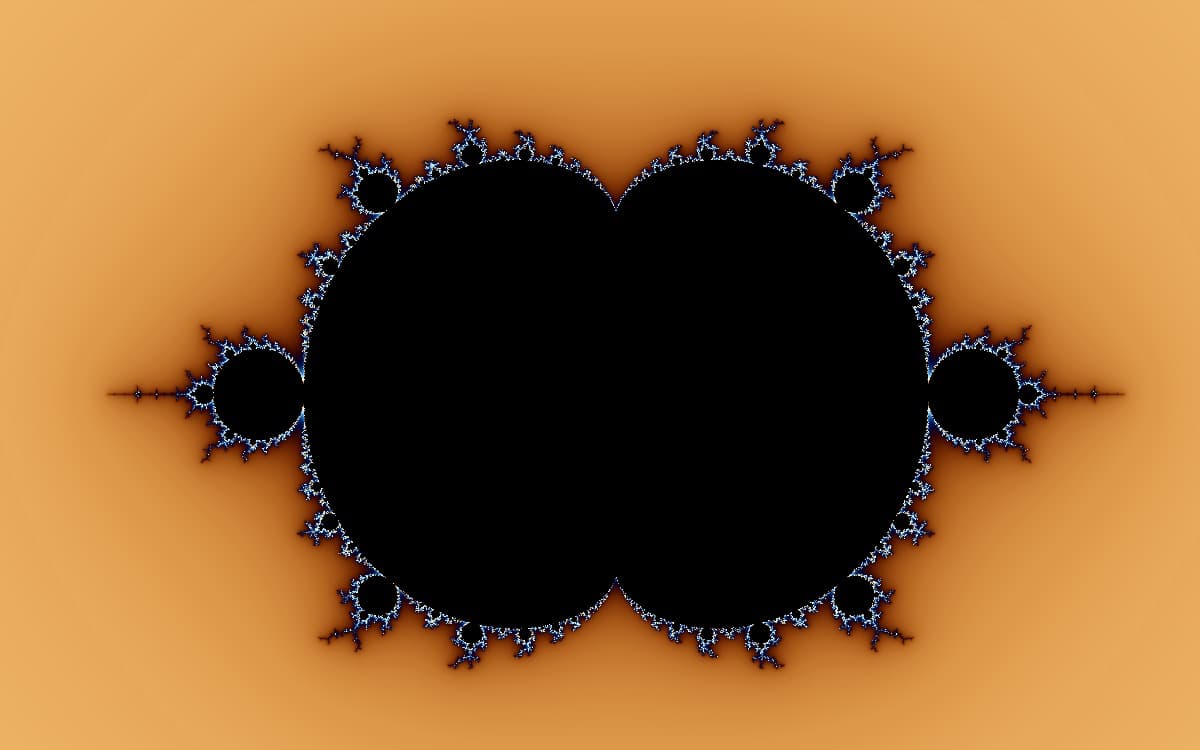
Conjunto Lambda preto contra um espaço azul-esverdeado, sua borda arrastando fios ramificados
O plano de parâmetros do mapa logístico complexo centralizado: um núcleo em forma de disco, bulbos anexados e uma borda filiforme.

Visão geral

Na reta real, o mapa logístico se tornou um pequeno laboratório do caos. Deixe seus valores vagarem pelo plano complexo e ele se abre no fractal Lambda, ou λ-. O FractalPark usa uma forma centralizada: c escala dois fatores complementares que puxam em direções opostas.

Uma mudança afim de coordenadas torna esta fórmula conjugada ao mapa quadrático padrão z² + c. Ela compartilha os traços de família do conjunto de Mandelbrot, mas não seu contorno: aqui há um disco onde o conjunto de Mandelbrot tem uma cardioide, e os bulbos anexados se organizam segundo seus próprios períodos.

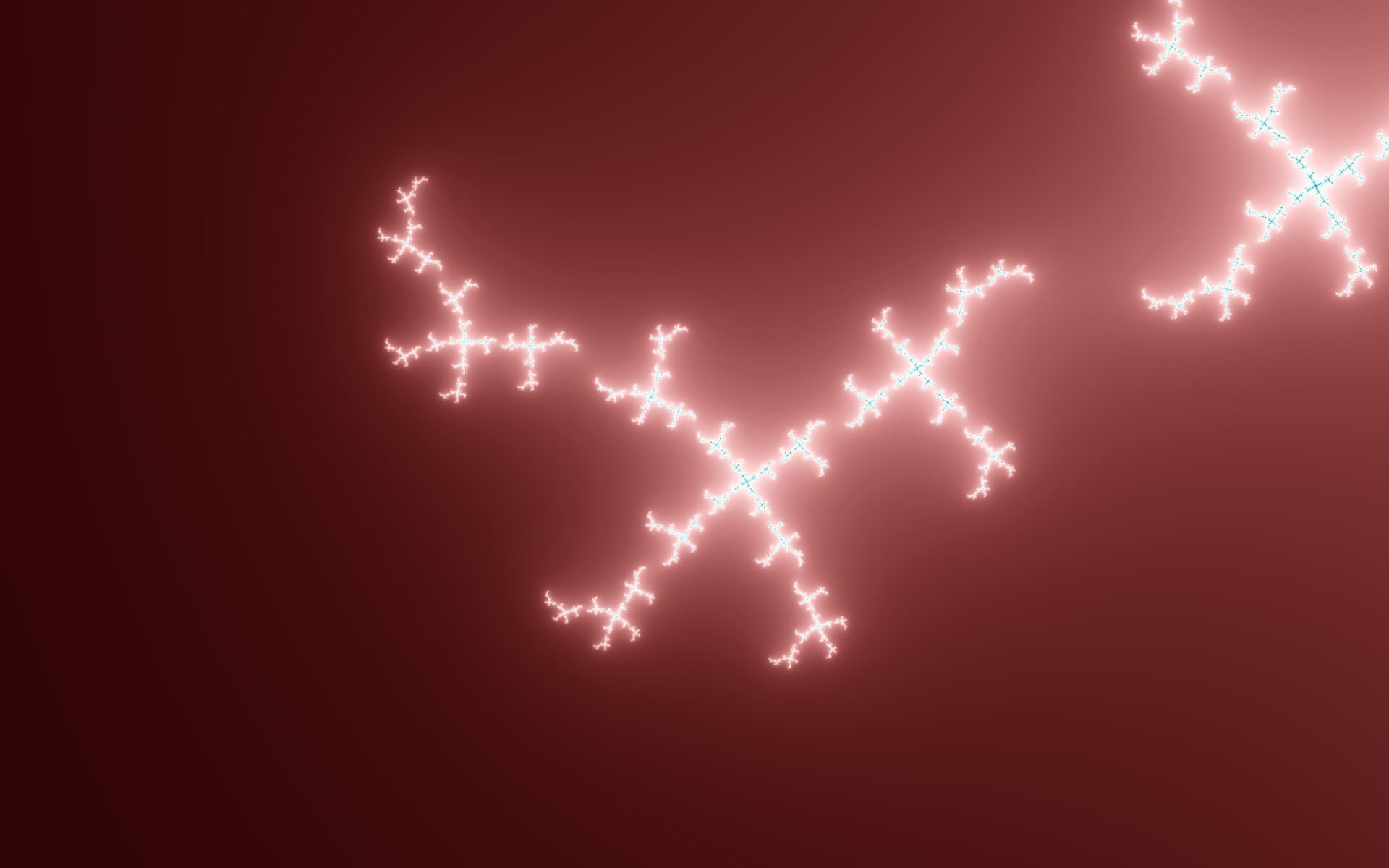
Aqui, c aciona dois botões ao mesmo tempo — crescimento e rotação. Fixe-o para uma visão de Julia e depois ajuste-o: uma bacia quase redonda pode se transformar em uma borda de ramos e espirais.

A Matemática

Complex logistic iteration

z(n+1) = c times (z(n) + 1/2) times (1/2 - z(n))

At each step, shift the current value halfway either side of center, multiply (z + ½) by (½ − z), then scale the product with c. The two factors make ¼ − z², so the same step reads z → c(¼ − z²).

Try c = 2 with z₀ = 0. The first step is z₁ = 2 × (½) × (½) = 0.5; the next is z₂ = 2 × 1.0 × 0 = 0. The orbit now shuttles between 0 and 0.5: a stable 2-cycle. Turn c up to 4 and the pull changes: z₁ = 4 × ½ × ½ = 1, then z₂ = 4 × 1.5 × (−0.5) = −3. The orbit diverges, so c = 4 lies outside the bounded set. In Julia mode, hold c still and vary z₀ across the image; the dividing line between trapped and escaping appears.

História

The map z → λz(1 − z) began as the complex extension of the real logistic map, studied extensively in the 1970s as a simple model of population dynamics and chaotic behavior. In 1980, Benoit B. Mandelbrot took the iteration to unrestricted complex λ and z. His paper, "Fractal Aspects of the Iteration of z → λz(1−z) for Complex λ and z," introduced the λ-plane parameter set—now the Lambda fractal—and placed it in the broader theory of iterated rational maps.

The groundwork was already there. Around 1917–1918, Pierre Fatou and Gaston Julia developed the general theory of iterated rational functions that later made families such as the logistic map available to explore. In 1986, Heinz-Otto Peitgen and Peter H. Richter brought the Lambda fractal to a wider audience in "The Beauty of Fractals," with some of the first widely seen computer-generated images of the set.

Características Visuais

At full scale, the Lambda set begins with an almost circular body—the countershape to the Mandelbrot set’s heart-like cardioid. Smaller bulbs cling to the disk; each marks a stable periodic cycle, and the largest marks a period-2 cycle. Beyond them lie branching channels, tiny disk islands, and spirals.

The islands give away the difference: they are round here, not cardioid-shaped, because the algebra has changed. In Julia mode, c can select a filled disk or a many-armed vortex.

Remix e Exemplos

Comece pelo Documento canônico

Abra o mesmo estado de fórmula aprovado usado por este guia e depois altere a visualização, a coloração, as transformações ou a animação no Explorar interativo.

Perguntas Frequentes

What does lambda control?

The complex parameter c—often written λ in the literature—sets both the orbit’s growth rate and its rotation. Its magnitude controls the strength of expansion or contraction; its argument supplies the turn at each step.

Why does Julia mode look especially varied?

Fix c and the question shifts to the starting point: does it stay bounded or escape? With linear and quadratic terms in the same formula, the border may be a smooth closed curve or a heavily branched connected set. The chosen c decides what the renderer reveals.

Referências