FractalPark
ClássicaFácil

Mandelbrot Set

Um mapa da família quadrática z² + c: escolha um ponto, comece em zero e observe sua órbita decidir o resultado.

Abrir no Explorar
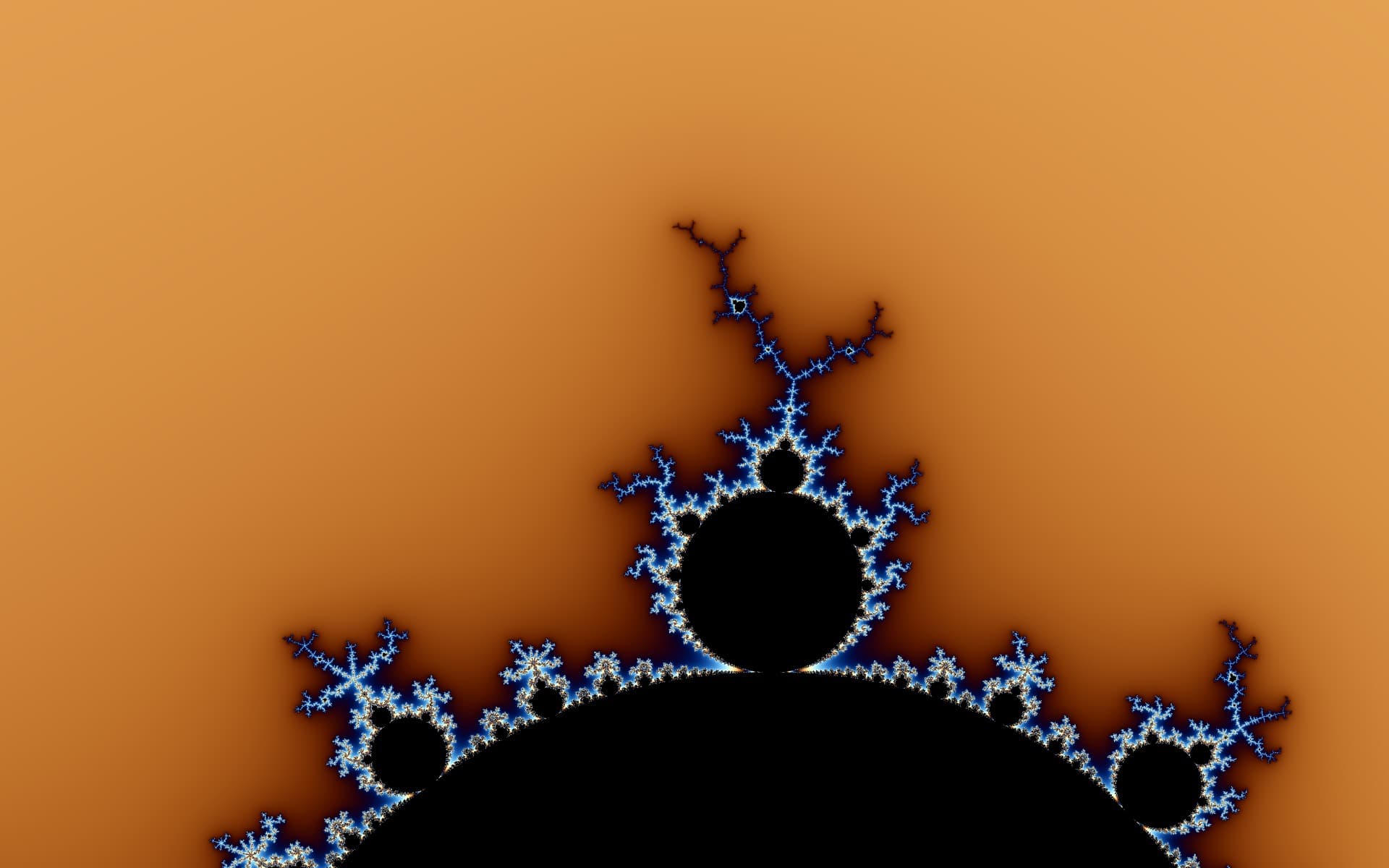
Conjunto de Mandelbrot preto sobre dourado quente, com um fino aro azul-esbranquiçado em sua borda
O conjunto completo: uma cardioide principal, bulbos anexados e uma borda ramificada colorida pelo tempo de escape.

Visão geral

O conjunto de Mandelbrot é um mapa para uma família inteira, não uma curva de uma única equação. Escolha um ponto c no plano complexo. Comece em z = 0, eleve ao quadrado o que você tem, some c e repita. A órbita é essa lista de valores em sequência. Alguns permanecem em uma região finita; outros fogem rumo ao infinito. Os valores de c do primeiro grupo formam o conjunto.

Ele também funciona como um índice para os conjuntos de Julia quadráticos. Fixe um c e você tem um conjunto de Julia; ele é conexo exatamente quando c está no conjunto de Mandelbrot. Desloque alguns pixels pelo plano de parâmetros e o comportamento pode mudar de um ciclo repetitivo estável para um escape.

Na imagem familiar, o conjunto costuma ser preto. A cor ao redor não é uma parte extra dele. Ela registra em quanto tempo uma órbita em fuga cruza o limite escolhido, como linhas de contorno traçadas pelo cálculo.

A Matemática

Give one parameter its turn

z(n+1) = z(n)^2 + c, with z(0) = 0

Choose a complex number c, then keep it fixed. The orbit starts at z₀ = 0; each new value is the old one squared, with c added back in.

Try two anchors. If c = 0, the orbit stays at zero forever, so 0 belongs to the Mandelbrot set. If c = 1, it runs 0, 1, 2, 5, 26, … and escapes, so 1 is out. In this quadratic map, once the magnitude of z exceeds 2, there is no return: the orbit diverges. A renderer treats that as its escape signal and stops at a chosen iteration limit.

História

The story starts before anyone could print a detailed parameter plane. Around 1917–1918, Pierre Fatou and Gaston Julia laid foundations for iterating complex functions. Fatou was a French mathematician and astronomer at the Paris Observatory; Julia’s 1918 memoir on iterated rational functions became an early landmark.

There is no uncontested “discovery moment.” At the 1978 Stony Brook conference, Robert W. Brooks and J. Peter Matelski were studying Kleinian groups when they published an early image now recognized as this same parameter locus. Their question was different, and the rough image did not yet carry the interpretation that later made the set famous.

Benoit B. Mandelbrot, at IBM’s Thomas J. Watson Research Center, used computer graphics to examine related quadratic parameter spaces and published his study in 1980. He placed the images in the wider frame of fractal geometry, making the object hard to ignore on its own terms. Mandelbrot was born in Warsaw, educated in France, spent 35 years at IBM, and later taught at Yale.

In the early 1980s, Adrien Douady and John H. Hubbard built the modern mathematical theory of the set, including the proof of its connectedness. Their work helped establish the name “Mandelbrot set.” Douady, a leading French mathematician in complex dynamics, died in 2006; Hubbard’s Cornell faculty page remains available and describes his work on iterative systems and computer-assisted mathematical exploration.
Características Visuais

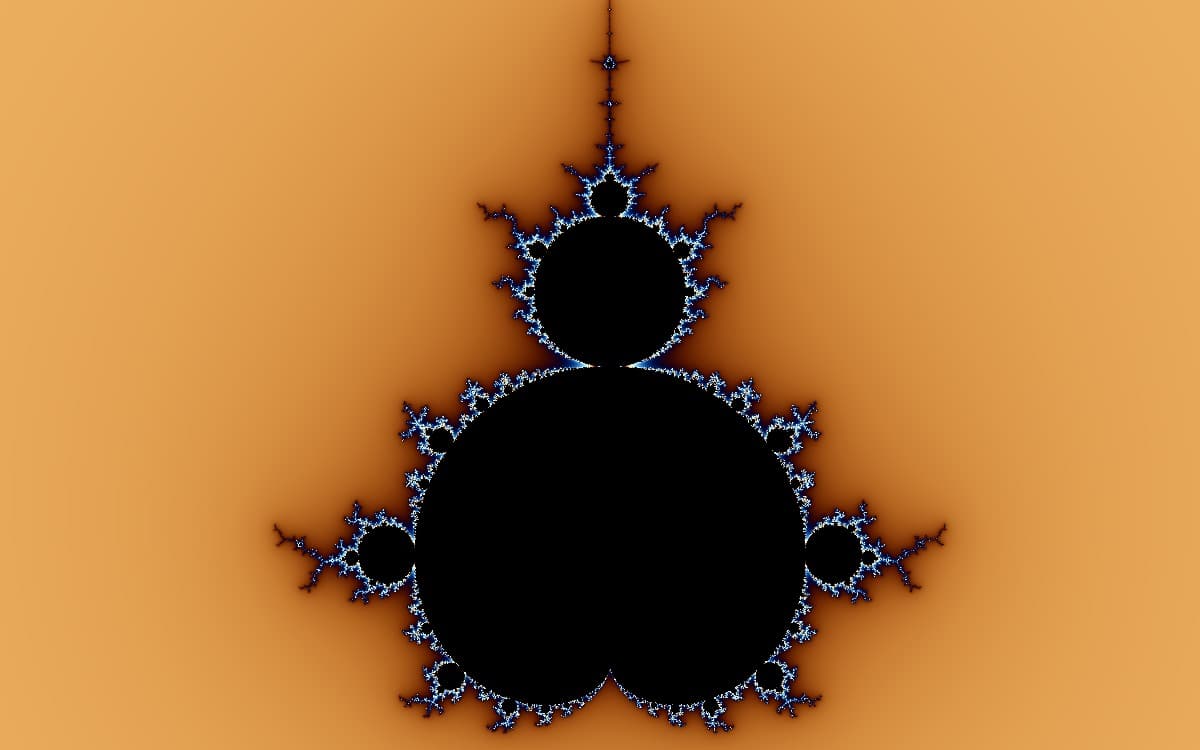
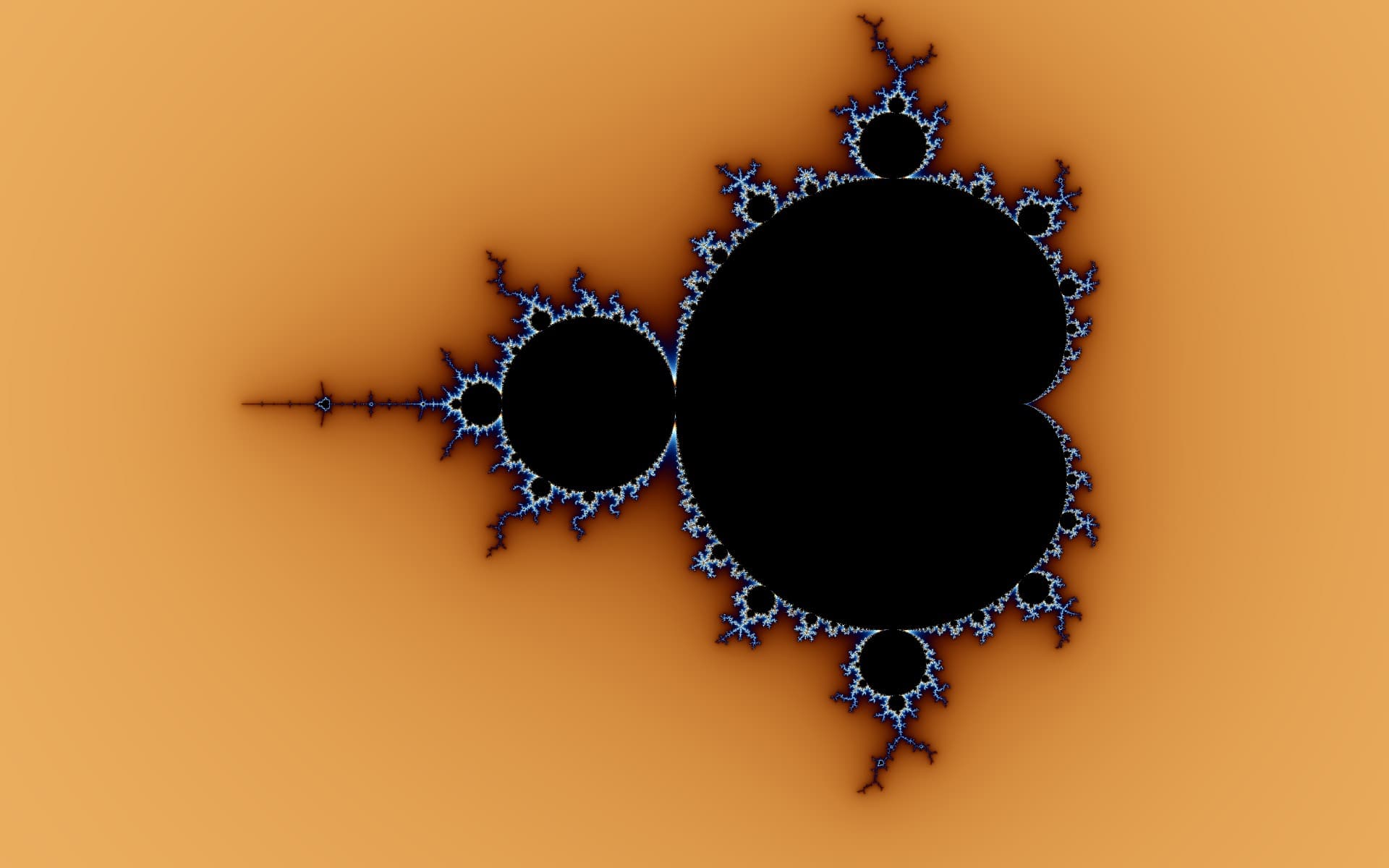
From a distance, first comes the heart-shaped main cardioid, then its round bulbs. The largest bulb marks a stable two-step cycle; smaller ones collect other repeating cycles. Follow the edge and the smooth arc frays into antennae, spirals, threads, and tiny copies of the whole set.

The boundary never finishes. Zooming brings out more structure, though not exact photocopies: local dynamics stretch and bend every return. The broad black interiors are relatively calm. At the fine edge, the slightest nudge to c can send an orbit elsewhere.

Remix e Exemplos

Comece pelo Documento canônico

Abra o mesmo estado de fórmula aprovado usado por este guia e depois altere a visualização, a coloração, as transformações ou a animação no Explorar interativo.

Perguntas Frequentes

What gets a point into the Mandelbrot set?

c belongs when the orbit from zero remains bounded under iteration. On a computer, |z| exceeding 2 settles it: the orbit escapes. Points that have not escaped by the iteration limit are drawn as members, although a point tight against the boundary may need many more steps for a dependable verdict.

Where do Julia sets enter?

For a Julia set, c stays fixed while the starting point z₀ ranges across the image. For the Mandelbrot set, zero stays fixed and c moves instead. In the quadratic family, the link is exact: the Julia set for z² + c is connected if and only if c belongs to the Mandelbrot set.

Referências