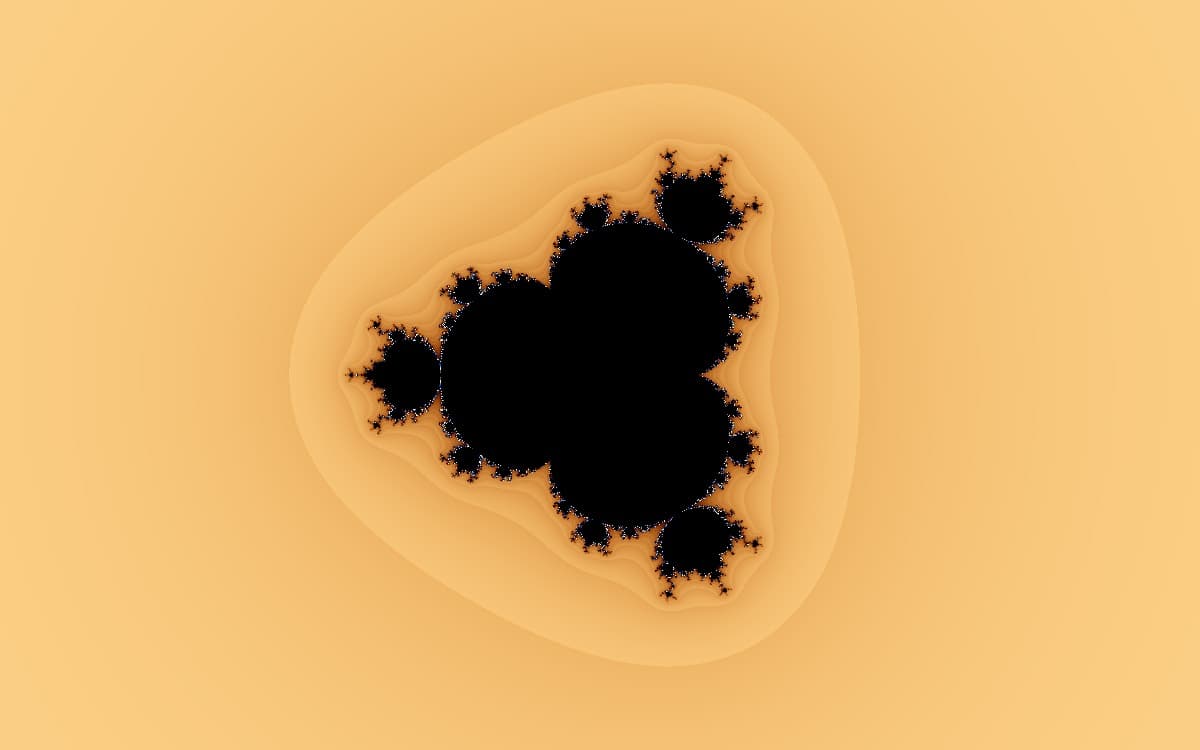
FractalPark
ClássicaFácil

Quartic Julia

Um mapa de Julia de quarto grau: eleve z à quarta potência, some um c fixo, e a ramificação quádrupla começa.

Abrir no Explorar
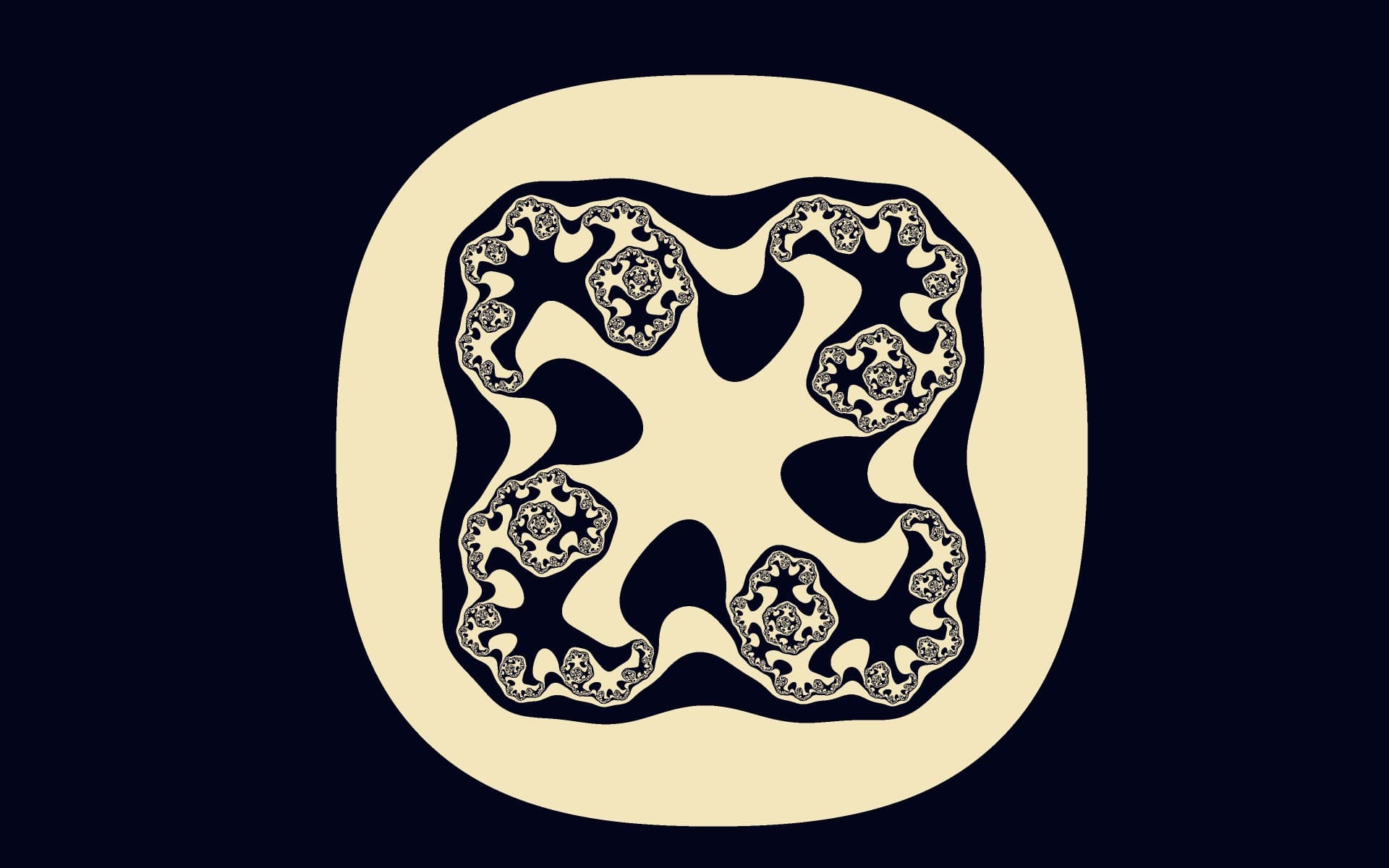
Conjunto de Julia quártico com bordas marfim, rosetas quádruplas e filigrana ramificada
O Quartic Julia do FractalPark: filigrana marfim segue rosetas ramificadas e filamentos quádruplos.

Visão geral

Pegue a receita usual de Julia e gire o botão um entalhe: fixe uma constante complexa c e repita z → z⁴ + c. Cada quarta potência multiplica o argumento complexo por quatro. Uma direção que se bifurcaria em duas em um mapa quadrático pode se abrir em quatro aqui — a origem da ramificação quádrupla.

Com o mesmo c, este mapa de grau mais alto costuma comprimir mais voltas no conjunto do que seu primo quadrático. Se o conjunto de Julia preenchido permanece em uma única peça ou se despedaça ainda depende de c, segundo a classificação de Fatou–Julia para polinômios de grau mais alto. Observe a órbita crítica — aqui governada pelo ponto crítico z = 0 e pelos pontos críticos da derivada — e ela dá a pista dessa conectividade.

Na tela, ele parece menos uma nuvem e mais um ornamento estampado: filigranas finas, rosetas e nós semelhantes a selos se repetem com simetria quádrupla. O grau extra empacota detalhes, mas o arranjo angular permanece notavelmente ordenado.

A Matemática

Quartic iteration

z(n+1) = z(n)^4 + c

One step has the effect of four squarings: the argument is multiplied by four, so a point near the boundary can split four ways. Try c = 0. The recurrence becomes zₙ₊₁ = zₙ⁴, simply a fourth-power map. From z₀ = 0.5 + 0i, the values shrink toward zero and remain bounded; from z₀ = 1.5 + 0i, they grow rapidly and escape. As in the quadratic case, |zₙ| signals escape: once it passes a fixed threshold (about 2 for this quartic), the orbit must diverge. The fourth power hastens the outward flight; it also speeds the angular splitting that creates the four-fold shape.

FractalPark holds c fixed across the image and varies the starting point z₀ from pixel to pixel—the usual Julia-family setup.
História

The theory came first. Pierre Fatou and Gaston Julia developed the classical framework for iterated rational functions in 1917–1918, and it applies to polynomials of any degree. Quartic Julia sets inherit its principles for connectivity and dynamical classification. When fractal-rendering software moved beyond quadratics in the 1980s and 1990s, computer exploration of higher-degree Julia sets became common. The named quartic variant belongs to that line; no single discoverer is attributed to it.

FractalPark uses the standard fourth-degree recurrence as a fixed-parameter Julia-family formula.

Características Visuais

Angles multiplied by four leave a recognizable trace: fine seals, branching rosettes, and filaments arranged on a quartic grid. A quadratic Julia may grow a spiral or one pair of arms; here, feature centers often send out four matching arms or lobes.

More detail fits into the same space than in a quadratic Julia, but it arrives in a tidier order. Turn ninety degrees around a prominent point and a motif often returns. The canonical FractalPark image picks out those edges with ivory filigree.

Remix e Exemplos

Comece pelo Documento canônico

Abra o mesmo estado de fórmula aprovado usado por este guia e depois altere a visualização, a coloração, as transformações ou a animação no Explorar interativo.

Perguntas Frequentes

Why is this called Quartic Julia?

Its rule uses the fourth power of z, so it is a quartic, or degree-four, polynomial. The name distinguishes it from the standard quadratic Julia set and other higher-degree variants.

What does c change?

The fixed complex constant c decides whether the filled Julia set is connected or disconnected, then shapes its fine geometry. Nudge c and four-way branches rearrange, seals and filaments shift, and a connected set can fall into disconnected dust.

Referências