FractalPark
PhoenixMédio

Multi-Phoenix

Uma recorrência quadrática com memória: um coeficiente complexo carrega o valor anterior da órbita para o passo seguinte, produzindo formas emplumadas, semelhantes a chamas.

Abrir no Explorar
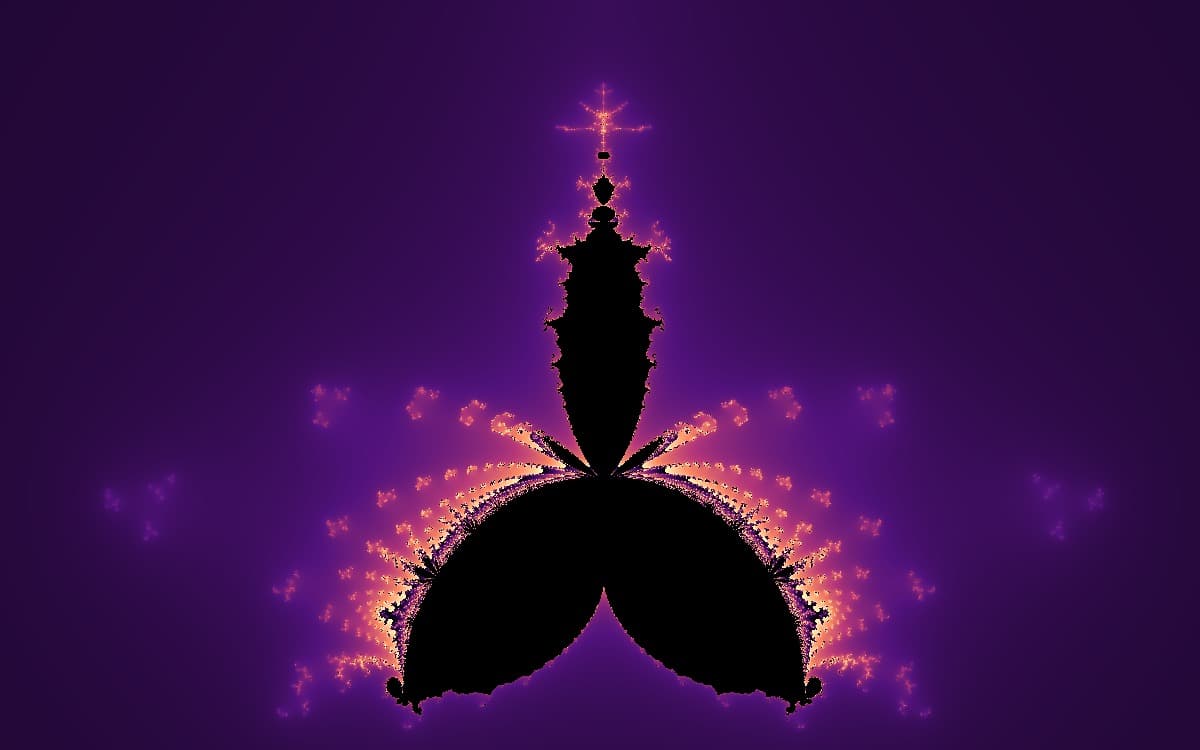
Fractal Multi-Phoenix com raios emplumados e aglomerados de filamentos semelhantes a brasas ("Ember Compass")
O Multi-Phoenix do FractalPark ("Ember Compass"): raios semelhantes a bússola irradiam por aglomerados brilhantes de filamentos.

Visão geral

O Multi-Phoenix lembra seu último passo. Esta recorrência de segunda ordem usa tanto o z atual quanto o valor imediatamente anterior da órbita, ponderando este último pelo coeficiente de memória complexo p. Essa memória muda a direção de um elemento e por quanto tempo ele persiste.

O passo padrão de Julia, z → z² + c, não tem memória. O Phoenix traz o z anterior como p·zₙ₋₁. Mude p e o passado carrega um peso diferente; como p é complexo, esse peso pode girar, além de crescer ou encolher. Seguem-se raios emplumados, leques semelhantes a chamas, rosetas de bússola e aglomerados semelhantes a brasas.

Os filamentos sugeriram as asas e a cauda da ave mítica, daí "Phoenix". Shigehiro Ushiki, da Universidade de Kyoto, o descobriu e publicou em 1988.

A Matemática

Phoenix recurrence

z(n+1) = z(n)^2 + c + p times z(n-1)

Take the standard quadratic step zₙ² + c, then add p times the value from two steps ago. A second-order recurrence needs two starting values before its first iteration: z₀ and the “previous” value, usually 0. FractalPark exposes p as an adjustable complex control.

Try the classic Phoenix parameter pair c = 0.5667 and p = −0.5. Starting with z₀ = 0 and z₋₁ = 0, the first few values stay bounded and trace angular, wing-like arcs. Make p positive with a similar magnitude and the feathered structure can break apart or rotate: the memory term now reinforces the earlier direction instead of opposing it.
História

Shigehiro Ushiki, a mathematician in Kyoto University’s Graduate School of Human and Environmental Studies, discovered the Phoenix fractal. In 1988, he published the Phoenix iteration in IEEE Transactions on Circuits and Systems. He presented it as a complex-one-dimensional section of a Julia-like set derived from a complexified Hénon map. The paper is simply titled "Phoenix." The classic parameter pair (c = 0.5667, p = −0.5) produces the named Phoenix curve, later well known in fractal-rendering communities.

Ushiki’s broader research covers complex dynamical systems, Julia sets with polyhedral symmetries, higher-dimensional complex Hénon maps, and the dynamics of surface automorphisms. His Kyoto University homepage lists publications from the 1980s to the present.

The Phoenix family later appeared in Ultra Fractal and other fractal software in both Julia-mode and Mandelbrot-mode variants. FractalPark’s Multi-Phoenix uses the same core recurrence and adds a multi-preview parameter interface.

Características Visuais

That one-step memory is visible in feathered spokes radiating from centres, flame-like fans curling along filaments, and compass forms with a sense of direction. A standard quadratic Julia does not make these in the same way; they rely on the directional persistence of p·zₙ₋₁.

With different parameters, the same rule can close into ember-like clusters, open into radiating pinwheels, or dissolve into dust-like regions. FractalPark’s “Ember Compass” foregrounds the compass spokes and warm filament clusters.

Parâmetros

Memória
The complex memory coefficient p sets both the strength and the rotational direction of the previous orbit value’s influence on the next step.

Remix e Exemplos

Comece pelo Documento canônico

Abra o mesmo estado de fórmula aprovado usado por este guia e depois altere a visualização, a coloração, as transformações ou a animação no Explorar interativo.

Perguntas Frequentes

Why does this formula need the previous value?

The recurrence is second-order: its next state depends on the current and immediately preceding orbit values. It is a discrete analogue of a delay differential equation, where the past feeds back into the present. The extra parameter p sets how much of that past continues forward.

Does the initial previous value matter?

Yes. A second-order recurrence requires two initial conditions — z₀ and the value of z before iteration begins (z₋₁) — for a deterministic orbit. FractalPark initializes z₋₁ to zero by default, the standard convention for the Phoenix family.

Referências