FractalPark
ExóticaMédio

Spider

Um mapa racional que adiciona c/z a uma órbita quadrática; o polo em zero estende longas pernas e filamentos semelhantes a teias.

Abrir no Explorar
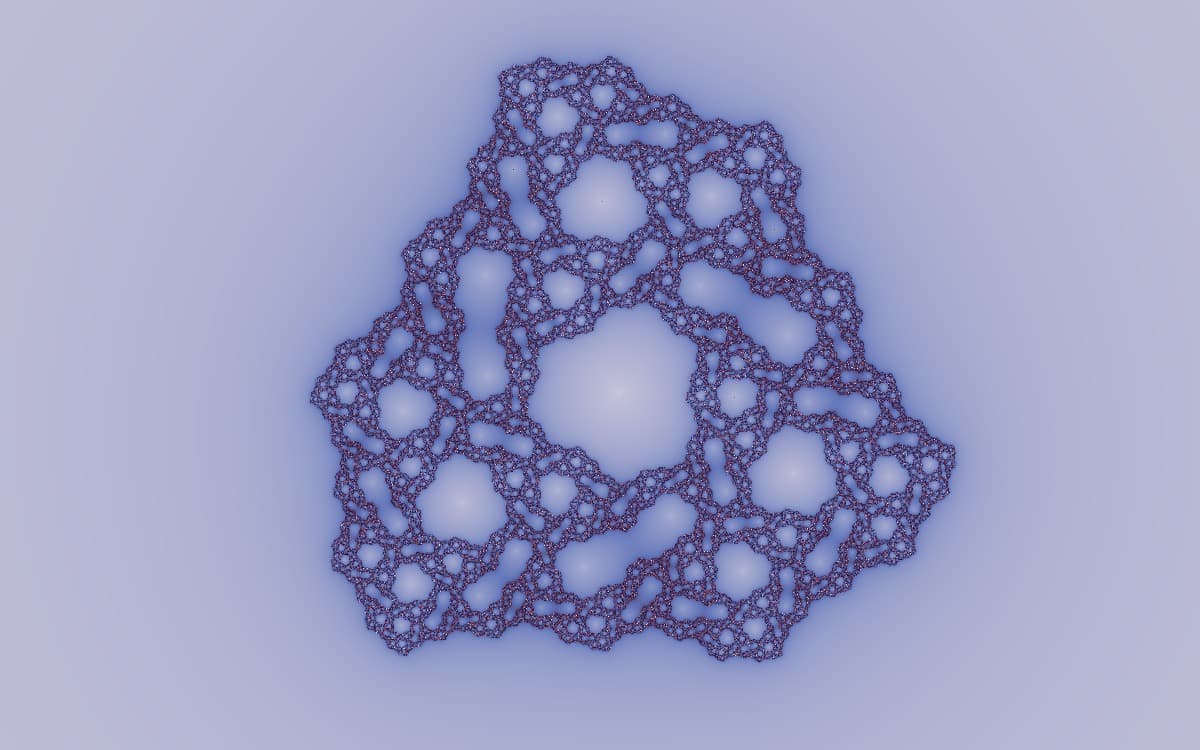
O fractal Spider: pernas longas e filamentos abissais irradiando de um núcleo central escuro
O fractal Spider renderizado pelo FractalPark: pernas longas e filamentos semelhantes a teias emergem de um núcleo escuro, em azuis e pretos abissais profundos.

Visão geral

A fórmula Spider une o termo quadrado familiar z² a c/z. É um mapa racional de grau 2 com duas forças em competição. Longe de zero, z² conduz a órbita quase como num escape quadrático de Mandelbrot. Perto, c/z assume e aponta em direção ao polo na origem.

Essa disputa estica a borda do parâmetro em filamentos ramificados, não apenas em um limiar de escape deslocado. Um centro estreito, pernas radiantes e lacunas escuras explicam o nome.

Como a regra divide por z, z = 0 é singular. Os renderizadores precisam lidar com valores extremamente próximos de zero usando um recurso numérico de segurança. O próprio c pode ser zero; então o mapa vira z² e a dinâmica quadrática usual de Julia retorna.

A Matemática

Spider iteration

z(n+1) = z(n)^2 + c / z(n)

The reciprocal term gives a quadratic orbit a sharp tug around the pole at zero.

Start with c = 0. The reciprocal term vanishes, leaving z², the standard quadratic Julia map; initial values inside the unit disk can still have bounded orbits.

Now take c = 1 and z₀ = (1, 0). The first iteration gives z₁ = 1² + 1/1 = 2, already far from the origin; the next gives z₂ = 4 + 1/2 = 4.5, and escape is rapid. Begin near zero instead—say z₀ = (0.01, 0)—and 1/0.01 = 100 dominates, throwing the orbit out at once. The spider filaments live on the boundary between those regimes.
Características Visuais

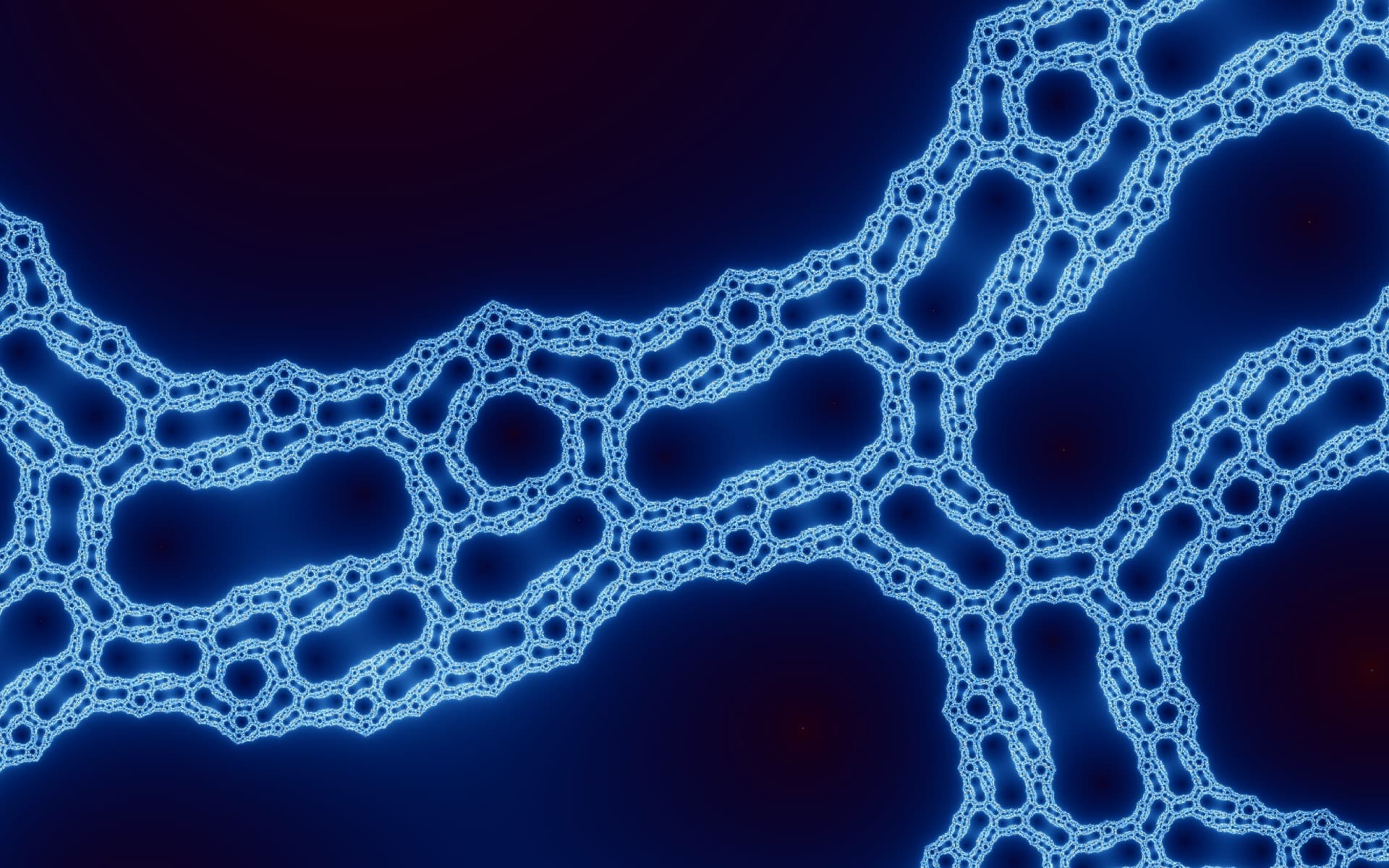
Long legs, dark filaments, and web-like junctions run out from a narrow centre. The origin's singularity makes a dark core; from it the threads branch and thin.

The canonical FractalPark rendering uses deep blues and blacks. The rational term breaks full symmetry, leaving the set slightly twisted rather than neatly balanced.

Remix e Exemplos

Comece pelo Documento canônico

Abra o mesmo estado de fórmula aprovado usado por este guia e depois altere a visualização, a coloração, as transformações ou a animação no Explorar interativo.

Perguntas Frequentes

What happens at z = 0?

At z = 0 the reciprocal term asks for division by zero, which is undefined. The implementation uses a stable fallback for extremely small values, by clamping the magnitude or substituting a small constant. This does not change the visible structure: points entering that near-zero zone are normally flung outward by the large reciprocal value on the next step.

What creates the spider‑like legs?

The legs form where quadratic expansion and reciprocal attraction are nearly balanced. There an orbit can alternate between a pull toward zero and a throw outward, drawing the boundary between bounded and escaping behaviour into long threads. The effect is strongest near the origin, where the reciprocal term is largest; farther out, z² regains control and the threads taper.